
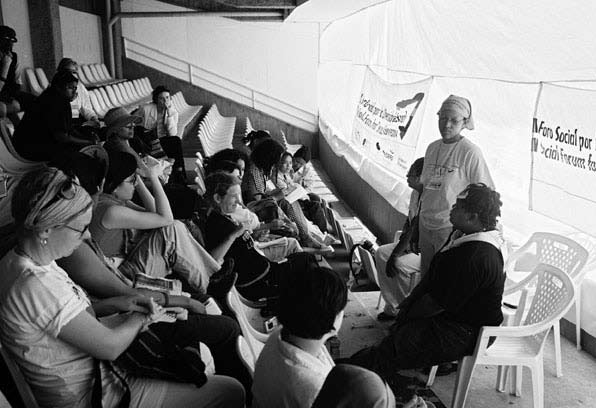
Nancy Castro* argues that the WSF perpetuates the ghettoising of women’s issues, despite the best efforts of initiatives such as the Feminist Dialogues.
Gender Equality
The principle of equal opportunity and treatment between men and women in social movements is widely accepted in most countries of the world. It is recognized that women’s equal participation is essential to the promotion of social justice. Yet, in practice, inequalities persist and it is not clear what should be done. Even after decades of Gender Training and the promotion of Gender Perspectives that claim women’s empowerment, in fact it would seem that women’s participation and conditions are worsening. This is the case even in progressive forums like the WSF in Nairobi 2007 where it is claimed that “Neoliberalism strengthens the patriarchal nature of society”.
In the WSF there was a vast representation of women in different social, political and economic struggles and organizations. Women from different classes, races, age, sexual orientation, religions, cultures and traditions, women from urban and rural areas, women with special needs, women from academic backgrounds, women from grassroots organizations, women with different political positions and women from different social movements.
“The objective of this activity (i.e. the women’s sector in the WSF) is to demonstrate how Neoliberalism strengthens the patriarchal nature of society and the inequalities between sexes. How the neolilberal policies produce the pauperisation of women, and the oppression. The alliance between conservative categories and the owners of all markets produces cultural schemes and woman-man relationships that are systematically oppressive and limitative of the political freedom and the freedom of the body”. (Extract from the World Social Forum Programme).
women’s organisations at the wsf
Most of the women represented at the WSF participate in a range of different struggles, struggles reflecting issues essential to their survival. One of the many examples of a struggle for women’s empowerment is the work of a locally based community group in Kenya, the Daughters of Mumbi, an organisation of grassroots women and girls. The organisation focuses on food security, relationship building across age groups, people living with HIV/Aids, and becoming economically independent. An international example of an organisation struggling to eliminate poverty and violence against women is “The World March of Women”, an international feminist action network connecting 6000 grassroots groups in 163 countries and territories working to eliminate poverty and violence against women. Many other self -proclaimed feminist groups were also represented at the WSF, such as “Humanitarie”, struggling for the sexual and reproductive rights of women, “International feminists for a Gift Economy”, struggling to protect local and indigenous approaches to economic development as an alternative to patriarchal capitalism, and the “Collective of Brazilian Women”, a collective of more than 200 different feminist groups who analyse all the different social, economic and political struggles from a feminist perspective. A number of the self proclaimed feminists were also present at the third Feminist Dialogues that took place in Nairobi just before the WSF. The aim of the Feminist Dialogues is to deepen feminist analysis and strategy while strengthening feminist presence within other social movements and within the WSF itself.
It is clear that organisations representing women and self proclaimed feminists were present at the World Social Forum. But what does this tell us about the inclusion of feminist views in the 2203 activities during the 4 days of the WSF?
women as a ‘sector’
For 3 days about 300 women in the Feminist Dialogues prepared an updated feminist agenda
for the WSF. Even with this agenda and the support of many feminist groups at the WSF, feminism was ghettoised. In the WSF, women’s struggles appear as one of 21 sectoral struggles and not integral to each of the sectoral struggles. While it is important to have women’s struggles as a clearly defined issue in the WSF, at the same time it is necessary for the struggles of women to be present in all of the 21 sectors. In the sector defined as women’s struggles, water and women, health and women, free trade and women, debt and women, national and international institutions, democracy and women, peace, war and women, etc. all feature. But this remains in “our” space and not in the space of the WSF as a whole. Important discussions about women and war were developed in the sector dealing with women’s struggles but this discussion, with the same strong emphasis on women, does not feature in the sector on peace and war in the WSF. This problem manifests itself within all of the discussions. Another important example is in the forum on “memory of struggles and resistance”.
Being in this forum would make one think that presence of women. Women are seen as numbers and not as political activists in all the struggles that are not defined as women’s struggles, and this view is being perpetuated in the WSF.
Another example is the Q tent. One of the most vibrant forums in the “Dignity/human being diversity and discrimintation” sector was the “Q” tent focussing on LGBTI 1 rights. Activities were organised from 8.30am to 8.00 pm for all 4 days of the WSF. This was the one forum dealing directly with capitalism and patriarchy. But it was another ghettoised space even if the tent was permanently full with not only people organising the LGBTI movement, but with many grassroots African women’s groups, progressive sections of the church and many grassroots male activists. Notwithstanding the impact of the Q tent at the WSF, the person putting forward the proposals for action during the general closing ceremony was openly verbally and physically abused during her presentation. Even though feminists at the WSF might not have been physically and verbally abused it would seem that the struggle against patriarchy is not seen as a key part of the social justice struggles. This is a clear indication that the social movements have a long way to go in struggling against the interconnected oppression and exploitation of capitalism and patriarchy.
what do we as women need to do?
On the one side we need to continue meeting in forums like the Feminist Dialogues to construct, update and reinforce the feminist agenda. But in future forums like the WSF we need to be prepared to place on the agenda of all sectoral struggles the feminist agenda.
It is necessary to work towards the construction of a popular feminist movement. As feminists we need to recognise that for the women involved in the struggle for basic needs, understanding that poverty affects us as women differently from the way it affects men is essential in changing patriarchal capitalist relations. We need to put more clearly on the agenda the double oppression women experience as at present this does not feature prominently in the practice of the WSF.
Leave a Reply
You must be logged in to post a comment.