
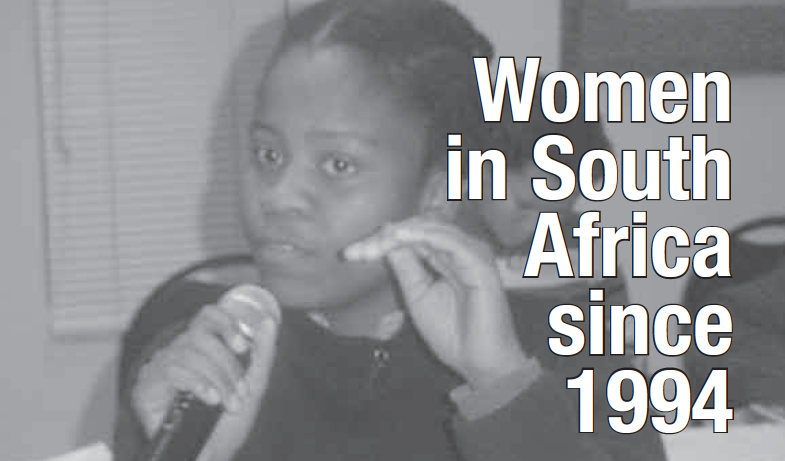
Duduzile Zamantungwa Mabaso argues that after ten years of democracy, women in South Africa still lead a life of poverty.
Women in South Africa are the majority in almost everything that is negative. Women are the majority of the unemployed, the majority of the HIV/Aids infected and affected and the majority of the illiterate, amongst other things. Because of the effects of apartheid, poverty is rife and women bear the brunt of this, in urban and especially rural areas. Poverty is the main obstacle against women accessing education, healthcare, economic participation and their full potential in decision-making.
While South Africa has inaugurated its first female deputy-president and a couple of women have had the chance to play president, the progress of ordinary women is quite vague, and slow.
A life of poverty
Lack of education has meant that many women are unable to get proper jobs, if any. In turn, the lack of employment has meant that many females are unable to receive an education. Therefore, women constitute the majority of those classified as ‘illiterate’. This limits their access to employment and they are exploited as ‘unskilled’ labour. Because apartheid was a racial, class and a patriarchal system, women have suffered triple oppression and discrimination. Discriminatory and ‘traditional’ laws barred women from owning land, from being employed in certain work – basically from being independent from all men. In poor households without enough money to educate all of the children, the male children got first preference and in many communities they still do.
Being unable to read the impact on women’s ability to control their own health, and being uneducated and miseducated about contraceptives leaves women vulnerable to sexually transmitted diseases particularly HIV/Aids. In the 1999 Annual Antenatal HIV Survey, an average of 22% of all women pregnant in antenatal clinics and 17% of teenage mothers, tested HIV positive. There are many more women who are not able to go to clinics and are therefore missed by such surveys, so one can only guess what the real figures are.
A cycle
Another prevalent issue amongst women (particularly in the rural areas) is that of teenage pregnancy. Often, boys carry on studying while girls drop out to give birth and look after their babies.
The girls often never return to school simply because they then have more children. Lacking a satisfactory education these young women end up working as domestic workers, farm workers or in other ‘unskilled’ work which lacks government protection. Some end up relying on child grants for survival. Many young women drop out of school to head households when death and/or HIV/Aids and other diseases claim both parents. Often, it is women who stop working to care for sick family members. In this way the cycle of poverty continues.
Women, particularly in the rural areas, still do not have access to information. They are not well informed about the law and their rights. They endure rape for fear of not being believed or becoming outcasts. Women still accept polygamous relationships because of so-called ‘culture’. ‘Culture and tradition’ prevent women from refusing to have unprotected sex or being able to say ‘No!’. In order to combat poverty education is essential. However, if you are living in poverty you are not able to get an education. Abject poverty is a factor in pushing women into sex work and the traps related to human/women trafficking. South Africa still has no law against human trafficking and sex work is still a grey point. Sex workers need protection as they are criminalised and victimised by the police.
Economically marginalised
There are some black women like Wendy Luhabe and Brigitte Radebe who head big companies and are making strides in business. These strides in top management, no matter how small, have done very little to uplift working women. A document prepared by the Office on the Status of Women pointed out that in October 1999 only 26% of African women between the ages of 15 and 65 were employed compared to 41% of all African men.
In the employment ranks women are mostly in low-paying jobs. Twenty-one percent of employed African women are in clerical or sales jobs while 11% are in semi-professions and 4% in the professions. While companies like Woolworths and Pick ‘n Pay still hire women as casual workers with no benefits or job security, domestic workers have attained a minimum wage and some legal protection. In many industries men still get paid higher than women in the same positions.
In business, women account for only 25% of all managerial positions, and 62% are white women. Many of these women are token appointments still accountable to a male superior.
There are many initiatives taking place to empower women, but many are gender-biased work like sewing, bead-making and small vegetable gardens. These projects rarely help women to become historians, scientists or filmmakers. Women’s contribution to the economy continues to be undermined and marginalised.
Power and decision-making
The government has since its inception made sure that it increases female representation in Parliament and the cabinet. Currently there are 146 women in parliament and 12 women in the cabinet. South Africa has its first female deputy-president. On the face of it it seems that many women have power and are decision makers. However, women in powerful positions often have to battle to be taken seriously and given respect. While the government has many women in leadership positions, working women have made little or no progress in gender equity.
Other factors
Government has put into place laws that protect women against violence and exploitation and also laws that give women choices with regards to their reproductive functions. The real issue, however, has always been implementation. The police and justice system, still fail to be sympathetic to rape and abuse victims and they fail to convict offenders. The media still perpetuates gender discriminatory images and perceptions of women. The media hardly covers women role models in any significant way, other than those in business. For example, an official women’s league in both soccer and rugby exists, but they receive little or no broadcast time. Women are still largely portrayed as submissive, unintelligent, sexual objects who use their bodies to rise to the top. It seems that women still only exist to clean men’s houses and wash their clothes, cook their meals, bear their children and do all the menial work that men are too good to do.
We still live in a country (and a world), where the decision makers are predominantly male. Women are still the poorest group in society. But, to say that women have not progressed at all since 1994 would be wrong. There has been some progress for some, while the majority of South Africa’s women still live in poverty, are unemployed, do low-paying work, live with HIV/ Aids and are illiterate. Progress crawls forward at a snails pace for ordinary women, but there is light at the end of the tunnel. The tunnel is just very long.
Duduzile Mabaso is an activist with the Sounds of Edutainment and is a member of the Editorial Collective.
Leave a Reply
You must be logged in to post a comment.