
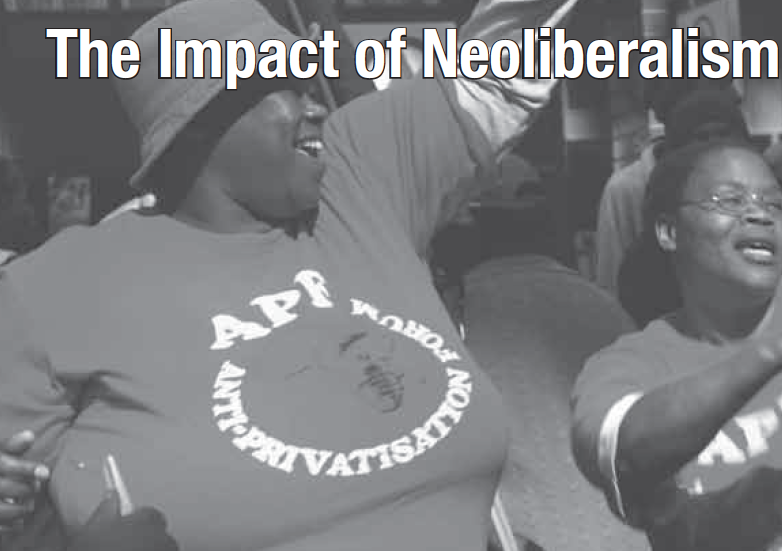
Maria van Driel discusses capitalism and neoliberalism, its impact on women and the need to organise women.
Patriarchy or male dominance and the origins of women’s oppression preceded capitalism and colonialism. But we did
not always have patriarchy, and within Africa we still have remnants of what were once matriarchal
– female dominant – societies. This indicates that gender – the relations between men and women
– are socially constructed and have changed
over time. This is emancipatory for us as human beings, and as social agents: we are not bound to the specific gender relations that exist in society today. The struggle for liberation from all forms of oppression and exploitation includes gender equity. We have the conscious choice to decide the kind of gender relations we want, and more importantly, the kind of society in which we want to live.
Women and capitalism
Historically, capitalism has used women as and when it has suited its needs. Women have often been the reserve army of labour, prepared to work for less money than their male counterparts. In
this way, women have been used to drive down wages. Women are paid less as the capitalist argue they have male ‘breadwinners’ who support them. When it suits them, women are called upon to participate in the workplace. This occurred, for example, during World War Two when the men went to fight and women were encouraged to work in many of the war industries. There were many public campaigns to woo women out of their homes into the workplace. When the war ended the men returned and needed their jobs, and the women
were publicly encouraged to return to their place ‘in the home’. Women are often used opportunistically to suit the needs of capital.
Women’s rights in South Africa Under apartheid capitalism, women were oppressed and exploited as workers, and as black people they had no democratic rights. Their roles were defined based on their gender. This meant financial (and other) dependence on men. Black working class women were at the bottom of the pile. The new South Africa has brought with it a number of fundamental changes that have impacted positively on all South Africans, including women. Racism has been wiped off the statute books and the constitution guarantees everyone, including women, their basic democratic and human rights, including rights to basic services such as water, health and housing.
Taking into account the legacy of apartheid, there are specific rights for women: women are no longer minors, they are adults in their own right and do not fall under traditional chiefs or husbands, women have the right to own property such as land, the right to choose whether to have children, the right to participate in public life, rights in the workplace and in the family.
GEAR and neoliberalism
The South African government’s adoption of a neoliberal programme, the Growth Economic and Redistribution Strategy in 1996, consistently
undermines the South African Constitution and the basic human rights of the people, especially black people and black women. The economic and social policies based on the GEAR prevent women from realising their rights in any meaningful way.
Neoliberalism is aimed at increasing the profits of capitalists in a context of economic crisis. This is done through cutting state expenditure on social services, through privatisation of basic services like water and education, and through the deregulation of labour, commodity and financial markets. These measures have had a major and negative impact on the lives of women all over the world.
Precarious work
Neoliberalism has effected many changes to the world of work. Permanent and secure employment is becoming increasingly rare, and it is often women who are being pushed out first. Precarious forms of work, with low pay and little or no rights, are becoming the dominant form of work: casual work, home-based, contract work, occasional work and work on demand. Women, because of their general oppressed position in capitalist society, are particularly vulnerable and are found in many of these precarious jobs.
At the same time, informal work or the informal economy has increased. Informal workers are not protected, recognised or represented, affecting about 50-75% of the workers in developing countries, excluding those in agriculture. In
sub-Saharan Africa, women make up 84% of the informal economy. Informal sector workers are extremely vulnerable, incomes are low, and there are no social benefits and very little protection. In South Africa women struggle to make ends meet in the informal sector just like their sisters in the rest of the developing world.
Home-based work forms part of this precarious work. The more obvious side to this is the advantage to owners, as they don’t have to pay for factories, supervisors and related expenses. Instead, the women have to pace themselves and provide
the space for their work. This also causes pressures and tensions within the home, as women have to complete the home-based work and their household chores. This tension is then brought together within the home.
What is seen as more ‘respectable’ work is extremely taxing on women, for example call centres and telesales. The women work under tremendous pressure, forced to respond to a certain number of calls per day. The call centres are ‘global’, and even though based in South Africa, they service people from all over the world. This means shift- work. Some studies have indicated a high number of miscarriage and the failure to conceive in jobs such as call centres.
Impact of neoliberalism
The impact of neoliberalism has been devastating on working people internationally. In South Africa one million jobs have been lost since 1994. Similarly, this has been the impact in Southern Africa with the neoliberal Structural Adjustment Programmes imposed on governments by the International Monetary Fund and the World Bank. Retrenchments and unemployment exacerbate the spiral of poverty and devastation. Based on these policies, Africa and especially women, are worse off today than 20 years ago. The debt crisis has deepened and the standard of living has dropped. The access to, and the quality of education and health services have declined as user fees have increased. Increasingly, girl-children are being removed from schools as the strain on families makes even basic schooling inaccessible. But, this has now also affected boy children. The decreasing food security has undermined women’s ability to at least put food on the table. In the sub region, people take turns to eat, and women and children bear this burden. Women also bear the burden of the HIV/Aids pandemic as carers, in the absence of government services.
A legacy of oppression & exploitation
The new South Africa has demonstrated that constitutional rights are important, but they need to be implemented to ensure a fundamental shift in the quality of life of working people, black people and especially women. In South Africa, black women still bear the burden of oppression and exploitation as workers and because of their colour and gender. It is black women who make up the majority of the poor, the homeless and the unemployed. It is black women who bear the burden of walking for water, searching for firewood and caring for the sick. Despite the new democratic dispensation, after ten years of democracy, inequality has widened and
the intersection between colour, class and gender remains: black people, and black women remain the poor and the marginalised. While there have been overall changes, and the creation of a black elite, South Africa remains a divided and unequal society.
Problems organising women
The neoliberal agenda has fragmented society and broken down forms of solidarity that have existed. For example, in South Africa the extended family has been eroded. It is more difficult to organise workers, especially women workers, given the precarious nature of their work. The additional shifts in the home mean that women are often not amenable to joining organisations given the pressures of the household on their time. The trade unions are structured and organised around traditional forms of work, and have not significantly risen to this challenge, thus women workers are largely unorganised. This undermines solidarity among workers and the trade union movement internationally. Different methods of organising women and other workers in these precarious forms of labour are therefore needed.
Women, however, have many facets to their lives besides being workers and mothers. Women have a right to their sexuality, to make choices about whom they want to be with, and the right to live to their full human potential. The current conditions keep them in subservience, focused to eke out an existence for themselves and their children. For these reasons, women need to be organised around many other aspects of their lives if they are to realise their full potential.
Emancipate yourself!
The rise of the new social movements to resist the impact of neoliberalism is a positive development, building on the spontaneous struggles of the working class. However, the new social movements are reproducing the patterns of patriarchy, and reinforcing women’s subservience and oppression. This is a major problem as the composition of these movements is predominantly women. Women are therefore important human potential that needs to be developed if we are to bring about meaningful change in South African society. In as far as neoliberal capitalism needs to be struggled against, we need to ensure that the struggle against patriarchy is also advanced. This means enabling women to exercise their rights meaningfully, within the constitution and beyond.
It means struggling against patriarchy wherever we find it: within civil society organisations, the social movements, the family, and within our intimate relations. This struggle also entails engaging with our internalisation of patriarchy, and the way in which we reproduce patriarchy, and our own subservience as women. This means an honest engagement of ourselves and our roles in society. We need to engage with these issues in our study groups. We need to mobilise and take up campaigns that will advance the positions of women concretely. The Constitution provides important rights and important spaces for women, we need to struggle for their implementation. It is vital that women lead and initiate these struggles. We are after all, our own liberators!
Journal Study Groups for Women
The Khanya Journal is committed to the emancipation of women. Unless women are free, society can never be free. This means a simultaneous struggle to change society as well as ourselves. As human beings we are not bound to the limitations of the society in which we live, we do not have to wait for society to change before we engage in equitable relations with men. Through the Khanya Journal study groups we can assist in the development of women activists, and aim to build their leadership abilities. By critical debate of our struggles and our movement we can advance the struggle for women’s emancipation and gender equity.
Maria van Driel is a member of the Editorial Collective.
Leave a Reply
You must be logged in to post a comment.