
While South Africa has just passed its ‘ten years of democracy’, arguably the most developed and wealthy country in the subregion, it still harbours huge levels of social inequality, unemployment, poverty, homelessness and violence against women and children. While there is a legacy of apartheid, the South African Government’s neoliberal Growth Economic and Redistribution strategy is responsible for increasing impoverishment and deepening social inequality.
It is still black people – especially black women who make up the unemployed, the poor and the marginalised. Black women bear the burden of privatised basic services – they walk for water and firewood, care for the sick and especially the victims of the HIV/Aids pandemic, and they are vulnerable in contracting the disease. Yet, this is the country with a progressive Constitution and a Bill of Rights, which guarantees women their basic human rights. This country also boasts the largest number of women members of parliament in the world.
But the general situation, as well as its impact on women, is not unique to South Africa. These conditions are widespread within the Southern Africa subregion where women bear the burden, struggle to make ends meet and make up about 80% of the informal sector. The position of women in Southern Africa has also been shaped, though unevenly, by amongst others things, civil war, issues of social class, gender, colour and language.
Like South Africa, there is a huge number of women within the different parliaments in Southern Africa. But the plight of women has been particularly exacerbated by the dominance of neoliberalism, which is a phase of capitalism. Neoliberalism undermines any form of solidarity in society. The society is geared to making profits, to extracting and transferring wealth from the poor to the rich. This is done through amongst other measures, the tyranny of the ‘free market’, the free movement of capital and goods, the privatisation of basic services, cutting the state budget in the provision of social services, high interest rates to protect the huge amounts of capital available, and low taxes for the capitalists. Women especially, and men, are vulnerable to the insecure forms of low paying work, which have no social benefits.
The implementation of neoliberalism has given rise to resistance and in particular, the social movements, although unevenly in Southern
Africa. The majority of the social movements are the unemployed and women. While these organisations are resisting neoliberalism, they are also reproducing patterns of patriarchy.
This edition of the Khanya Journal is important given the oppressed and exploited position of women generally, and specifically under neoliberalism; and the Editorial Collective’s commitment to the struggle for gender equity and women’s emancipation. In this edition we discuss the origins of women’s inequality and patriarchy or male dominance. Patriarchy, although having preceded colonialism and capitalism in Southern Africa, did not always exist. In our human history we had societies based on equality, and we had societies based on matriarchy or female dominance. It is therefore clear that gender is socially constructed, and that human beings as social agents can change their society. We therefore hope that this edition will encourage debate amongst women and men activists beyond the social movements, to include the home and all our human relationships. We need to ensure this debate is included in the process of our struggles and in our strategy and tactics.
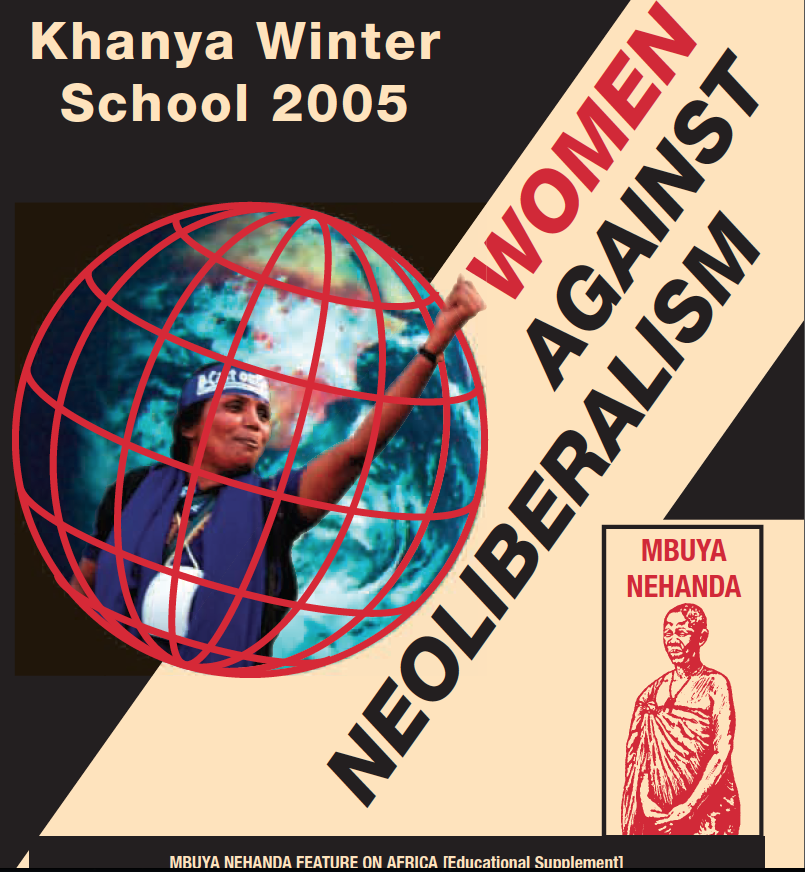
In this 10th edition of Khanya: A Journal for Activists we focus on women, gender and neoliberalism. This edition is combined with the Khanya College Annual Winter School 2005 and also includes some of the writing developed at the Journal’s Writing workshop for women in the latter part of 2004.
Every year, during the first week in July, Khanya College hosts a Winter School for activists in the social movements and other mass organisations, from Southern Africa. The Winter School was launched in 1999 and represents an important aspect of Khanya’s response to the changing political and economic environment within which social movements, community based organisations trade unions and non-governmental organisations have to work and struggle.
The theme for this year ’s Winter School was “Gender and Neoliberalism and the Social Movements”. As expected, more women activists attended this year given the particular focus on women. The Winter School was different from those held in the past in its approach and teaching methods, due to the theme it was dealing with which relates to human social relationships. Many group activities such as games were held, and participants were requested to analyse human behaviour, gender stereotypes and changing gender relations.
This edition is divided into themes, and the articles are arranged according to the theme they focus on. The first theme is on Gender &
Patriarchy. Nerisha Baldevu gives an overview of the Winter School, how the theme was constructed, the gender activists involved, the actual School, and its influence on the Khanya College Gender Programme. Maria van Driel has two articles: the first article is a brief historical overview of the changing gender relations over time, and includes a discussion on the rise of patriarchy and monogamy. Another article focuses on the changing gender relations and the family in South Africa, particularly after 1994 and the new Constitution, which guarantees women their basic rights.
Melanie Knight looks provocatively at women and sexuality. This article is followed by Jonathan Hellberg’s male perspective on gender. Ramjuttun Pranjeewan argues that gender relations can and must be changed. This theme ends with Zanele Guqaza’s interview of a man who works for a women’s organisation.
The second theme is on Gender & Neoliberalism. Linn Hjort argues that the negative effects of neoliberalism have affected women more than men because, amongst other things, women have to run the home with less and less resources. Maria van Driel discusses neoliberalism and the struggle for gender equity in South Africa today. She argues for the need to build a broad based feminist women’s movement. Duduzile Mabaso discusses the position of women in South Africa after ten years of democracy. Ontibile Moalusi shares some suggestions on how women can take charge of the environment and fight against companies polluting their areas. Judy Merkel assesses women’s reproductive rights in the past ten years and its impact on women. In her second article, Merkel argues for the struggle to implement the reproductive rights legislation. In her article about women volunteer workers in the HIV/Aids programmes; Fazeela Fayers argues that as long as women are available as substitutes, working without pay at high risk to them, the government will not take responsibility. The last article in this section is Desiree Takalo’s sexual violence against women in South Africa.
The third theme is on Gender and the Social Movements. In her article Modiehi Khuele maps out the patterns of patriarchy that have being reproduced within the social movements, even as these movements struggle and resist the impact of neoliberalism.
Related stories from the subregion and beyond, includes Eunice Apio’s shocking expose` of Uganda’s rebel group, the Lord’s Resistance Army’s carnage and abuse of young girls, the resulting unwanted pregnancies and the prejudices against children born out of this war. The next is an article on the coalition formed for informal sector workers in Zambia, a first for Africa.
In this edition we introduce an exciting new regular educational supplement for the Journal, a focus on Africa, called Mbuya Nehanda. This feature is an educational supplement to enable us to critically engage and understand our history. The feature will focus on the history of Africa, the struggles against oppression and exploitation, and the men and women who participated and led these struggles. We will focus on Africa before colonisation, during colonisation and the post-colonial period. This will assist us in understanding the struggles taking place in Africa today, and their historical sources. Maria van Driel introduces this educational supplement on Africa and motivates why it should be named after Nehanda. In this supplement she includes an article on Mbuya Nehanda, the spirit medium who led Zimbabwe’s first war of liberation. This supplement also includes a tribute to the award- winning Zimbabwean writer, the late Yvonne Vera. In her writings, Vera broke the silence about issues affecting women such as rape, incest and violence against women.
Our regular feature, the Barometer of Resistance in Southern Africa and South Africa is included. The poetry in this edition is interspersed throughout the different themes we cover. The documents section includes the Women’s Charter and the petition written by African women workers who marched to Pretoria (South Africa) in 1955, called: What Women Demand.
We also want to use this opportunity to draw your attention to the Special Edition of the Khanya Journal that is currently being prepared. This edition will be out shortly and focuses on the hot debate currently taking place within the social movements on: Strategies and Tactics for the New Social Movements. We include an advertisement in this edition.
In Solidarity
Convening editor: Maria van Driel
Guest editor: Nerisha Baldevu
Leave a Reply
You must be logged in to post a comment.