
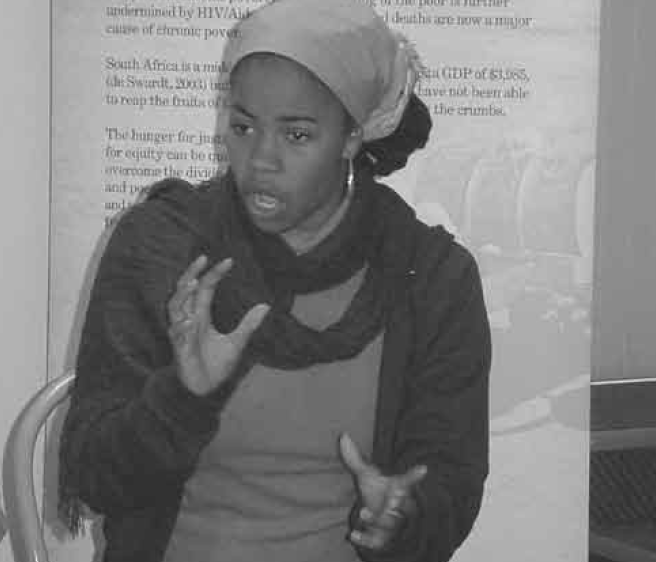
Nerisha Baldevu gives an overview of this year’s Winter School
The seventh annual Khanya College Winter School took place from 4 – 8 July 2005 at the Booysens Hotel in Johannesburg, South Africa. The theme for Winter School 2005 was “Gender, Neoliberalism and Social Movements”.
Context of Winter School 2005
Khanya College has determined the need to rebuild the Khanya Gender Programme. This decision is based on Khanya’s internal assessment, as well as our work with movements and organisations. There is also the recognition that Khanya College, and these movements and organisations, are reproducing patriarchal gender relations.
The Gender Programme of Khanya College seeks to contribute to raising consciousness about gender inequality in progressive mass organisations and social movements, as well as within Khanya itself. The programme assists in developing approaches to overcome gender inequality within mass organisations and the social movements, and in the daily functioning of the College itself, including its various programmes.
Khanya’s 2005 plans are threefold. Firstly, increasing our internal capacity to deal with gender issues. Secondly, strengthening the programme by employing full time staff that will address some of the education and training needs of our constituencies. Thirdly, developing a more gendered approach to all the programmatic work that the College is involved in. The ultimate aim of all of these is to contribute towards the building of a layer of gender activists able to lead the struggle for women’s self emancipation.
Some of our activities for 2005 include:
- The development of a Khanya Gender policy.
- A Khanya College Winter School focusing on Gender and Neo-liberalism that included a prior process of capacity building for women from the social movements.
- Hosting exhibitions on women in the trade unions at the Winter School and on Women’s Day, 9 August.
- Programmatic work focusing on the conditions of migrant women in South Africa and girl learners in South African schools.
- The Journal Project will host study groups and writing workshops for women and girl learners.
- We will engage in a process of self-clarifica- tion where as a College we firstly, explore what we understand as gender and the emancipation of women. Secondly, where we explore the scope and nature of gender activities in the social movements, unions, and women’s organisations.
- The College will organise ongoing reflection activities to evaluate the development of our Gender Programme.
This, then, was the backdrop against which the
2005 Winter School was held.
The aims of the Winter School were:
- To discuss patriarchy and the oppression of women;
- To explore the impact of neo-liberalism on gender relations in the different spheres of social life, e.g. the workplace, the home etc;
- To raise consciousness about the conditions women, specifically working class women, face under neo-liberalism;
- To explore the role women need to play in self-emancipation.
Profile of Participants
There were 137 participants at the School from 69 different organisations, including 20 Khanya College staff, and 32 organisations from the Southern African region. Organisations represented included non-governmental organisations, trade unions, community based organisations, the corporate sector and social movements. Seventy percent of the participants were women.
There were 10 countries represented at the School. These were South Africa, Zambia, Malawi, Botswana, Namibia, Zimbabwe, Mozambique, Mauritius, Swaziland and Uganda. Thirty-seven percent of the participants at the School came from countries outside South Africa.
The majority of the participants at the School were from NGOs and trade unions. This was a change from previous years where the majority of participants were from social movementsand community based organisations. The most likely reason for this trend is a lack of funds and other resources among the social movements and community based organisations.
Participants said their reasons for attending Winter School 2005 were largely the topic of gender and neoliberalism, and their expectations of gaining information and experience to deal with issues of skewed gender relations in their own organisations. However, participants also attended the School because of the profile of Khanya College and the work that it does. This was also an opportunity for organisations to extend their own areas of work and utilise the space provided by the School for building solidarity.
The Winter School Reference Group
In preparing for this School, Khanya College recognised the need for women activists to take a leading role in conceptualising, planning, preparing, facilitating, designing and evaluating the process. As such, Khanya College identified 20 women activists from the organisations we work with. These included community based organisations, social movements, school learners and the immigrant communities. These women were chosen on the basis of their strength as activists in their communities and they made up the Winter School 2005 Reference Group. All 20 women in the Reference Group attended the School.
The Reference Group assisted Khanya College with the following:
- Assistance in the design of the Winter School2005 programme;
- Daily evaluation of the programme during Winter School;
- Identification and training of the media team from the Reference Group for the production of the daily newsletter at the Winter School;
- Overall evaluation of the Winter School afterwards;
- To measure the impact of the School on participants;
- Increase the participation of women in the School.
Khanya College ran a 3-day women’s empowerment workshop with some of the Reference Group from 3-5 June. Two media workshops were held in the run-up to the School in which 10 members from the Reference Group were trained on basic writing skills for the daily newsletter. Based on the outcome of the Reference Group workshop, Khanya College revised the programme, taking into account issues that the Reference Group had identified as particularly relevant. Furthermore, the programme and educational methodology of the School was assessed and revised on a daily basis with the Reference Group during the Winter School.
This made for a more effective programme, and provided Khanya College with some insight into how the participants were responding outside the sessions.
In addition, the media team successfully wrote and produced the daily newsletter. This entailed interviews, writing to deadlines, editing, pictures, and layout and design work.
The Reference Group was a positive addition to the Winter School design process and to the School itself. Khanya College aims to continue working with this group of women as part of our aim to assist in the development of a layer of women activists. This group of women will also be part of the overall external evaluation of the School, which will assist Khanya College in the rebuilding of its Gender Programme.
Programme
The five-day Winter School programme looked at gender relations under capitalism, the sources of such oppression under capitalism, how gender relations have changed over time, what neoliberalism is, its impact on gender relations
in different institutions, forms of resistance to gender oppression, obstacles to such resistance and strategies for overcoming these obstacles.
Education Methodology
Educational methodology at the School included small group discussions, plenary debates, role- plays, inputs, games and case studies. In the workshops, facilitators began with participants’ knowledge and experience, then brought that experience into a collective framework and added new information and knowledge. The basic educational philosophy that underpinned this approach was that education must empower people to act for change. Education must be based on democratic practices i.e. creating the conditions for full and equal participation in discussion, debate and decision-making. We aimed to involve people in a process of critical analysis so that they could potentially act collectively in a participatory, creative and empowering manner.Evening Sessions
Evening sessions at the School included a discussion on the Khanya Journal for Activists which introduced participants to the Journal, the study groups, submission and subscription processes, and the nature of the content of the Journal. We also received useful feedback from participants on the accessibility of the Journal through a questionnaire which participants filled in.
Other evening sessions discussed the political situation in Zimbabwe and Uganda, with participants from these countries outlining the struggles and the challenges. There was also an evening session on land struggles in South Africa, with a particular focus on the golfing estates in the Southern Cape.
Particularly revealing and informative was the gender and sexuality session which looked at the politics of the bedroom, the freedom of choice in terms of sexual partners for both men and women, and women’s right to sexual pleasure.
Participant evaluation of Winter School2005
The overall response from participants on the Winter School was positive. In general, they said that the methodology used at the school encouraged respect between them, allowed for interaction and inclusivity, permitted the sharing of local and international views, and facilitated an understanding of neoliberalism in relation to gender relations. In particular, the School made participants rethink gender issues.
As part of assessing the impact of the School on participants, Khanya College requested participants to fill a questionnaire on the first and the last day of the School. The questionnaire asked participants to define their idea of a “real” men and women in the home and the workplace. A comparison of the responses before and after revealed a definite shift in perception on gender relations among all participants.
Although some responses from male participants revealed defensiveness and a need to assert themselves in the traditional African male role, overall, it seems that men are rethinking their own behaviour and attitudes. Women participants stated that unlike other conferences where they felt very much like “playthings for the sexual comfort of the male participants”, at the Winter School, they felt powerful, in control of discussions and their free time, and able to make their own choices in a range of issues, including choosing their own sexual partners at the School. Many women believed that the School provided them with the space that enabled them to take the lead.
Khanya College has completed its internal evaluation of the School and will do the external evaluation with the Reference Group in August. This will help determine the way Khanya College takes forward the issue of gender relations.
Nerisha Baldevu works at Khanya College and is active in the Anti-War Coalition.
Leave a Reply
You must be logged in to post a comment.