
Adamos Zachariadis, Vasianna Konstantopoulou and Elisabeth Lountou*
The spring of 2006 in Greece was stamped by the formation of one of the strongest movements in the educational sector of the last years. From that time on and up to this moment, the people of the educational community of the country are in a state of continuous mobilization. Via massive demonstrations, occupations of all the university campuses, national and local coordinating committees of university and school students, teachers’ assemblies (from pre- school to university), the pan-educational front is organizing its action. This wave of mobilization was sparked off by the plan of the current right-wing government to enact through legislative reforms the privatization of higher education. With the university space as the focal point, the opposition and resistance exerted by university students and teachers against this plan is organized in terms of a massive movement. In the course of the past few months, the movement expanded to all levels of education. The new movement, through its militancy and size, has up to now succeeded in driving the right-wing government, as well as the oppositional party – which is politically close to it – in continuous retreats regarding the far-reaching “educational reform” they envisaged.
Neoliberal greece in a neoliberal Europe
During the last decade in Greece, the two main parties that alternate in power, the party of the right (New Democracy), which governs today, and the social democratic party (PASOK), which ruled the country for two decades, are completely for with the neoliberal economic model. The economic and social policies they implement are in total agreement with the instructions of the World Trade Organization, the International Monetary Fund and the European Union, of which Greece is a member. The program of economic modernization which they follow in an increasingly fast pace, comes with the curtailment of rights and the degradation of the social welfare state.
The privatization of public goods (like health), the tax increase on working people together with the simultaneous wage cuts, the bad insurance and retirement provisions, constitute the main effects of the state policies. Against the social discontent that is generated by job insecurity and the increase of unemployment, the governments reply with intensification of repression and amplification of the police apparatus, which reached to its peak with the Olympic games of 2004 in Athens.
An unprecedented pan-educational resistance
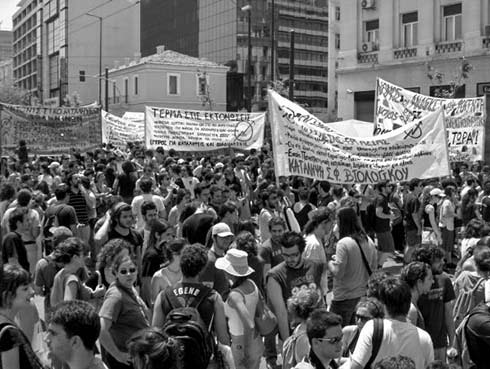
The movement of university occupations starts almost unexpectedly on the first days of May of 2006 without the support of the largest leftist block of the country, that of the Greek Communist Party. The university campuses close one after the other and in less than three weeks 90% of them are occupied. The occupations are characterized by great spirit and big participation. For the students the occupations represent the open university, a way of self-organizing time and space, with lots of activity and political discourse; not, as the government prefers to allege, closed and empty university campuses. The General Assemblies, where the students make decisions regarding the course of the movement collectively and according to the principles of direct democracy, are the most massive of the last decades. The student movement objects to the constitutional reform and the new government law for the universities. The students, however, do not stop there. They make radical demands for a better and freer university. They call for free access to all levels of education, free housing and food services for all students, increase of the state funding to public education to the 15% of the GNP, abolition of tuition fees for foreign students, the provision of global and not specialized academic knowledge. The students, aware of the extent of the neo-liberal attack, incorporate in the movement demands relating to working rights and they invite the public and private worker unions to unite in the struggle against the privatization of education and call for a general strike.
The demonstrations taking place every week in the center of Athens are getting bigger and bigger, while the national coordinating committees are successful in organizing the movement’s actions, despite the fact that student organizations with very different orientations and a multitude of students without party affiliation participate in them. The government, initially through its student organization, tries to stop the occupations and when it fails to do so, it resorts to the familiar method of repression. The center of the city is filled with hundreds of special anti-riot policemen and the student blocks receive violent and unprovoked attacks by the police. The dozen or so student arrests are a weekly phenomenon, while tear gas and other chemicals are used by the special riot- police forces in immense quantities. Yet, student participation in the demonstrations exceeds all expectations.
The University teachers range themselves from the beginning on the side of the students. Their union, after it first rejects the so-called “national dialogue on education” which the government initiated with the participation of the Greek Industrialist Association and the Church, declares at the beginning two and three-day strikes and later on, longer strikes. The teachers’ claims include the radical increase in the level of funding both for education and for research, increase in wages by 20%, exclusive employment and job security and safeguard for all the teachers in universities, regardless of their position.
Under the pressure exerted by this large national movement, which succeeds in gaining social support and resonance, the government does its first retreat in June 2006. The Minister of Education who was, up to now, describing the students and the teachers as “minorities of inciters”, announces that the contested bill will not be introduced until “the dialogue with the relevant parties is concluded and the largest possible consensus is achieved”.
The new school year starts in September in the most dynamic way. The primary and preschool teachers declare weekly strikes, demanding wage increases and other claims relevant to their branch. Under the pressure of the most radical segment of the teachers, demands against the privatization of education are included. After two weeks of strikes, high-school students and teachers enter the mobilizations. Schools all over the country are under occupation and the students take to the streets in the continuing pan-educational demonstrations, demanding mainly the abolition of the very strict grading system for university admission. The highschool student and teacher movement last six weeks and manages to gain the support of the public. However, the strikes end under the weight of wage cuts and the government intransigence.
The baton is nevertheless passed once again to the university students. From October and until today the occupations persist, with the support this time of all the leftist forces of the country. The occupations are now less vivid but the demonstrations and the General Assemblies remain massive and contentious. And whereas the government was planning the voting for the constitutional reform to take place on March 2007, the social-democratic party PASOK, which up to then consented to the reform, now –under the pressure exerted by the immense effect that the movement had on the public opinion– withdraws itself from the voting procedure. In this way, the government does not secure the necessary parliamentary majority to reform the constitution and go ahead with the privatization of universities. It seems like the constitution will not be reformed, the government plans collapse for the time being, and the defenders of the privatization of education are trying with evident unease to block the dynamics of this new and unexpected movement.
The struggle goes on…
Despite its great defeat on the matter of the constitutional reform, the government persists and is trying to pass whatever it can in the form of a bill introduced at the end of February, which provides among other things for the abolition of the university asylum.
The struggle for education in Greece is certainly not over yet. After many years of inertia, the educational movement reappears in the forefront and this time it seems determined to achieve victories. In these past ten months, students flood the streets and demand an open university, without class barriers, a space for the free movement of people and ideas; a university in the hands of the educational community and not of private interests. Despite the intensification of repression and the government and media efforts to slander the movement, resistance remains strong and the public voices its support. The victory of the French youth with the withdrawal of the bill which would abolish their basic working rights (CPE), and the massive educational mobilizations of last year in Denmark and Germany against the privatization of their universities join with the Greek movement and create good prospects. They indicate that the European plans for a neo-liberal kind of education, for a university-“supermarket”, cannot be implemented undisturbed. It seems like the sound of the slogan “for a free university in a free society” gets louder and louder in the streets of Europe…
Leave a Reply
You must be logged in to post a comment.