
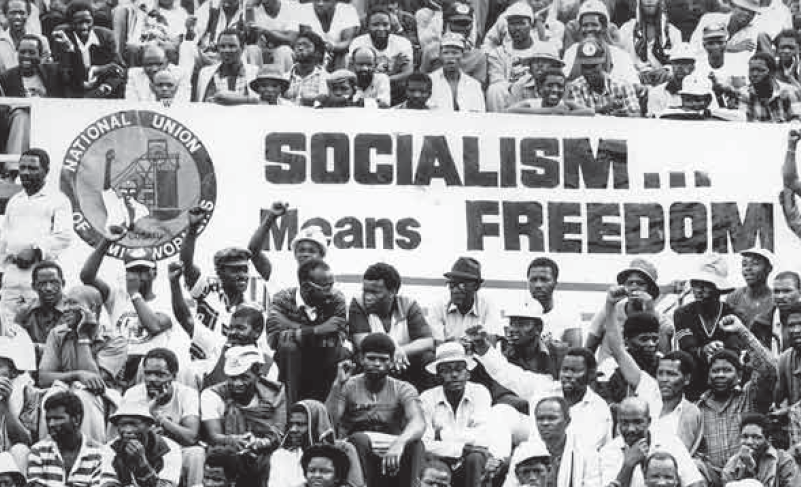
Sakhela Buhlungu argues that since the early 1990s COSATU’s membership has been changing, and this might have the effect of toning down its radical politics.
THE CHANGING SOCIAL COMPOSITION OF COSATU MEMBERS
A Changing Workforce in a Changing Society
Research has shown that the structure of the black workforce has been changing consistently over the last three decades. A feature of this change has been the decline of the unskilled stratum and the growth of the semi-skilled and skilled strata. This change resulted from the retrenchment of thousands of unskilled workers, giving rise to a division between employed workers and the unemployed. The growth of the semi-skilled layer of workers was achieved through the fragmentation of skilled trades into semi-skilled occupations in which black workers could be employed. The militant unions of the 1980s and early 1990s drew substantial support from the employed and semi-skilled category of workers, many of whom occupied leading positions in the unions.
A survey of COSATU shop stewards conducted in 1991 showed that although just over half of these shop stewards occupied unskilled and semi-skilled positions, a significant proportion (44 percent) occupied skilled, supervisory and clerical positions.
COSATU members in 2005 – What has changed?
The results of three recent surveys show a remarkable change in the social composition of COSATU’s membership. This change becomes most evident when we examine the age, occupational category, security of tenure, formal education and the year in which a member joined his or her union. Below I explore this changing social composition and consider the implications thereof for the future of unions.
Age
The survey shows that since 1998 there are proportionately fewer union members under the age of 36. At the same time, the 36 – 45 age group have increased significantly over the last 5 years. The age profile of COSATU members seems to be a function of recent trends in the labour market. On the one hand, it suggests that few young workers have been absorbed into formal permanent employment in recent years. On the other hand, the age profile shows a sudden drop of the representation of the 56 – 65 age group. This is probably a result of retrenchments and/or early retirement arrangements implemented to minimise the possibility of conflict with unions.
Occupational Category
The survey shows a steady decline of unskilled (and even semi-skilled) workers in COSATU occurring at the same time as a steady increase in skilled and supervisory categories of workers. This shows a continuation of the trend that began in the mid-1960s when the structure of the black workforce started to change in fundamental ways. However, these results also reflect the impact successful public sector unionisation has had on the composition of COSATU’s membership. COSATU’s public sector membership constitutes a third of the total membership.
It should be noted that the responses in this part of the survey are based on the actual designation of workers’ positions (as defined by management), and not on the workers’ view of how their positions should be graded or designated.
The period 1994 to 2004 saw a fundamental change in terms of the composition of COSATU’s members. Whereas in 1994 the federation had 60 percent of its membership in the unskilled and semi-skilled categories of the workforce, today the federation draws more than 60 percent of its membership from the skilled, supervisory and clerical categories of the workforce.
Security of Tenure
One of the most significant findings of the survey is the one concerning the security (or insecurity) of tenure for COSATU members. Unfortunately, there is no comparative research material as this question was included for the first time in 2004.
Nevertheless, the new research material enables us to reach certain conclusions regarding COSATU. Ninety two percent of COSATU members are in permanent, full time jobs. Not only does this project COSATU members as privileged relative to the growing army of the unemployed and those workers in precarious employment and the informal sector, it also suggests that the federation has failed to make headway in organising beyond the diminishing core workforce in full-time permanent jobs.
One of the implications of this finding is that COSATU and other unions are not making progress in organising the growing sections of the working class that face retrenchment, casualisation, and outsourcing. In future, the federation and other unions could find themselves increasingly isolated from the rest of the working class, particularly from the new movements formed to mobilise against the effects of economic liberalisation on the working poor and the unemployed.
Highest formal educational qualification
The last ten years have seen a remarkable improvement in the educational levels of COSATU members. While the proportion of those with educational levels up to standard 8 dropped from a high of 65 percent in 1994 to the present 36 percent, the proportion of those with standard 9 and above increased dramatically from 35 percent in 1995 to 64 percent in 2004. This finding has far-reaching implications for the future of COSATU. Research shows that union activists with higher education stand a much better chance of upward social mobility. While workers with little or no formal education led the mobilisation of the struggle period, the period of democratic consolidation seems to rely on those with higher levels of educational attainment.
The significant presence of public sector and white workers, particularly in unions such the South African Democratic Teachers’ Union
(SADTU), the Democratic Nurses’ Organisation of South Africa (DENOSA) and the South African Society of Bank Officials (SASBO), some of which affiliated to COSATU after the 1994 and 1998 surveys probably account for this dramatic increase in educational levels. But even the traditional COSATU unions have been gaining members from new sectors of the workforce such as airline pilots, public sector managers and skilled workers.
Year in which the worker joined the union
A generational change has been taking place in the union movement over the last ten years. This process of attrition has resulted in the decline of the 1970s and 1980s generation of union membership as a proportion of the total. Fifty five percent of COSATU members today joined from 1991 onwards. Of these, 13 percent joined between 2001 and 2004. Put differently, 79 percent joined unions after COSATU’s formation in December 1985.
This suggests that there may have been uneven organisational and political socialisation of workers into the federation, its policies and organisational traditions, particularly because of uneven capacities among unions to conduct education and training programmes. Indeed, it is possible that by the time this majority joined the federation, many of these policies and traditions would have become rituals, which each new member was expected to imitate and repeat in a mechanical, unquestioning way.
What does this mean for the future of COSATU?
COSATU has played a pivotal role in struggles for change in South Africa and many of the transformation processes that have been unfolding during the last ten years are gains arising out of the struggles and sacrifices of workers.
However, the processes of economic and political transition that have been unfolding over the last ten years have also impacted upon unions in fundamental ways. This is so because economic liberalisation, on the one hand, and democratic transformation on the other, has dramatically altered the landscape within which trade union mobilisation and organisation occurs. The changing social composition of COSATU’s membership that I have highlighted above is, directly or indirectly, a function of these processes of transition.
When we look beneath the surface of union rituals and rhetoric that paint a picture of an unchanging movement we see that to be a COSATU member today is different to what it was ten years ago. Today’s member faces far less risks (in terms of personal safety) and more possibilities of personal gain than their counterparts ten years ago. The democratic dispensation ensures that the worker, like all citizens, enjoys basic rights. But more importantly, the COSATU worker has a relatively better education, occupies a better position in the occupational pecking order and therefore stands
a better chance of earning a promotion that their counterpart in 1994. Also, the growth of workers in precarious jobs and the decline of formal employment (where COSATU’s membership is concentrated) is going to make it increasingly more difficult for COSATU to legitimately speak for these sectors.
It can be argued that oppositional politics occur in cycles and that while a core group of activists may be inspired by radical transformative ideas when they initiate a cycle of struggle, the rest who come after them tend to pursue more modest goals and settle for reformist outcomes. This may be the process through which COSATU is going through at the moment. For example, as members of the federation grow older, occupy higher positions in the workplace and attain higher levels of education, they may believe they have a stake in the current dispensation. In post-apartheid South Africa a unionised worker in the age bracket 26 – 55 (90 percent of our respondents) is likely to be married or living with a partner, with children of school-going age, other members of an extended family, a mortgage and insurance policies. Given these responsibilities, they are likely to moderate their claims and tone down their political rhetoric. Although many of COSATU’s members struggle to make ends meet, the fact that they are in full- time, permanent employment with prospects of upward mobility always gives them a sense of hope and aspiration. After all, many unionists in similar circumstances have made it and are now relatively well off.
Since the beginning of South Africa’s democratic transition and the era of economic liberalisation, the collectivist working class culture and politics of the 1980s and early 1990s has been unravelling, giving way to a more individualistic and accumulationist tendency among activists. The aspiration for a middle class life-style is a pervasive one in post- apartheid South Africa and unionists are not immune to it.
Sakhela Buhlungu lectures sociology at the University of the Witwatersrand in Johannesburg, and was active in the unions in the 1980s and 1990s. The article is based on the research report presented to the COSATU conference.
Leave a Reply
You must be logged in to post a comment.