
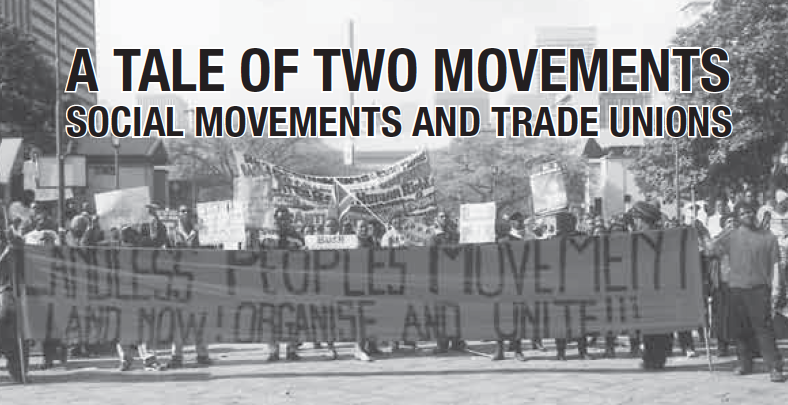
In this interview with Mondli Hlatshwayo, Mxolisi Mafilika looks at working class organising over the last 30 years, and argues that its important for the new layer of activists to appreciate the importance of understanding the history of struggle.
Introduction
This article is based on two interviews that were conducted by the labour history project of Khanya College with Comrade Armstrong Mxolisi Mafilika on 8 and 22 March 2003 at Sebokeng, KwaMasiza Flats. The purpose of the interviews was to allow Cde Mafilika to tell his story of working class organising over the past 30 years. He shared his experience of organising in the new social movements and in trade unions in the 1980s and 1990s. He also talked about the “dark” period in the 1960s that preceded the emergence of independent trade unions in the early 1970s.
Brief background of comrade Mafilika
Mafilika was born on 3 January 1945 at Khundulu village in the district of Lady Frere. He left school at Standard 3 in 1953 because he had to look after his father ’s livestock. Today Mafilika lives at KwaMasiza Flats with his wife and three daughters. His family and other residents living there are facing evictions.
The weapons of the weak – A time of no movement
The repressive arm of the state intensified its role after the Sharpeville massacre in 1960. The liberation movement was banned and most of the leaders of the South African Congress of Trade Unions (SACTU) were either arrested or banned. Workers had to come to terms with the fact that they had no trade unions during this period.
In 1966 Mafilika decided to work in Vryheid in Natal for LTA Construction Company. He worked as a drill operator and earned R15 per week. When asked about trade unions at that time, he said during those days there were no trade unions. Africans were called “kaffir”.
Mafilika narrated a story of the abuse and cowboy tactics often practiced by white foremen at LTA. There was a white foreman called Swanepoel who quarreled with a worker from Pondoland in 1967 and told him that because they were not agreeing on work related issues the only way of resolving the dispute was by stick fighting. Swanepoel lost the fight and gave the worker a wage increase. In another fight Swanepoel was thoroughly beaten by another worker to an extent that he had to be hospitalised. After hospitalisation he came back and gave this worker a wage increase.
Although work was difficult and alienating, the workers managed to find some space for ukukhekheleza (soldiering). When white foremen were not around, the workers would use that time for smoking, talking and resting. In the presence of whites, workers would chant songs that were meant to lift up their spirits during work and the songs were also reflective of their difficult circumstances.
Weekends gave them some space for cultural activities. They used to hold dance competitions in the compounds and, according, to comrade Mafilika, the competition groups were often ethnically based. They played soccer and some workers visited people in the local area. Mafilika was an administrator for his soccer team, he wrote letters and arranged soccer matches.
Workers’ residential conditions were bad because, according to him, blacks were not allowed to live in decent places at that time. They lived in a compound, which was made of metal. This form of housing was cold during winter and hot during summer. Workers cooked their own food. Whites lived in the towns and enjoyed the fruits of black labour.
Mafilika’s contract at LTA ended in 1969 because the task of building a railway line was finished. In 1970 he went to work for the Cape City Council as a drill machine operator in the road construction department. He earned R17 per week and his rest periods were the same as those at LTA. He stayed in a Paarl hostel and living conditions were also bad. The place was cold and had no privacy. In winter they used a home-made coal heater (imbawula) to keep warm.
They had no trade union representation as municipal workers. When asked how workers survived, he said: “We had our own tricks of dealing with the white men. We used to take ‘unauthorised’ rests when a foreman goes somewhere else. We would say ‘uze ngomva’. This meant the white foreman was not looking at us. That gave us an opportunity to stop working and do other things such as smoking, talking, etc.
When a foreman comes back, we would warn other workers and say ‘kubomvu’. This meant it was red and that was danger. Workers would quickly go back to work.”
In 1977 Cde Mafilika’s family left Lady Frere and moved to Hewu, an area in the former Ciskei homeland. A local chief recruited men for Iscor Vanderbijlpark Works, and within the same year he joined the company. About 300 men were taken by bus to Iscor Vanderbijpark Works in the then Transvaal. On their arrival at Iscor Vanderbijlpark Works, comrade Mafilika and other men were taken to Madala Compound. They went through fitness and other tests and stayed at the compound for a week before being relocated to Sebokeng Hostel.
Mafilika found work at the coke oven mill and his job was to control the flow of coking coal. Coking coal is used in heating iron ore in the blast furnaces. Compared to the other places where he had worked, Mafiliki found Iscor to be extremely oppressive. The shift system that was used did not give workers adequate time for resting and a social life. He did not have lunch or tea breaks. He used to eat while working. Just like his previous work places they had no trade union representation. “Life was tough at Iscor”, he said. “There was a lot of dust and heat where I worked. I had no time for taking a gap and I was always tired.”
Iscor had an unusual method of disciplining workers according to Cde Mafilika. A worker would be told to rest for five days without pay.
Furthermore white foremen would beat up workers for failing to obey instructions. In some cases some workers physically fought back and got dismissed. Black workers were not allowed to testify against whites workers in a hearing. The matter would be left to white workers and managers.
In 1978 Mafilika decided to move to another job because he was dissatisfied with his remuneration. Before getting the job at the railway traffic department his friends and other black personnel warned him about the dangerous nature of the work in that department. Because he wanted better wages he decided to take the job offer, but he soon realised that it was very bad. Fellow workers were injured in front of him. Some had broken legs because of accidents in the railway lines at Iscor. However, he continued to work at this department until he was retrenched in 1999.
The Trade union movement
The Metal and Allied Workers’ Union (MAWU) introduced Iscor workers to trade unionism in 1895 MAWU was part of the independent union movement that came out of the Durban strikes of 1973. In 1986 he became a MAWU shopsteward in the railway traffic department of Iscor Vanderbijlpark Works. In May 1987 MAWU merged with other unions in the metal industry to form the National Union of Metalworkers of South Africa (NUMSA) and he maintained his position as a shopsteward.
NUMSA made serious economic and political gains for Iscor workers. Workers were no longer seeing themselves as individuals but as part of a trade union movement that challenged the oppressive workplace and the entire system of apartheid. To bear testimony to that shopstewards were members of the ANC and they also assisted in building the civic movement in the townships. The ANC was viewed as an organisation that had the potential to lead the struggle for the emancipation of workers and communities.
In March 1990 Iscor management organised a seminar on “participative management”. The management’s plan was popularly known as Omega. Workers and shopstewards debated this plan and the outcome was the rejection of Omega. In June 1990 a meeting of dissatisfied workers demanded the resignation of four shopstewards. The meeting also elected 20 shopstewards.
NUMSA’s regional congress did not recognise those elected workers because they felt that the electoral procedure was unconstitutional.
Cde Mafilika was part of those 20-elected shopstewards, called the “Top 20”. Differences arose between the “Top 20” and NUMSA which led to violence at KwaMasiza in which many people died.
The “Top 20” and their supporters joined a steel union and later an electrical union. These unions never satisfied them. Mafilika argues that: “We were always betrayed and Iscor management knows how to deal with unions. They just buy the union leadership off”. The retrenched Iscor workers who were part of the “Top 20” in the 1990s have now joined the Working Class Coordinating Committee (WCCC).
Joining the social movement
Between 1995 and 1999 the Iron and Steel Corporation (Iscor) Vanderbijlpark Works retrenched workers including Mafilika. Some of these workers were suffering from occupational injuries and diseases such as severe burns, loss of eyesight and hearing. Not all of them got financial compensation and have therefore decided to take legal action against Iscor. The case is now at the Labour Court.
The WCCC, of which Mafilika is a leading figure, is a community organisation in the Vaal region affiliated to the Gauteng Anti-Privatisation Forum (APF). It has assisted the KwaMasiza residents in taking their case to the court. The WCCC and the APF have also supported the ex-Iscor workers in political mobilisation for their demands.
These ex-Iscor workers also face evictions from the flats they have lived in since 1977 when Iscor employed them. On 11 September 2002, residents of KwaMasiza Flats were forcefully removed.
On the night of 12 September residents of KwaMasiza decided to re-occupy their flats. This is Mafilika’s account of the reoccupation: “The barbed wire fence was removed and the flats were occupied. We had to defend our mere existence. Iscor retrenched us and they owe us money. Now they want to forcefully remove us from the flats we paid for when we were working. What do they expect us to do? In that struggle two of the “red ants” people – who carry our evictions- died.”
The WCCC is concerned about the attitude of Iscor workers who are living in the flats towards the retrenched workers. Iscor workers want their retrenched colleagues to leave the flats because they are not paying for services. The Iscor workers have their own committee that is in opposition to the WCCC.
The defiant KwaMasiza residents and the retrenched workers belong to a movement that has emerged as a result of neoliberalism and the apparent failure of traditional organisations in the area such as trade unions and civic organisations to articulate the interests of the residents.
The emerging movement is struggling against evictions, electricity and water cut-offs, environmental issues, land, debt and privatisation. It does not have a noticeable presence in the shopfloor but has a strong presence in the residential areas. The KwaMasiza story clearly shows that the movements’ geographical location is in the residential areas. Some of its members like Cde Mafilika, were part of the trade union movement in the 1970s and 1980s. These are the people that can be useful in bringing in the strategic heritage of the trade union movement to the new anti-neoliberalism movement.
At the end of the interview Mafilika said that it is important for the young generation to understand and appreciate the fact that the struggles of today trace back a long way. Life was tough for them during apartheid.
Mxolisi Mafilika is an activist in the APF-Gauteng, and
Mondli Hlatshwayo works at Khanya College.
Leave a Reply
You must be logged in to post a comment.