
Where are we as Southern Africa social movement?
Mhlobo Gunguluzi* argues that networks and solidarity are important components of the struggle against neo-liberalism and globalisation
The building of networks and solidarity are important components of strategies to strengthen our struggles against capitalism and neo-liberal globalization. Recent struggles against neo-liberalism have led to the rise of social justice movements that are taking up the challenges facing our communities today. Most of these movements are single issue based and their activities remain scattered. The social movements have not being able to unify their struggles against the common cause of their misery in a joint decisive and cohesive manner. Networking and solidarity are thus critical in galvanizing the social forces against neo-liberalism.
Current state of Networking and Solidarity
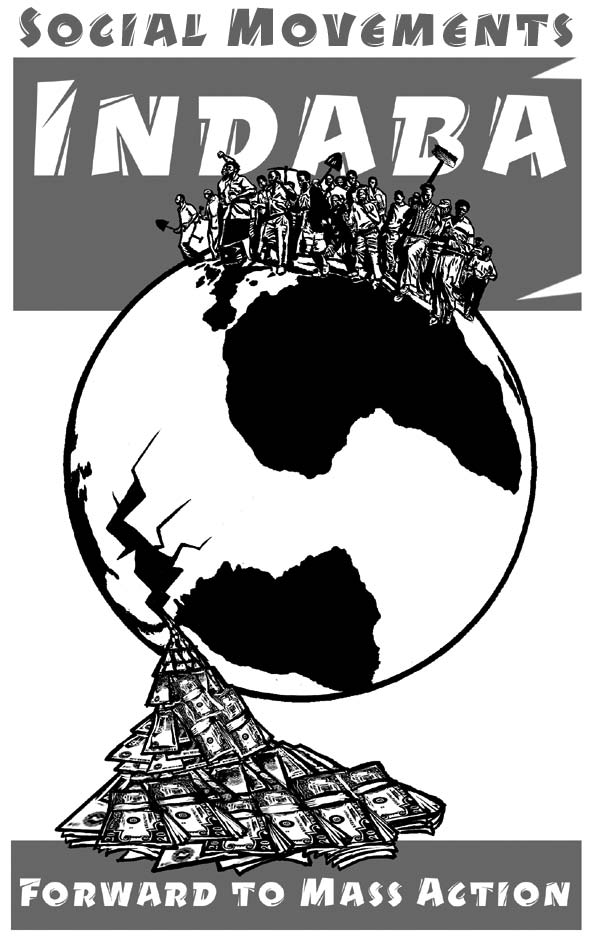
Recently we have witnessed attempts by social movement activists to link struggles against neo-liberal globalisation. In South Africa there is the Social Movements Indaba, elsewhere there is the World Social Forum (WSF), with country specific, regional and continental forums. These forums provided spaces for sharing experiences of struggles. There are also movement to movement networks because these networks also have a local, regional and international outlook, they have helped activists to better understand struggles in other parts of the world.
The Nairobi gathering of the WSF in January 2007 gave examples of how social movements can exercise solidarity in action. WSF also came with programmes like declaring the 20th March as the day of action against imperialist wars and the 18th May as the day of action against human rights violations in Zimbabwe. These actions have not always succeeded, like the Southern African action against water privatization as agreed upon by the Southern Africa Social Forum in 2006. There is an ongoing debate on the effectiveness of these actions and activists are exploring alternative ways of strengthening solidarity in action.
Political Solidarity
At a political level the social movements have been able to maintain consistently progressive positions. For example, in the WSF in Nairobi social movements condemned the over commercialization and militarisation of the WSF. The WSF not only denounced the nonparticipation of poor people in Kenya, but also embarked on action which made sure that the poor people who wanted to trade are free to trade without fear of victimization by the police. We marched through the squatter camps highlighting the importance of unity of the oppressed people in Africa. We developed a political consciousness that requires us to struggle wherever there are social, economic and environmental injustices.
South African social movements have moved a step further and embarked on low intensity solidarity actions such as pickets in parliament in condemning the silence of the government on violations of human rights in Zimbabwe. Building Women Activism based in Cape Town voiced their anger on the violence against women in Zimbabwe. The Social Movements Indaba Western Cape (SMI WC) opened its doors to the activists of immigrant communities so that they can engage in struggles that affect both the immigrant communities and local communities. Social movements need to explore forms of solidarity around neo-liberal programmes like NEPAD and the role of South African multinational companies on the continent.
Education and Solidarity
NGOs like Khanya College (KC) and International Labour and Research Information Group (ILRIG) are playing an important role in supporting the struggles of social movements through educational activities. Such educational activities assist in the theorization of the nature of current forms of domination and the alternatives to the current capitalist globalisation. These activities, in the form of workshops, seminars, journals and schools also help create platforms for local and continental social movements to share ideas and debate strategies for taking their struggles forward. Space is also created for movements that are active in a particular sector or region to meet and discuss possible ways of supporting each other ’s struggles.
Financial resources and Solidarity
Most of the movements that continue to struggle are limited by the lack of money to continue their work with vigor. One of the most crucial things needed at this time by the progressive and left social movements is to support each other financially. Even political actions like mass marches need money to organize. There is also a need for movements to generate financial resources and organize their own educational activities and break their dependency on the NGOs. We need to mobolise funds for solidarity actions. Social movements in the South e.g. Brazil, Venezuela, Bolivia can also play a role in generating such funds. It is also important that groups like COSATU, APF and progressive NGO’s directly support their counterparts in struggles elsewhere, in particular the Zimbabwe movements.
Forward to Solidarity!!!
While we need to encourage networking to share experience and information, we need to take actions together. Solidarity should not be reduced to “trading” whereby people support others because they have supported them before. We need to build a movement that will recognize our struggle as one. True solidarity can only happen to movements whose vision is the same. The unevenness of social movements in the region can be overcome if we struggle together against bourgeois governments in the region and the continent. As social movements we need to have a direct involvement in all our struggles in the region, continent and the whole world.
Leave a Reply
You must be logged in to post a comment.