
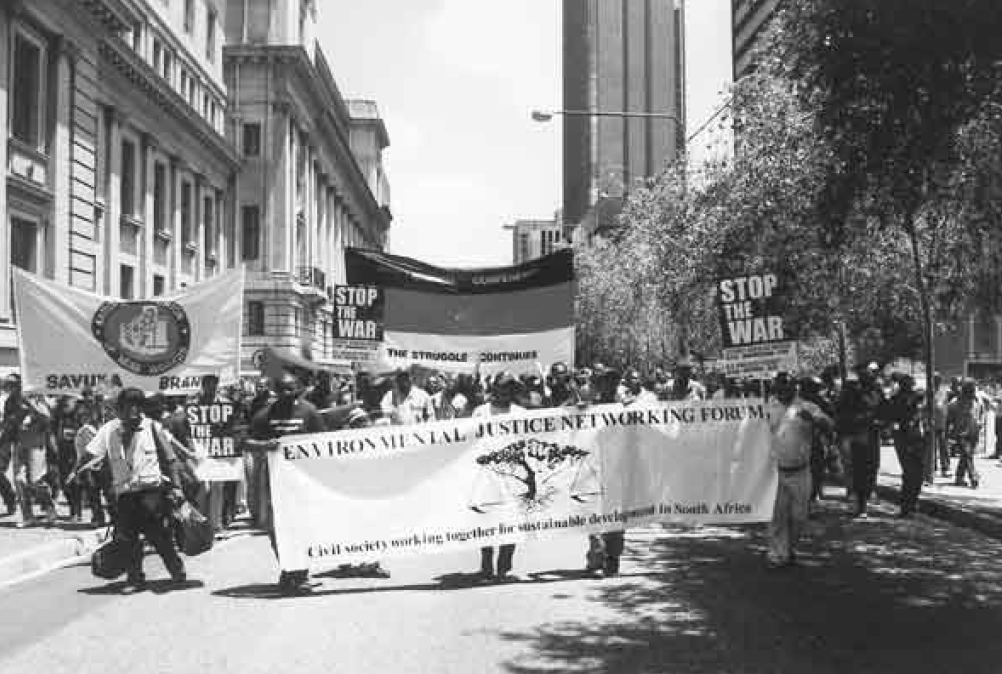
Thabo Madihlaba* argues that NEPAD environmental initiative is driven by neoliberal perspectives, and avoids most issues concerning the environmental justice.
The conceptual and political framework of NEPAD
NEPAD has been conceptualised to try to deal with the broad spectrum of issues affecting the African at the all levels politically, socially, economically as well as culturally. The Nepad document itself is, at best, flimsy because there is not enough detail about almost everything. Despite this, it has been rallied around the whole world as the document for the revival of Africa and has been adopted by the African Union as its fundamental programmatic framework. On the other hand, NEPAD is tremendously top-down, even at government level. Only five African leaders understand it and only 19 agree with it. Ordinary people fought the struggle, but their involvement is not recognised.
Much as it claims to deal with all the issues in Africa, NEPAD’s approach is to focus on the economic aspects of our societies. At a broder contextual level, NEPAD is premised on the fundamentals of capitalism, and, at a more specific level, is conceptualised within prevailing neoliberal discourse.
Despite the evident evils and failures of neoliberalism all over the world, NEPAD does not challenge the neoliberal ideology to allow redistribution of social and economic goods and to build the capacity and potential of people to deal with problems like environmental degradation, HIV/AIDS etc. The initiative lacks the creativity the African leaders need in order to move away from their dependence on the West and the North.
NEPAD subjects all its initiatives to the market driven economy. With its focus on attracting investment from the west, African leaders had to use the same conditions normally set by World Bank and IMF for economic growth in Africa (Structural adjustment conditions). I would therefore argue that NEPAD is Africa’s self-imposed structural adjustment plan. The leaders are almost saying, We are good boys. We are doing structural adjustments for ourselves. Please come and invest and lend us money”. We have to ask ourselves very critical questions such as:
Who is going to benefit from NEPAD?
How will NEPAD affect the lives of people and communities on the continent?
What does it mean for lives of ordinary people?
The NEPAD environment initiative
One of the areas that NEPAD tries to address is the environment. The environment needs to be addressed in a broader context taking into account the interlinkages between socioeconomic, political, cultural and environmental issues.
The main weakness that I picked up in NEPAD is its basis or rather, the lack thereof, of argument regarding environmental issues. It is simple problem solving logic to acknowledge the problem and analyse the causes of the problem before one deals with the solutions to the problem. NEPAD, however, does not fully acknowledge the causes environmental degradation problems on the continent. Instead it pretends Africa found itself with environmental problems without the West through colonialism – playing a role.
NEPAD’s chapter on environment (environment initiative) is primarily focused on three main areas i.e. conservation, desertification and global warming. This, in my opinion, is a deliberate move to avoid criticising the West for its contribution towards environmental degradation in Africa.
The colonial era has seen a systematic ruining of the continent through resource extraction of raw materials for the benefit of the West. We have seen mining houses wreaking havoc on the whole continent. We are now sitting with the liability to pay for the medical expenses and social security grants to victims of this greed – we have to continue spending millions of taxpayers’ money cleaning their mess instead of using that money to pay for basic services. Yet NEPAD identifies mining as one of the backbones of the African economy. This is clearly linked to avoidance to tackle socioeconomic and environmental injustices that always come with uncontrolled and unregulated mining.
In this context, we need to support calls for ecological debt payment by the West. For civil society in the region, this is one of the possible common campaigns that we can adopt in SADC because it is common in most SADC countries
It is a shame that on global warming NEPAD only speaks about fire management projects whilst there are major issues that affect the continent regarding global warming. (I am aware that this is a controversial issue due to the minimal contribution the continent is making towards global warming).
NEPAD and GMOs
In agriculture, NEPAD is almost silent o the issue of Genetically Modified Organisms (GMOs). This very contentious issue is being dealt with at the WTO level on trade agreements. There is a strong possibility is that the African governments are going to systematically support the introduction of GMOs on the continent. This will threaten the livelihoods of subsistence farmers, threaten seed security for poor people, and threaten our well- maintained biodiversity. GMOs will also undermine the use of indigenous knowledge and practices, and cause the dependence of the whole African continent on the multinationals for survival. The other issue regarding GMOs is the fact that their safety has not been proven.
NEPAD contains very little on the promotion of organic farming and the use indigenous practices instead there is more emphasis on the transfer of technology (foreign). GMOs and fertilizers will be obviously classified as “technology transfer”.
As civil society we need to fight for the application of the precautionary principle, and to get Monsanto and other GMO-promoting corporations out of Africa.
Dams and nuclear energy
There has been clear, unchallenged evidence on the negative impact of large dams on people’s lives and the physical environment. Yet NEPAD advocates strongly for hydroelectric power generation, which is only done through building of big dams.
The issue of nuclear energy is deliberately avoided – for obvious reasons: the South African government is the leading agent of NEPAD and is promoting the development of nuclear energy.
This is the technology that has failed and has been rejected in many parts of the world – including developed countries that ironically pledge to support South Africa to develop nuclear energy. With South Africa playing the role of big brother on the whole continent, smaller, less powerful
African countries will be coerced into accepting this dangerous technology.
There is also less emphasis on promoting and investing in sustainable energy. This is done deliberately to please the West, which has got dirty energy economies. This applies particularly to the US and Japan.
Transport and pollution
In addition, there is no suggestion within NEPAD of improving the public transport system on the continent. It is well known that the dilapidated public transport system and the abundant use of private transport on the continent cause the highest levels of pollution on this continent.
On the health front, NEPAD fails to acknowledge and deal with the health problems from the industrial pollution. This is again related to the avoidance of challenging big business because the continent wants to be investor friendly. Referring to these problems and trying to deal with them will be regarded as rendering Foreign Direct Investment “not viable” in Africa.
Conclusion
African leaders have accepted and are promoting NEPAD as Africa’s route to economic recovery. Much like colonialism and apartheid in South Africa, NEPAD looks set to stay on this continent for years, even decades. We as activists need to ask ourselves:
How do we move forward with all these challenges posed by NEPAD?
- Do we engage NEPAD? If so at what level? If not, what is our alternative project, which we hope, will knock sense into our leaders?
From an analysis of NEPAD in general, and its environmental initiative in particular, it is clear that:
- The levels of poverty are going to increase. The gap between the rich and the poor is going to increase internally within countries, between the African countries and between Africa and the north/west.
- There is no way one can address poverty by privatising the provision of basic services such as water, energy, waste management etc.
- There is no way any one will be able to address poverty whilst protecting the private property rights of the rich, especially when it comes to land issues.
- Poverty cannot be addressed by offering workers deadly jobs that will kill them in a few years and leave their families without sources of income.
- Poverty alleviation in Africa will not be achieved through avoidance of the causes of environmental degradation. Industries using redundant and dirty technologies that cause people to be unproductive must be challenged and addressed.
- Giving tax holidays to multinational companies and relaxing environmental and labour laws in Africa will definitely worsen the level of poverty on the continent.
- Continuing to pay for the ecological debt – with taxpayer’s money, which Africans do not owe, increases the burden of poverty.
- Subjecting our agriculture to market driven economies will only worsen the level of poverty in Africa.
- Allowing dependence on multinationals for food production and survival as well as eroding indigenous food production practices will only exacerbate the level of poverty in Africa.
We can always resist and protest against NEPAD, just as we have done with globalisation. Societies are made up of different class interests, and NEPAD represents the interests of certain classes. We need to analyse NEPAD and establish who benefits from it. In South Africa, for example, if we want to canvass the opinions of the masses, we first have to consult about structural adjustment and Gear with the workers and the unemployed.
We may then be able to negotiate an African solution.
“The alternative to NEPAD can only come from the bottom!”
* Thabo Madihlaba works for the Environmental Justice Networking Forum (EJNF), and is active in the social movements in South Africa.
Leave a Reply
You must be logged in to post a comment.