
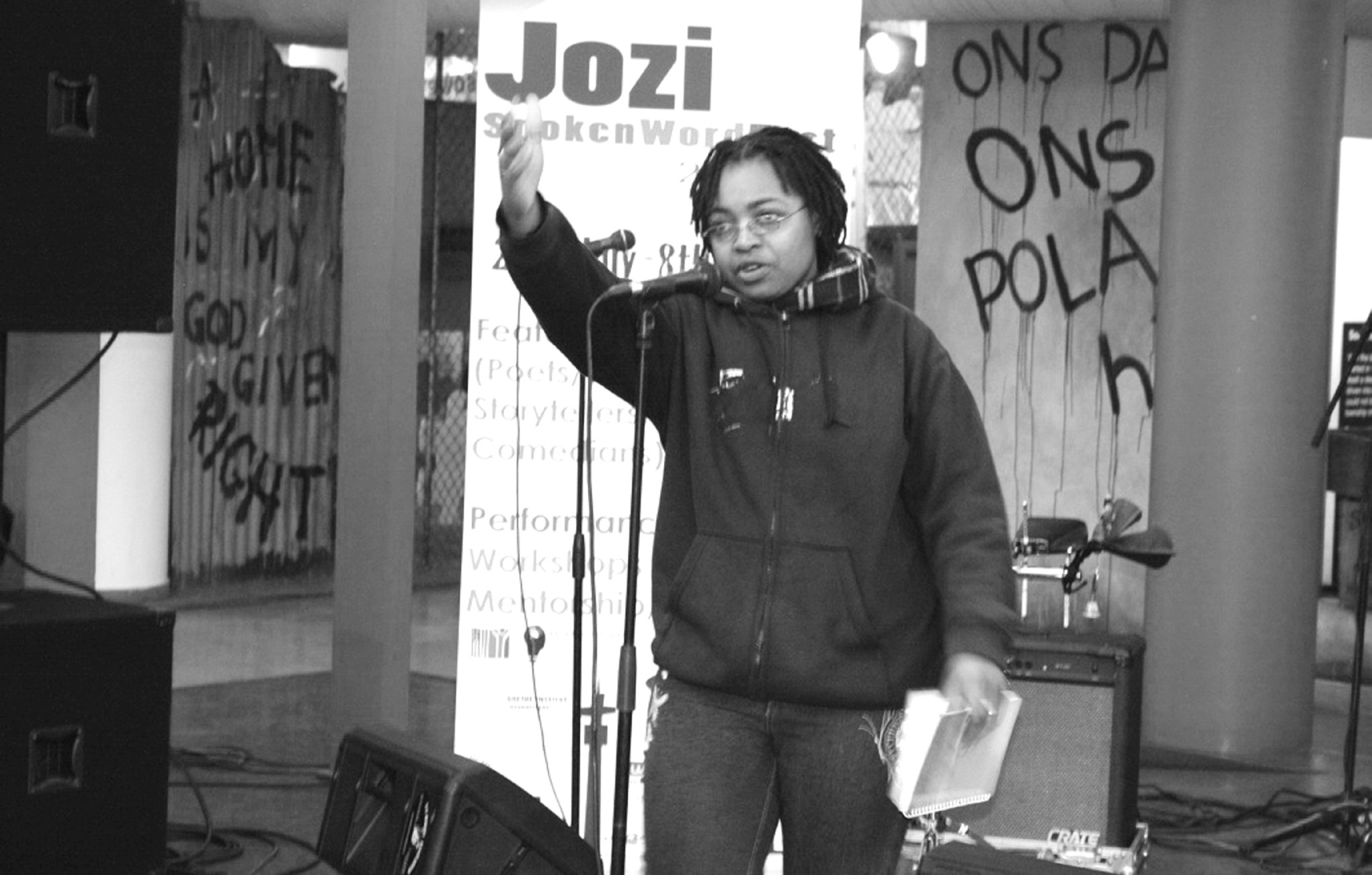
Allan Horwitz* discusses the nature of art, poetry and struggle under Apartheid in the 1970s and 1980s, and the ‘new’ poetry in post apartheid South Africa.
The ‘obvious’ and generalised conclusions presented by the media about South Africa are inadequate to the task of capturing the essences of our still divided but dynamic society. We, as poets, offer them to you – indeed, we hope our poems will break their surfaces: that they will take you into the guts of our fears and fantasies, take you into our emotional and physical landscapes by tapping the force and life in them. This transformation wrought by words will happen because their themes, images, styles and rhythms will be truer, more honest, to our particular and more objective realities than the agencies of news reporting.
Shadow of Apartheid
Art is dependent on and is a reflection of the political situation in a society at any given time. (By ‘political’ one refers to the whole complex of individual and social relations that give rise to a culture.) To discuss South Africa, including the poetry being written and performed here, is to do so in the shadow of apartheid and its hideous legacies, and the glow of the energy unleashed by the movement for democracy and equality. This tension is deeply rooted and permeates all aspects of our lives as we live out the daily contradictions of a period of transition.
On the one hand, there is substantial and ongoing transformation. An authoritarian, racist social system has been opened by a constitution that offers unparalleled human rights, and whose influence is felt at many different levels. Today we have genuine freedom of expression and association, legal equality for women and gay people, and the deracialisation of workplaces, residential areas and social institutions. Also of key importance, we are coming of age with regards to sexual identity and practices. In the past we had to deal with deep seated repression. Afrikaner Calvinism and African feudal polygamy were both rigid, conservative modes of living, and although they seemed in opposition to each other they shared many aspects. There have been important and positive advances.
However, the immediate post apartheid period has also been characterised by mass unemployment, coarse materialism, widespread sexual and criminal violence, large-scale corporate and state corruption and deadly epidemics of HIV/AIDS and tuberculosis.
As a result there is a national sense of buoyancy mixed with despair. The stability of institutions and question marks over progress in poverty eradication remain major issues.
Art
Artists in extreme societies often find that such contrasts offer wide and rich subject matter while, at the same time, also cause great personal trauma and insecurity. But there is another angle to consider. The British writer, Oscar Wilde, famously said,“All art is quite useless”. What does it matter then as an artist, if one is living in an economically and socially divided and violent country which reflects all the major human imbalances plaguing our planet?
After all, the primary impulse behind making art making is not educational or wealth-creating. We make and appreciate art because of a ‘germ’, an irrational impulse to express and voice our agonies, our joys, and to provide philosophical and moral commentaries.
What is ‘real poetry’?
In this vein, the key literary debate since the early 1970’s onwards was whether ‘protest’ or ‘struggle’ poetry qualified as ‘real poetry’. The academic establishment and most reviewers generally slated such work as sloganeering and propagandistic simply because its main focus was to expose the evils of the social system and to mobilise the victims to resist.
Such subject matter was said to lack elegance, subtlety and to be expressed crudely. Purity of language and non-political themes were held to be the ideals that were to be structured in the forms that came from Britain, and to some extent the United States. Poetry written in South African English was frowned upon – particularly when languages were mixed and local jargon used.
At that time such narrowness was to be expected because in the alienated, elitist society that was Apartheid South Africa, artistic norms were set by the ruling (white) nationalist/colonial class. Only as an afterthought, were a tiny number of black writers or radical writers admitted into the canon – their acceptance hard-won and only achieved (certainly with respect to Black writers) because they had absorbed the colonial/ metropolitan models and demonstrated proficiency in reproducing them.
However, as the anti-colonial revolt gathered momentum, new challenges to that hegemony grew confident enough to create their own mechanisms for artistic production and distribution. In the 1970’s new magazines and publishers gave a platform to a wide range of previously unheard voices. This diversity was accelerated by the open revolt of the 1980’s so that the ‘canon’ began to widen and reflect the true cultural mix of our society. As importantly, poetry, as a means for expressing and extending the revolutionary currents, achieved a mass following at political meetings and funerals, and though still largely ignored by the academic establishment, became a mass art form enjoying high legitimacy and appreciation.
Decline in movements
Twenty years later, there is a decline in the mass movements, and people are generally apathetic in the face of their disempowerment. Anti-ideological currents and consumerism rule mass consciousness. With the globalisation of the capitalist system, the contestation between the neo-liberal ruling classes and green/egalitarian thinking continues to play itself out in familiar, new and unpredictable ways. In literary terms, this battle is being fought on various terrains: in publishing (what publishers will promote/ what they believe will sell), in the media (in the mix and orientation of reviews and art programs), aroundcultural awards and selections for school curricula and university courses reinforcing or revising standards of excellence; and, lastly, around financial support (both state and corporate) for work that the commercial sector is not prepared to fund.
What then is the state of poetry in South Africa today?
The news is both good and bad. In the 1970’s and 80’s white academia and the press insisted that only the lyrically sedate was acceptable, and this was successfully resisted by the radical. Today, in the first decade of the twenty-first century the same arguments are being used to sideline and sometimes attack independent non-commercial publishers that support politically and sexually frank writing. This backlash comes after a temporary lull – the honeymoon of the 1990’s when the“Mandela rainbow nation”, though largely ignoring the hard truths of inequality and corruption, was nevertheless vibrant, full of promise and ready to experiment.
Now critics frequently damn these poets by calling them doctrinaire and bemoan their lack of“craft”as if conventional British English forms and themes are hallowed. Though contemporary South African poetry offers a wide spectrum of experience and utilises rhythms suitable to our natural speech and expression, and more literary magazines, websites and publishers are available for poetry and fiction than ever before – and the appreciation of and support for poetry performance is enjoying unprecedented interest – the critical apparatus that analyses and dispenses literary recognition is still very narrow.
Leave a Reply
You must be logged in to post a comment.