
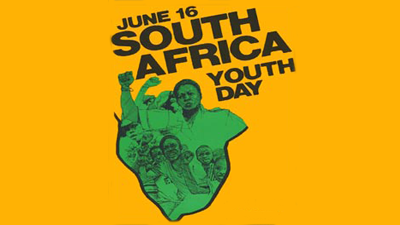
Mphutlane wa Bofelo* discusses the influence of the 1976 students uprising
Allusion to the national students uprising of 16 June1976, which started in Soweto, is found in numerous poems, stories,songs, paintings and theatrical works by both local and international writers and artists. Amongst others, the uprisings are depicted in the film, ‘Cry Freedom’, the musical ‘Sarafina’, the film ‘Stander’, and the movies ‘1989’ and ‘When We were Black’. The events of 16 June ’76 are also a major inspiration in books such as Andre Brink’s ‘A Dry White Season’, Miriam Tladi’s ‘Amandla’, Mongane Serote’s ‘To Every Birth its Blood’, and Sipho Sepamla’s ‘The Soweto I Love’ and ‘The Root is One.’ For a very long period in South African history, poetry recitations, plays and visual arts exhibition featured prominently in events and activities marking 16 June 1976.
June 16 Commemorations Growing up in the structures of the Black Consciousness Movement I always looked forward to the 16 June commemorations not only for insightful political lectures, but also for poetry recitals, short stage-plays and story-telling. It is during the commemoration services of 16 June 1976, 21 March 1960 and Biko Week that many of us were introduced to the voices and works of Ingwapele Madingoane, Don Matterra, Gamakhulu Diniso, Maishe Maponya, Matsemela Manaka, Farouk Asvat, Duma ka Ndhlovu and Mafube Arts Commune among others. It is also at these commemorations that I first recited my poetry and acted in stage plays. I reminisced about these moments as I reflected on the influence and symbolism of the 1976 Students’ uprising in South African literature and arts. Here I focussed on the significance of 1976 and Soweto as landmarks in the emergence and resurgence of what critics have referred to as ‘Soweto Poetry’, ‘Township Poetry’, ‘New Black poetry of the Seventies’, ‘Participatory Poetry’ and ‘People’s Poetry’.
A literary revival
The 1976 National Students Uprising put Soweto on the international map as a symbol of the totality apartheid South Africa, and the collective discontent and anger of Black people. The radical shift also illustrated the consciousness and self-confidence of Black people that was infused with the philosophy of Black Consciousness. As art and literature captures the heart and soul of a people, this new consciousness was expressed in literature and the arts. The June 1976 events unlocked the nation’s creative imagination and gave impetus to a literary renaissance and a cultural movement akin to the Harlem Renaissance. In many ways June ‘76 reinvigorated the creative impulse of the literary and arts practioners in their quest for idiomatic and innovative expression of social reality that went beyond euro-centric conventions. Sam Nzima’s legendary photograph of Hector Peterson’s dead body – which caused world-wide shock and outrage – is in itself a classic example of the power of visual art. It is also significant as a means of exposition and commentary on sociopolitical reality and cultural expression.
Building on the momentum initiated by the literary journal, The Classic, which reflected the post-1960 political mood in the country, Black Consciousness re-established a vibrant literary tradition within the Black community. Writer’s circles and arts’ groups mushroomed; and literary journals like Staffrider carried the torch. This literary revival ignited vigorous debates between proponents of art for its sake and advocates of socially committed art. From the late sixties concentration on the immediate, everyday township experiences to the early seventies protest at a predominately white readership, Black writing from the mid-seventies expressed an uncompromising Black Consciousness voice, leaping into the potent poetry of resistance and rebellion.
Mass mobilisation
Fusing contemporary epic with African oral techniques of repetition and parallelism, writers like Mongane Wally Serote penned a rousing poetry that served as a mobilising tool of mass conscientisation as well as an all-out call to action:
“i am the man you will never defeat i will be your shadow, to be with you always and one day when the sun rises the shadows will move.”
The distinctly Black vision of this literary renaissance was expressed by a return to African names. For an example, Oswald Joseph Mtshali started using Mbuyiseni instead of Joseph, Sidney Sipho Sipamla and Mafika Pascal Gwala respectively began to sign themselves as only Sipho and Mafika and even Ezekiel Mphahlele started to refer himself as Es’kia. This influence spilled off to the music scene where the Beaters changed its name into Harare, and names like Sakhile, Malombo, Malopoets, and Batsumi developed. In contrast to the Black writers of the fifties and sixties (Brutus, Nortjie, Mphahlele, Nkosi and Nakasa) who straddled western and African philosophical models,“the Soweto poets made a rejection of Western literary and cultural continuities almost a moral and stylistic imperative”.
There is no doubt about the impact and influence that this literary and cultural reawakening had in the development of a people’s culture of the 80’s. The Workers Cultural Movement pioneered by Alfred Qabula, Eugene Skeef, Nise Malange, Ari Sitas and Mi Hlatshwayo in KwaZulu-Natal; and the revival of story-telling and oral poetry was popularised by Nokungcina Mhlophe and Mzwakhe Mbuli. Between the 80’s and the 90’s, literature, theatre and the arts were an integral part of political work and writers and artists were visible and audible in political spaces and platforms. Unfortunately with the euphoria of the new South Africa and the highly populist environment of parliamentary politics and electioneering, the literary and visual arts as well as theatre and serious music have been marginalised. Their voices have been drowned by the pop culture which is used by the political establishment to de-politicise the masses; and make them believe that glamour and pomp is the only thing worthy to pursue.
Promoting art and literature
What is encouraging though, is the new phenomenon where radical underground artists create their own platforms and spaces to keep the visual and literary arts, grassroots theatre and organic music of revolution alive. There is still room for spaces and platforms for artists and poets who speak truth to power to be created at the events of political parties and social movements. It is therefore refreshing to note that well known South African poet, Peter Horn, who made his mark with his anti-apartheid poetry, is one of the wordsmiths featured to read their work at the 16 June ‘76 commemoration hosted by the Socialist Party of Azania at Regina Mundi in Soweto on 16 June 2010. By featuring poets and artists regularly, and through arts and culture desks, political parties and social movements can promote literature and art, and the building of a reading nation. This is one of the tributes we can pay to the heroes and heroines of 1976 who died fighting against gutter education, instead of turning June 16 into a day of bumping and grinding to ‘lyric-less’, ‘message-less’ commercial music.
Leave a Reply
You must be logged in to post a comment.