
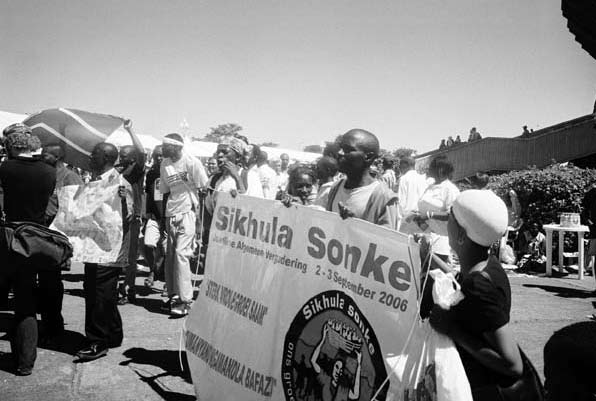
Mafata Mogodi gives an overview of the discussions and debates around farm workers in nairobi
Worldwide there are some 1.3 billion men, women and children who work on farms. They are among the poorest segments of society, often with no adequate housing, little or no access to health care and few educational opportunities. Women account for over half of them while child labour in the sector makes up seventy percent of the world’s working children. Farm work is undoubtedly one of the world’s most dangerous occupations along with construction and mining. Each year some 170 000 farm workers die because of workplace accidents. There is simply no talking of decent work decent life in the farming sector.
My particular task at the WSF was to organise the Farm Worker Forum to discuss the position of farm workers under neo-liberal globalisation. The primary aim was to place the plight of this highly invisible and poorly organised section of the working class on the agenda of the global social justice movement. The Farm Worker Forum was co- hosted by Southern Africa Farm Worker Network and Kenya Plantations and Agricultural Workers Union assisted by Khanya College and Swiss Labour Assistance. The network is made up of farm worker unions and support organizations working with farm worker communities in Southern Africa. The forum consisted of a panel session on 21 Sunday January and a meeting of farm worker unions and support organisations working with farm worker communities on Tuesday 23 January. The panel session had five panellists and brought together over 50 participants. The major focuswas on neo-liberal agricultural restructuring and land reforms and the impact of these on farm worker communities. The common theme that ran through the presentations is that the current wave of globalisation with its emphasis on agricultural trade liberalisation, export oriented production strategies, international competitiveness and market oriented land reforms has intensified unemployment, landlessness, deprivation and poverty in farm worker communities resulting in extreme vulnerability, exploitation and abuse.
Increasing mechanization, use of chemicals, privatisation of land and production of cash crops for exports markets have led to growing casualisation and feminisation of farm employment, massive retrenchments and evictions from farms, unacceptably higher levels of work related injuries and diseases, widespread use of child, forced and bonded labour, increasing incidences of HIV/Aids infections and massive poverty and starvation.
On the other hand the food chain (from primary production to retailing) has gone global in a huge way, opening avenues for increased national, regional and international solidarity with farm workers. Farm workers, once rendered invisible in this global food chain, are increasingly searching for new ways to globalize their struggle for decent work and decent life. One such initiative is the Southern Africa Farm Worker Network. The other, of course, is the participation of farm worker unions and support organisations at international gatherings such as the World Social Forum. Thus the panellists recognised that greater opportunities exist now than ever before for greater national, regional and international cooperation and solidarity with farm workers in different parts of the world.
The panel session had an inherent weakness of limited time for participants to share their particular experiences and map out possible cooperation. Of course the purpose was to set the scene for more substantive discussions and debates at the meeting of 23 January. The meeting brought together 47 participants representing mainly farm worker trade unions and support organisations working with farm worker communities. It was an open meeting held in a more informal and relaxed atmosphere to provide for the free flow of discussions among participants.
The meeting began with some discussions about Southern Africa Farm Worker Network, with specific focus on its structure, functioning and sustainability. An overwhelming response from the participants was that the network is welcomed as an essential vehicle towards building strong farm worker unions and forging greater international cooperation and solidarity. But there was also a gentle reminder that similar initiatives have failed in certain parts of the world because of scarcity of resources and competition among participating organisations for available resources – a challenge the network will have to face and overcome.
The meeting further recognised the general weaknesses of farm worker unions. Farm worker unions tend to be very under-resourced and poorly organised. The causes of this include the conditions of farm workers themselves, the geographical spread of farms, the attitude of farmers to farm workers and unions and the reluctance or inability of governments to enforce labour standards in the sector. Farm workers are badly paid and can hardly afford to pay union subscription fees. They are often denied educational opportunities and as such they tend to be ignorant about their rights, including the right to join trade unions. Their dependence on farm owners for employment and other basic social services puts them in a slave-master relationship.
Farm owners are very hostile to unions. Workers who try to form or join trade unions face intimidation, violence and dismissal. Union organisers are considered trespassers on private property. Labour inspection in the farming sector is rare and non-existent in many cases. The meeting also noted that these challenges are compounded by the attitude of farm worker unions to other civil society organisations. Historically farm worker unions like typical industrial unions have tended to work in isolation from other civil society organizations. Participants argued that this attitude is rooted in outdated models of trade unionism, which have sought to confine trade unions to workplace issues.
Thus the appropriateness of the industrial model of trade unionism, especially in the present period of heightened casualisation, was called into question. On the way forward, participants argued that farm worker unions need to reinvent themselves into social movement trade unionism and become part of the broader coalitions for social and economic justice. Other interventions included the need for more female representation at different union leadership levels and more engagement and greater cooperation with other civil society organisations. An important challenge is to build strong farm worker unions that can better represent the interests of farm workers and also ensure that farm worker struggles are fully integrated on the agenda of the global social justice movement.
On reflection, the Farm Worker Forum was a great success, in a WSF forum dominated by large international non-governmental organisations. Attendance for both two activities was impressive, particularly given the fact that not much publicity materials were distributed on the eve of the events. The issues discussed were pertinent to farm workers and very informative to those struggling in defence of the rights of farm worker communities. Individual organisations established links with their counterparts in different parts of the world and shared practical possible collaborative initiatives. The challenge is how to link up farm worker struggles across the world.
Leave a Reply
You must be logged in to post a comment.