
In this article Van der Westhuizen gives a brief overview of women’s struggles in South Africa and argues that this struggle is far from over.
Early struggles
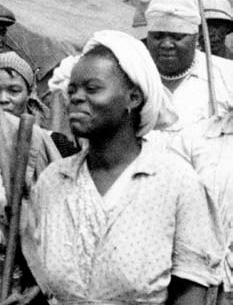
Women have always been at the forefront of the struggle for human rights and dignity for all in South Africa. Way back in 1913 women took the struggle to the Free State authorities when they tried to extend the pass laws to include them. Women under the leadership of Charlotte Maxeke (see Khanya Journal Edition no. 12, 2006 for an article on her) from the South African National Native Congress (SANNC, predecessor of the ANC) collected some 5000 signatures for a petition.
After the government of Louis Botha snubbed the deputation of women sent to take the matter up directly in Cape Town, women tore up their passbooks in front of police stations and/or set them alight in front of municipal offices. Their defiance caused the government to backtrack on its plans and staved off the carrying of passes for women for another 40 years.
Apartheid & pass laws
When the National Party government decided to extend pass laws to women in the 1950s, women took to the streets. Today the women’s anti-pass campaign of the early 1950s is regarded as having been more effective in frustrating the apartheid regime’s actions than even the Defiance Campaign of 1952. The ideologically and racially inclusive Federation of South African Women organised the much celebrated march of 26 000 women from across South Africa to the Union Buildings in Pretoria on 9 August 1956. While the NP leadership still went ahead with its imposition of movement control on black women, the images of Lilian Ngoyi, Helen Joseph, Sophie Williams and Radima Moosa leading thousands of women have come to symbolise women’s pivotal role in moving South Africa towards recognising the rights of all citizens, regardless of race or sex.
Abortion
In the 1990s a broad coalition of women across ideological and racial lines came together to push for women’s human rights. The Women’s National Coalition’s Women’s Charter, was drafted in 1993-4 to influence the constitutional negotiations taking place at the time, to include the demand that women have the right of control over their bodies and their reproductive decisions. In 1994, the ANC released its Reconstruction and Development Programme which stated the policies the organisation was proposing to implement. It contained the following paragraph:
“One important aspect of people being able to take control of their lives is their capacity to control their own fertility. The government must ensure that appropriate information and services are available to enable all people to do this. Reproductive rights must be guaranteed and reproductive health services must promote people’s right to privacy and dignity. Every woman must have the right to choose whether or not to have an early termination of pregnancy according to her own individual beliefs. Reproductive rights must include education, counselling and confidentiality.’’
The CTOP Act
It is therefore not surprising that the Choice on Termination of Pregnancy Act (1996) was one of the laws passed in the first few years of democracy which directly addressed women’s status. The others were the Maintenance Act, the Domestic Violence Act and the Recognition of Customary Marriages Act. The Choice on Termination of Pregnancy Act was passed in 1996, granting women the right to decide whether they want to end pregnancies or not. The passing of the law was made possible in large measure by the ANC which compelled members to support party policy when the law was put before the National Assembly in 1996. Given the ANC’s majority in parliament, the law was passed despite the objections of most of the opposition political parties. Sister Bernard Ncube, a former president of the Federation of Transvaal Women which was part of the United Democratic Front, was one of the struggle stalwarts who voted in support of the bill, much to the consternation of anti-choice critics who branded her an “unorthodox nun”.
Extending Access
In 2004, the Choice on Termination of Pregnancy Amendment Act was passed with the aim to broaden women’s access to termination of pregnancy services. It was this law that came under attack from the anti-choice lobby which launched a successful Constitutional Court challenge on the basis that parliament did not conduct proper consultation. The Reproductive Rights Alliance participated in the country-wide public hearings held by provincial legislatures and, finally, parliament. The Amendment Act was passed a second time in February 2008. Chairperson of the portfolio committee on health, James Ngculu, thanked the Reproductive Rights Alliance in an address to the National Assembly for its contribution to the committee’s decision-making processes. While we have come a long way since the days of Charlotte Maxeke and Lilian Ngoyi, the women’s struggle is not over.
Leave a Reply
You must be logged in to post a comment.