
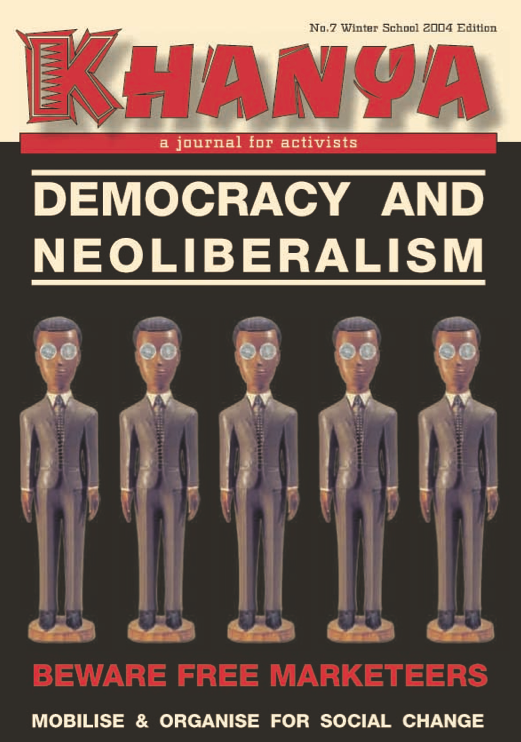
This is the seventh edition of Khanya: A Journal for Activists. The focus of this edition is the discussions and debates that took place at the Khanya College Annual Winter School 2004. Every July Khanya College hosts a Winter School for activists in the social movements and other mass organisations. The Winter School was launched in 1999 and represents an important aspect of Khanya’s response to the changing political and economic environment within which social movements, community based organisations, trade unions and non-governmental organisations have to work. In particular, the aims of the school are:
- To provide the space for activists to critically reflect on their organising and mobilising work in the present national and global context;
- To provide the space for activists to develop their theoretical understanding of present developments, debate topical issues, and exchange experiences with each other;
- To provide the space for building regional solidarity movements by bringing together activists from the subregion and beyond.
The overall theme of the Winter School “Mobilise and Organise for Social Change”, reflects these aims. Various educational events are delivered in the form of workshops, seminars, lectures, cultural events and speeches. An activist forum is also held and provides space for debates on strategy and tactics in the building of social movements. Within this broad theme of the Winter School each of the annual schools focuses on a particular issue that is relevant to the building of the modern social justice movement. The theme for Winter School 2004 was “Neoliberalism and Democracy”.
The focus on this theme was inspired by a number of developments over the last few years. Since the early 1990s African governments have been under pressure from many quarters to “democratise”, and to practise “good governance”. Within the African countries themselves, movements for democratic change have emerged and are struggling for the right for people to have
a say in government. Further, at an international level, the need to “democratise” has become one of the conditionalities imposed by the international financial institutions – in particular, the World Bank and the International Monetary Fund (IMF). The call to democratise is tied to the need to introduce “free market” economies. In other words, it is a call to reduce the role of the state in the economy, to privatise state enterprises, to liberalise the economy, and so on.
After more than three decades of IMF and World Bank imposed structural adjustment programmes in Africa, and despite the introduction of “democratisation” in most countries, the majority of Africans in these countries have yet to experience improved conditions of living. The promise of a better life and freedom from poverty has not accompanied the processes of democratisation.
The launch of NEPAD, and in particular its Peer Review Mechanism, together with the struggles about democratisation, ‘good governance’, and civil liberties in Africa, opened the debate about the relationship between market orientated economies and democracy in the continent.
The aim of Winter School 2004 was to take the debate on neoliberalism and democracy further by facilitating discussion on a number of related themes and issues:
- Deepening activists’ understanding of the NEPAD approach to democracy and good governance, and its PRM;
- Facilitate discussions on the relationship between civil society and the state in Africa; and
- Look at alternative (sometimes localised) experiments on democratisation in the African context, and look at other global experiences that we can learn from.
In her overview of Winter School 2004, Nerisha Baldevu traces the development of the school from a forum largely attended by non-governmental organisations and community projects, to one that now caters primarily for the emerging social movements. This shift in the composition of the school reflects changes that have been taking place in South Africa over the last few years. In South Africa, the impact of neoliberal policies adopted by the ANC government began to generate resistance among communities in the townships. The key issues around which struggles have erupted have been the privatisation of social services – water and electricity in particular – and the impact of growing unemployment on the living standards of township residents. The consolidation of the neoliberal project in South Africa marks a new phase of struggle for the political, social and economic liberation of Africa from neoliberalism.
Oupa Lehulere takes a broad historical overview of the development of democracy and its relationship to capitalism. He looks at how this relationship has developed and been transformed with the advent of globalisation and neoliberalism. Mondli Hlatshwayo looks at issues of the state in Africa. He explores and analyses the various theories of the state, the emergence of the African postcolonial state, and the effects of structural adjustment programmes on the state. Hlatshwayo argues that NEPAD pushes the African State down the slope of subordination to the forces of globalisation.
Lameck Simwanza and Dalitso Kubalasa critically analyse and explain the Poverty Reduction Strategy Papers (PRSPs). PRSPs were introduced by the World Bank as part of its attempt to counter criticisms of its SAPs. Lameck Simwanza looks at the issue of PRSPs in general, and the way they are supposed to work. Dalitso Kubalasa, on the other hand, provides an analysis of the Malawi experience of PRSPs, their effects and the country’s responses to them.
Simon Kimani Ndung’u looks at the issue of the war on terror, and what the Anti Terrorism Bill means for activists around the globe.
There has been a growth of popular resistance to the neoliberal policies of the African states. This is reflected in both the growth of social movements and community organisations, as well as in the increasingly militant actions of these groups. Lameck Simwanza and Mathilda Moyo provide analyses of the resistance in Zambia and Zimbabwe.
Over and above the political discussions that take place at the School, participants are encouraged to engage in other means of exchanging ideas and experiences. Two of the other forms of this engagement contained in this edition are the poetry that was written by the participants at the school, and articles published in the School’s daily newsletter. In these articles participants take up various issues facing their communities, movements and countries.
The next Khanya College Winter School will be held from July 4-9 2005, in Johannesburg. The main theme will be “Gender and Neoliberalism”.
This edition of the journal does not contain a number of regular features that have become part of the various editions of the journal. The EC decided that due to its size, the nature of the Barometer of Resistance will be issued as a special publication of the Journal. This special barometer will look at the regional struggles for independence and democracy. It also looks at the subsequent introduction of neoliberal policies and the emergent struggles for democracy. This edition also does not contain the document section.
The many debates at the School, both on a formal and informal level, as well as at the evening events raised many questions about the challenges facing anti globalisation movements. We hope that this edition of the journal provides you with some insight into the nature of debates taking place in the movements, and offers activists the space to share and debate these issues further.
Since the last edition of Khanya: A Journal for
Activists there has been a number of developments which the Editorial Collective would like to bring to your attention. Firstly, Console Tleane and Mohau Pheko have left the Editorial Collective due to work pressures and other committments. Melanie Sampson resigned from the EC due to disagreements over a number of issues. Both Khanya College and the EC would like to thank them for their contribution to the development of the journal. Jean Chimhandamba joins the Khanya College and in particular the EC as the Managing Editor of the Journal. Henceforth all issues pertaining to the journal, including submission of articles, subscription queries and other matters will be handled by her. Her email at Khanya is Jean. Chimhandamba@khanyacollege.org.za
The Journal was launched during the WSSD as part of Khanya’s attempt to create spaces and platforms for activists to debate issues facing the social justice movement. The Journal is now two years old, and Khanya and the EC are in the process of planning what we see as a new phase in its development. In the first edition of the Journal we set out the motivation for launching it, and we outlined various activities that we saw as forming part of the Journal project. These activities included seminars, publication of occassional papers, forming and supporting study circles or discussion forums, and so on. The EC has now began the process of developing a plan for the implementation of these various activities, as well as a plan for making the journal more relevant and accessible to activists in the social justice movements.
The EC will be engaging with various groups and organisations about the way forward for the Journal. We hereby take the opportunity to invite your ideas and comments on the Journal and on how we can make it a more relevant and accessible space or platform for the building of the social justice movement. If you have any comments please send them to the Managing Editor.
Looking forward to hearing from you
Yours in solidarity.
Nerisha Baldevu (Guest and Convening Editor)
Leave a Reply
You must be logged in to post a comment.