
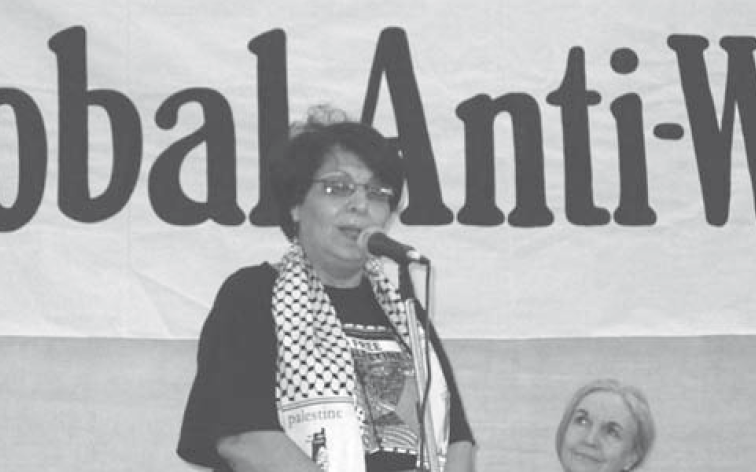
Leila Khaled* spoke to Mondli Hlatshwayo on the Palestinian people’s struggle against Zionism, her politics, the armed struggle, and on South Africa-Israel relations.
I am Leila Khaled. I am a Palestinian freedom fighter, but I am a refugee, since 1948, when the Zionist organisation attacked the Palestinians. They forced them to leave their country. My mother took us as children to the south of Lebanon where her relatives were. But we didn’t know where my father was because my father was with the fighters at that time. After we reached the south of Lebanon, my father came after six months. He had been arrested, and had had a heart attack. We lived in Lebanon, where my family still lives.
I finished high school and then studied one year at the American University of Beirut. But my family couldn’t afford to pay the fees so I was obliged to go to Kuwait to teach. Now I led, like all Palestinians, a very difficult life, because we were out of our country. We had no income. My father couldn’t work; he was paralysed. And we were 12 children, seven sisters and five brothers. That’s why I stayed six years teaching in Kuwait.
I began my political life very early, on the age of 15, when I became a member of the Arab National Movement. But the first person who influenced me was my mother, who always explained our sufferings and our miserable childhood because we were out of Palestine. She planted in our minds that to have a better life we have to return to Haifa in Palestine.
On-armed struggle and political shifts within the PLO
After 1967, the Popular Front for the Liberation of Palestine (PFLP) was established, declaring itself as a Marxist-Leninist organisation and having the goals of liberating Palestine from the Zionists by armed struggle. That was my dream also. So I directly was a member of the PFLP, and up till now I am a member of the Central Committee of this organisation.
The armed struggle began from outside Palestine. The armed struggle factions like the Popular Front, dominated PLO. The stream of struggle influenced, of course, our people inside Palestine. That’s why, when PLO received a blow in 1982 after the Israeli invasion of Lebanon, and we were driven out again, our people, accumulating all the struggles since
1917, the Intifada was a necessity for them. So all our people participated in the Intifada.
But unfortunately, the leadership of PLO couldn’t benefit out of the Intifada as a way of struggle. A new stage of struggle to impose its goals was decided by PLO – the right to return for the refugees to their homeland, the right for self- determination and establishing an independent state with Jerusalem as its capital. But even contrary to this, the leadership signed the Oslo Agreement in 1993. This meant a diversion of the national programme of the Palestinians, where all Palestinians acknowledged and supported PLO as its sole representative.
We as PFLP still think, that when the balance of forces between us and the enemy is not equal, negotiations can’t achieve our goals of the struggle. The core issues of the Palestinian cause are the land and the people. The land, to be sovereign over it. The people, the refugees, to go back to their homeland and to their houses that they were driven out of by force in 1948. We have to mobilise our people to a goal where all our people, inside Palestine and outside Palestine, can unite and fight the Isreali regime.
On Israeli occupation and resistance in the present period
You know, the Israeli strategy is based on force just to subjugate our people by force. The Israelis are making life hell for us. We have a very big solidarity from the whole world, and the Palestinians who have the will. So we have all around the world people supporting our struggle. Our leadership accepted to negotiate. They also accepted to divide the land. So it would be easier for the Israelis to control us. The new strategy of Sharon is a very big apartheid wall, thinking that Israeli society will be secure. Our people can reach anywhere in Palestine, and they can hit!
On relations between the Israeli and South African states
To my knowledge, the only country who did not boycott South Africa was Israel, before the ending of apartheid. This relation is not only a political one. It’s an interest – military and it’s for goods, having goods and expertise from South Africa, from Israel to South Africa. After the end of the apartheid regime, the new government did not cut all the political and military co-operation. This is a criticism from us because we look upon South Africa as a symbol and an example of how the people ended Leila Khaled Speaks the apartheid regime with their struggle. And it’s not logical to have links with such a state which is based on racism and apartheid. So we really depend on you to put pressure on your government, that it’s not logical for them to have these contacts. We know that it’s a relation of interest, but of course South Africa shouldn’t think of interests with a state, which depends on apartheid.
On the centrality of the Palestinian struggle today
We are getting support, real support, from the people, whether it’s political or material. But I think humanity is faced with Zionism as an ideology and as a reactionary movement, a racist movement, which is spread all over the world. And it is influencing the governments. And this movement is that much dangerous because it is a creation of the capitalist system, it is a part of the imperialist powers now. I think that in the whole world we are defending humanity in Palestine, and the peoples of the world have to take steps against Zionism as a concept and as a movement, because it is a sister of Nazism. Nazism made the world pay 50 million victims at the Second World War. I wonder and ask a big question for the whole world – what is Zionism going to make humanity pay for its racist and Nazist and fascist ideas?
On Palestinian Women
Women of Palestine are a part of their people, so the sufferings of occupation and diaspora are the same for men and women. But women, since the beginning of the struggle, since 1970, participated in the struggle. Women participated in all the stages of the struggle because they have the same goals of their people, while in the stream of this struggle they also struggle for their rights. We as women struggle for our rights as a part of our right for return and for self-determination, because we cannot divide the rights – the national ones from the social ones. But the social rights come after, because the traditions and the concepts of the society is deep in the minds of the society itself, whether men or women. So it needs more struggles and more patience to achieve women’s rights as a part of human rights. Now, the Palestinians are deprived of their human rights. We are still fighting for our humanity. So when we achieve this, I think we women are cutting out the way to their full rights.
*LEILA KHALED IS A LEADING MEMBER OF
THE POPuLAR FRONT FOR THE LIBERATION OF PALESTINE. THIS IS AN EDITED vERSION OF A CONvERSATION WITH MONDLI HLATSHWAYO OF KHANYA COLLEGE IN MuMBAI, 19 JANuARY 2004.
Leave a Reply
You must be logged in to post a comment.