
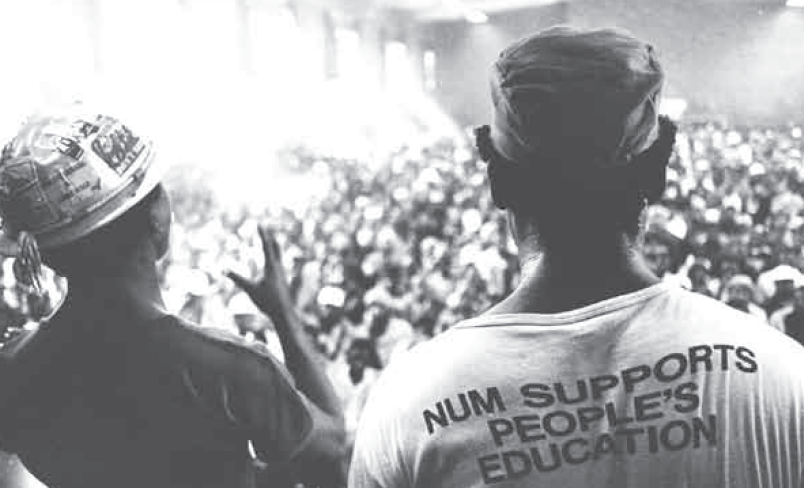
Linda Cooper argues that the struggle between education as a tool for social transformation and political practice and education as a human resource development is no longer an evenly balanced one, and that the balance has shifted decisively away from worker education as ‘political practice,’ in favour of human resource development.
Worker education in South Africa is being pulled in two opposite directions. The one direction has emerged: “…. out of the history of the labour movement and links education closely to political practice; it sees learning as emerging out of workers’ collective experiences of oppression and exploitation and views the purpose of education as one of empowerment and social transformation. The other has been appropriated by the labour movement from the world of human resource development; it emphasises the assessment and accreditation of learning from life and work experience as the basis for creating new routes into higher education, employment and training opportunities.”
The struggle between these two different worker education traditions is not an evenly balanced one (if ever it was). The advantage has shifted decisively away from worker education as ‘political practice’, in favour of the second tradition: the one related to human resource development.
What do these two, different worker education traditions represent and where did they come from? How can we begin to understand the historical shift that has taken place from one to the other? And what does it mean in terms of the political challenges faced by the trade union movement and the workers’ movement more generally?
Worker education as ‘political and practice’
The ‘political’ approach to worker education has deep roots within the history of struggle in South Africa, but it re-surfaced most recently with the re-birth of the South African labour movement following the 1973 Durban strikes. These strikes were a ‘school’ for workers: the experience of mass action taught them that despite the fact that apartheid laws and employers’ practices denied workers’ rights, they could still demand and win some rights through united action. The strikes also acted as an educating force’ for others: workers elsewhere watched what was happening and began to sense that they, too, could change their lives. The ‘message’ of the strikes was passed on not through structured educational events, but through the collective action of workers.
The 1970s and early 1980s was a period of painstaking building of union organisation, with learning and education deeply embedded in organisation. The bitter, day-to-day experiences of organising – with some victories and many set backs taught workers the principles which would come to guide the union movement in years to come. They learnt to build strong shop-floor organisations; they learnt about the importance of worker leadership and democratic worker control; they learnt that ‘the union is not the office’ – the union is the workers; and they learnt about the full power of the alliance between the apartheid state, the police, and the factory owners.
As time went by, this ‘learning by organising’ was supplemented by more structured trade union seminars, workshops, training programmes and education conferences. In addition, the production and sharing of knowledge was consciously linked to cultural work such as the production of songs, plays, and poetry, as well as the growth of mass media such as union posters, pamphlets and magazines. Education work also sought to support the building of women’s structures, and promote debates around gender oppression and exploitation. There also emerged new forms of worker self-education, such as the all-night seminars known as siyalala’s.
The boundaries between these different forms of worker education – structured education, learning by organising, and education through mass action were not hard and fast: each one influenced and enriched the others. The balance between these three also shifted over time. While ‘learning by organising’ was most important during the building of new organisations in the 1970s, the emergence of structured education programmes assumed importance with the emergence of the union federations, FOSATU and NACTU, in the late 70s and early 80s. With the establishment of COSATU and the significant growth of widespread mass struggle in the mid-1980s, there was not only increasing ‘learning through mass action’, but workers also played a key educative role in (and also learnt from) the township struggles of youths, students and women.
Organised workers began to seek answers to fundamental political questions related to issues of state power, and to how to build workers’ political power. These found expression in the debates in FOSATU in the early 1980s around the establishment of a workers’ party, and the campaign in COSATU for a Workers’ Charter representing the rights of workers. With the growth in workers’ intellectual confidence, there also emerged a more conscious theorising of the role and identity of workers education. The 1987
COSATU Education Conference resolved that education should:
- Discourage individualism, competitiveness and careerism;
- Be directed against racism, sexism, elitism and hierarchy;
- Promote a collective outlook and working class consciousness;
- Be linked, as part of the struggle for socialism, to production “in a creative, liberating way” as opposed to entrenching exploitation;
- Build working class leadership of the struggle for a transformed society.
- Be a way of ensuring maximum participation and democracy;
- Serve the needs of workers and their allies and develop an understanding among the working class “that their struggle forms part of the world struggle against oppression and exploitation”.
Worker education as ‘human resource development’
A different approach to worker education began to emerge within the labour movement in the late
1980s and early 1990s, and was reflected in two key, new developments.
The first of these developments was the trade union movements’ increasing involvement in workplace education and training policy development. COSATU’s 4th National Congress in 1991adopted a set of important resolutions: that workers should have access to ‘lifelong education and training’, with an emphasis on ‘flexible,
Worker Education: Embracing Globalisation or Supporting Workers’ Struggle?
Transferable skills’, access to ‘career paths’, and
‘Recognition of Prior Learning’ (RPL). From the early
1990s, COSATU became increasingly involved in the processes of education policy development with the establishment of related education institutions.
Trade union involvement in these processes was supported by the belief that workers should have the right to improve their workplace skills, and to have their skills and knowledge recognised.
This new emphasis on education and training over the past decade or more, and the labour movement’s involvement in skills policy, legislation and institutional structures, is not unique to South Africa. This has happened in many parts of the world.
Left critics argue that the ‘ideology of training’ has arisen as part of the crisis of globalisation and the implementation of neo-liberal policies. These have promoted less secure and ‘non-standard’ forms of employment, and greater ‘labour-market flexibility’. These, together with restructuring at plant-level, have placed workers on a ‘treadmill’ where they feel that they constantly need to ‘re-skill’ in order to keep employed. Training also becomes a mechanism for dealing with growing mass unemployment. In Europe and North America, cuts in social services and the establishment of training programmes have acted to force the unemployed off traditional social benefits and back into the workforce.
Trade union education as ‘human resource development’?
Developments in South African education and training outside of the labour movement have been paralleled by significant shifts in worker education within our trade unions. Over the past ten years, there has been a growing emphasis on developing trade union education which is professionally run and institutionalised, and which offers ‘career- pathing’ to trade unionists. With the continuing ‘brain drain’ of trade unionists into government and into management, the unions’ education resources have been increasingly directed towards ‘capacity building’ amongst its leadership and staff. Trade union leadership represents an increasingly educated stratum of workers, from which many women workers, and older (and less literate) workers with rich experiences of past struggles, are excluded.
There is an increased blurring – in theory and in practice – of the distinction between workplace education and training issues, and trade union education. This is perhaps best illustrated by the debate around whether or not to build a ‘trade union qualification’ which will offer trade union training formal accreditation, the emergence of arrangements with higher education institutions to provide accredited courses for trade union staff and shopstewards, and the view that trade union offices as workplaces in their own right – need to pay skills levies and submit workplace skills plans, as required by the new skills legislation.
These developments in trade union education have been criticised for promoting an approach where worker education becomes depoliticised and stripped of its class identity, and where it shares far more in common with ‘management’ education than with the forms of learning to which worker education was traditionally allied – learning through organisation and struggle, and education through cultural activism. It is also argued that this approach subordinates trade union education to the ideology of competitive individualism, which is so dominant today:
Worker education: where to now?
Approaches to education never exist in a vacuum they always reflect the broader social and political context in which they are located. The shift from the earlier tradition of worker education as ‘political practice’ towards the ‘human resource development’ tradition of worker education, cannot be understood outside of the broader changes experienced by the labour movement since 1994. These include a significant decline in mass militancy within the movement, the general organisational weakening of the trade unions (occasioned by falling membership as a result of retrenchments, and rapid turn-over of staff), the erosion of trade unions’ mass base amongst less formally-educated workers, and the growth of its base amongst ‘white-collar ’, more ‘career- oriented’ workers; and COSATU’s failure thus far to successfully challenge the government’s neo-liberal policies of GEAR.
Will it be possible to tear worker education away from its current embrace with globalisation’s ideology of training’, and re-embed it in the practices of worker organisation, cultural activism and mass struggle? It will be necessary to do this if it is to meet the needs of workers for an education which affirms and respects their knowledge, and which allows them to develop themselves in the interests of the workers’ movement, the working class, and society as a whole. It will only be possible to do this with the simultaneous rebuilding of organisations, cultural activism and struggle.
Linda Cooper is a lecturer at the University of Cape
Town and has been involved in labour education.
Leave a Reply
You must be logged in to post a comment.