
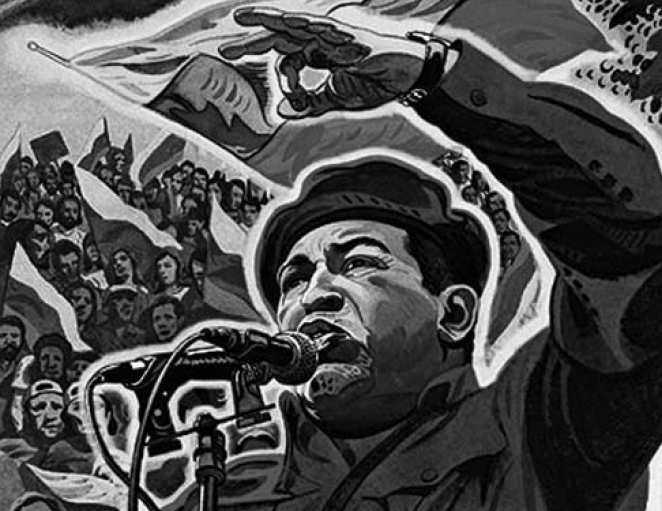
In this article Mondli hlatshwayo* discusses the World Social Forum in the context of significant changes in Venezuela, and latin America. In Venezuela, the struggle and memory of Simon bolivar is a constant inspiration for current struggles.
From 24 to 29 January 2006, more than 100,000 participants from around the globe descended on Caracas, Venezuela, to attend
the World Social Forum (WSF). The Caracas forum was one of the three “polycentric” forums taking place at the same time, to foster more regional collaboration. A second forum was held in Bamako, Mali, a third one took place in Karachi, Pakistan, in March (delayed because of last year ’s earthquake).
There has been a lot of debate among the South African left about the character of the revolution in Venezuela, led by President Hugo Chavez. The Venezuela Forum was important because
it provided an opportunity to assess the impact of social and economic developments under the Chavez government since 1999. Chavez views
his programmes of social change and the struggle against imperialism as a continuation of the struggle of Latin American liberation fighters, such as Simon Bolivar.
bolivar’s Venezuela
The history of the war of independence against Spain in Venezuela is linked to the lives of two liberation fighters, namely Simón Bolívar and Francisco de Miranda. Bolívar is recognised as the ‘father ’ of the independence in Venezuela,
Colombia, Ecuador, Peru, and Bolivia. Despite his success in leading these nations to independence, Bolívar never achieved his goal of creating a federation of South American nations. Today most Latin Americans hold Bolívar in high regard.
The revolutionary struggle began in In 1819 the republic of Gran Colombia was established, with its capital in Bogotá. Independence was assured with the decisive victory of Bolívar ’s forces over the Spanish royalist army in 1810. At first there was a federation with Colombia and Ecuador, but later Venezuela became an independent republic in 1829.
Linking the historical struggles of Bolivar with the ongoing revolution in Venezuela and a need to unite Latin Americans against imperialism, Chavez in his invigorating speech at the Social Movements’ Assembly at the WSF in Caracas exclaimed,
“Caracas! Here Simón Bolívar was born and here remain the ashes of the Father Liberator, that great man of our America, who one day realised that, like Christ, he would not in his lifetime be able to see
or hear, or feel the concretion of the dream, of the utopia.”
Drawing on the spirit and memory of Bolivar, Chavez called the social change in Venezuela a Bolivarian socialism or a Bolivarian revolution. Everything is named after Bolivar, from the banks notes to the airport, the university, the squares, and the museums. Chavez is using the country’s resources (oil) to improve the social and economic conditions of the poor in Venezuela, and to unite Latin America against imperialism in general and United States imperialism in particular. This is consistent with Bolivar ’s dream.
The significance of forum in Venezuela and latin America
The decision to hold the forum in the Bolivarian Republic of Venezuela is living proof of the WSF’s slogan: Another World Is Possible. In only seven years, Chávez and the Bolivarian Revolution have upended the Venezuelan economy, using a ready supply of oil money to fund social programmes for some of the world’s poorest citizens; and deepen participatory democracy in the communities and major industries. At the same time, Chavez and
his government have developed close ties with the Cuban people. As part of international solidarity, reciprocal trade and the building of the anti- imperialist bloc in Latin America, the government of Venezuela supplies Cuba with oil and in return the Cubans provide education and health services to the Venezuelan people. The Cubans train Venezuelan doctors and educators. There was a strong Cuban presence at the WSF.
The forum also celebrated the victory by Bolivian popular forces. During the WSF Chavez attended the inauguration of President Evo Morales of Bolivia, the first indigenous president in 500 years. Venezuela also signed trade agreements with Bolivia, an important ally. The Morales victory comes, thirty-six years after the death of the Latin American revolutionary, Che Guevara, who was killed by the Bolivian military government in 1967. The networks and social movements of indigenous communities, who struggle for land and access to Bolivia’s natural resources, elected President Morales.
On May 1 2006, the international workers day, Morales issued the decree nationalising the gas industry. This fulfilled the main demand of the popular movement that overthrew the two preceding presidents and the key promise of his election campaign.
The bolivarian opening March
The opening march in Caracas was festooned with national flags and insignia – not only from Venezuela but also from Colombia and an
800-member Cuban delegation that marched in lockstep, wearing matching baseball caps and waving flags. The march included about 30 000 people, mostly from Latin America, but also from Africa, the US and Europe. It is important to note that the march and the forum did not have a strong Brazilian presence. This is despite the fact that the Brazilian social movements have been spearheading the forum since its inception.
The Bolivarian Circles, who a few years ago defended Chavez during the coup of 2002, were also represented at the march. “We’re marching
in solidarity with the people of the world and the unity of the people of Latin America and the Caribbean,” said José Perada, the National Coordinator of the Bolivarian Circles
The march ended with a rally. Many passionate speakers spoke of the social changes sweeping Venezuela and the continent. Some denounced George Bush and his empire. While people danced and artists played protest music.
The Social Movements` Assembly
The Assembly of Social Movements meets during the WSF and takes decisions on concrete international campaigns against imperialism and
war. These deliberations result in The Call of the Social Movements Statement. Chavez opened the Assembly of 30 000 people on 27 January, and received popular applause. Chavez spoke for two and a half hours. He said that unlike Karl Marx, when he first issued the call for socialism in the 19th century, “We do not have much time left. The 21st century has now come, when the dilemma must be finally resolved. Time is short. If we do not change the world now, there may be no 22nd century for humanity. Capitalism has destroyed the ecological equilibrium of the earth. It is now or never!” Chavez called for
the building of a worldwide anti-imperialist movement, to cheering crowds.
On the 29th of January, the Assembly called for March 18th as the International day of mobilisation against the occupation of Iraq. Other demands of the assembly included an independent Palestine and an end to US military occupation in Latin America.
Women and the WSF in Caracas
Latin American women have a history of struggles against military dictatorships and oppression in general. At the WSF women were represented in large numbers, representing local women’s groups, national organisations, and international coalitions, unions, human rights ,farmers and peasants, poor people’s groups, anti-racist, environmental groups, and indigenous communities.
In a panel organised by a coalition of women’s organisations, speakers addressed the need for diversity and inclusiveness. Anna Luz, a speaker from La Marcha Mundial, pointed out that the WSF has accepted that feminism isn’t a token issue but needs to be part of the wider WSF perspective.
The issues women raised included opposing all forms of violence – personal violence against women and children, which has increased under globalisation at home, at work, and in public places; the violence of an exploitative economic system;
and violence caused by drug-trafficking, gangs, and heavy-handed military and police interventions.
Many speakers celebrated this new moment in Latin American history with six left-leaning presidents and the defeat of the FTAA last November. Women from Venezuela spoke proudly about the Bolivarian Revolution’s emphasis
on health and education, considered a social debt owed to the people; the food programme that feeds thousands of needy people each day; the reduced price of staples that ease women’s everyday household budgeting; and the alliance between Venezuela and Cuba whereby 20,000
Cuban physicians and health technicians are currently living and working in poor Venezuelan communities in exchange for oil. Indigenous
women spoke of the need to go back to cultural and economic roots, interpreting ancestral wisdom for current circumstances and challenges, balancing spiritual and material aspects of life.
Despite all their political insights and organising experience, women’s role in the WSF still seems somewhat tentative and marginal. Cándido Grzybowski, a founder of the WSF, noted that there were relatively few women speakers in the large plenary sessions.
The World March of Women, an international network of women’s organisations, and other organisations organised a Women’s International
Tribunal against the Patriarchal Violence of Neoliberalism. Over 1000 people listened to the personal accounts of 26 women from 16 countries that denounced different forms of femicide, exploitation and sexual trafficking. They spoke of the fight against fundamentalism, sexual diversity, trade union battles, women living with HIV/ AIDS, and the militarisation of Latin America. The Tribunal proposed alternatives to “the culture of exclusion, to violence against women in wars and through the capitalist market.
The Youth Camp had a bolivarianAmbiance
Parque Los Caobos, located in Bellas Artes, the arts center of Caracas, was transformed by the thousands of campers who came to the Caracas gathering of the sixth World Social Forum. Youth campers replaced the serenity with a vibrant energy as people from
across the Americas set up camp, put up banners and flags, participated in cultural activities, and talked about how to change the world.
Conclusion
The World Social Forum in Caracas was a celebration of a victory of progressive forces in Venezuela and Bolivia. In other words, it
acknowledged that we have suffered many defeats and setbacks under neoliberalism but we have something to celebrate from the developments in Bolivia and Venezuela. At the same time, the forum noted the challenges and tasks for building popular power in the world. Hence social movements in the Assembly made a call for advancing the struggle against imperialism.
*Hlatswayo works at Khanya College, and is an activist in the social movements.
Leave a Reply
You must be logged in to post a comment.