
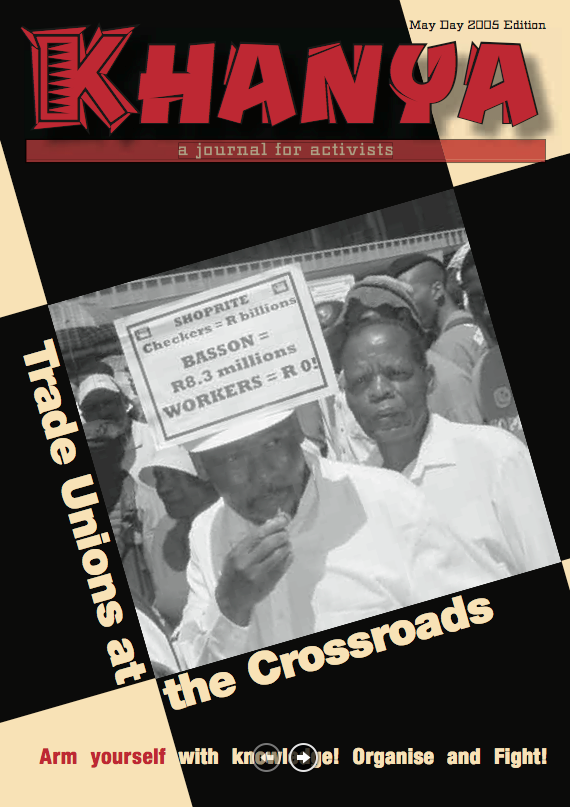
Trade unions at the crossroads
The 1973 strikes in Durban and the subsequent wave of worker uprisings are regarded as important landmarks in the making of the South African labour movement. The strike wave and the consequent revival of the labour movement have a direct bearing on the present labour movement. Key working class organisations that constitute the present labour movement can trace their origins back to 1973. The Congress of South African Trade Unions (COSATU), the country’s biggest trade union federation can also trace its roots back to the strikes of 1973 and commemorates its 20th anniversary in 2005.
Over and above this, the traditions established by the Durban strikes and the struggles it gave rise to have greatly influenced the way we understand democracy and politics in South Africa. Some of these traditions and practices, such as the shopsteward movement, the principle of workers’ control and other democratic practices, continue to inspire those who are struggling for democracy in working class organisations and in society at large. Union practices such as leadership accountability, regular election of shopstewards and attempts to establish participatory democracy were replicated and adapted in student, civic and other mass organisations during the struggle against apartheid.
There has been an acknowledgment of the contribution made by the trade union movement in the struggle for democracy, and there has also been an attempt at reflecting on the state of the labour movement in the era of globalisation and after ten years of democracy. At the beginning of March this year COSATU convened a conference, which reflected on the role of trade unions over the past ten years of democracy.
In the same vein, Khanya College is convening a conference on 20 – 22 October in Johannesburg to reflect on the role played by the federation since its formation in 1985. The conference will contribute to the current debate about the state of the labour movement in the context of globalisation. The conference will be preceded by a number of different activities that will take forward this reflection. In May, Khanya College will launch a book on the history of the labour movement since the Durban strikes, and will follow this with a series of seminars dealing with various aspects of the contribution by the labour movement to the struggle for democracy and social justice in South Africa. This edition of the journal marks another contribution to this debate.
From different angles a number of articles in this edition reflect on the emergence of the modern trade union movement, of which COSATU is the most important organisation. Nicole Ulrich discusses the Durban strikes and the subsequent rebirth of the trade union movement in the early 1970s in Natal, and reflects on the traditions that came to define the modern labour movement. Lennie Gentle looks at the relationship between trade unions and other sections of the mass movement, at the ideological contestation in the labour movements and the liberation struggle, and the current debates about the role of trade unions.
John Appolis revisits the 1980s registration and industrial councils debate. He argues that contrary to the spirit of debating strategic and tactical options in the struggle against the state and capitalism which prevailed in the 1980s, the absence of debate on the participation of the present trade union movements in state and business institutions is a problem.
Mondli Hlatshwayo argues that the cycle of struggle that began with the Durban strikes of 1973 has come to an end. He argues that the decline of blue-collar workers, the shop steward movement, activist-organisers, intellectuals, cultural life and the grassroots intellectuals of the trade union movement evidence this.
In her evaluation of trade union education, Linda Cooper argues that the struggle between education as a tool for social transformation and political practice and education as a human resource development is no longer an evenly balanced one, and that the balance has shifted decisively away from worker education as ‘political practice,’ in favour of human resource development.
The role of white activist intellectuals in the labour movement has always been a controversial one. Sakhela Buhlungu introduces the debate on the role of white intellectuals, and argues that these intellectuals developed unequal power relations with their black counterparts in the labour movement.
In his reflection on the economic policy debate, Oupa Lehulere argues that over the last ten years COSATU has moved from being a militant socialist organisation to becoming an organisation whose policies are now acceptable to the capitalist class in South Africa. In a further contribution dealing with present trade union strategies, Maria van Driel takes a look at ‘social dialogue’ as a strategy, and argues that the promises of social dialogue cannot be achieved under conditions of neoliberalism.
Mthetho Xali examines the relationship between trade unions and social movements in the Western Cape. The article is a contribution to the current debates about a lack of trade union presence in community struggles. Mxolisi Mafilika, who was interviewed by Mondli Hlatshwayo, reveals that some of the activists in emerging social movements were also part of the trade union organising that began in 1973. The interview also shows how trade unions have failed to take up issues affecting their former members, such as those who have been retrenched.
Sakhela Buhlungu, in a different contribution, argues that current COSATU membership is in a relatively privileged position compared to those in precarious (casual or outsourced) jobs, those who are unemployed and those in the informal sector.
He further contends that the growth of workers in marginal sectors of the labour market and the decline of formal employment (where COSATU’s membership is concentrated) is going to make it increasingly more difficult for the confederation to legitimately speak for all these sectors.
In his contribution to the debate about international solidarity and xenophobia, Thabang Mohale argues that globalisation has increased xenophobic tendencies and trade unions as part of the struggle for international solidarity should unite with the immigrant communities and workers.
This edition of the journal has been jointly produced with Khanya’s Working Class History Programme, and the edition also carries an article that introduces the Programme, its perspectives and role.
Our regular feature, The Barometer of Resistance, seeks to capture major worker struggles since the Durban struggles of 1973. Because of space, we have not included documents in this edition. These will be available on the journal page of the Khanya College website.
Mondli Hlatshwayo
Guest Editor
Leave a Reply
You must be logged in to post a comment.