
Lennie Gentle looks at the relationship between trade unions and other sections of the mass movement, at the ideological contestation in the labour movements and the liberation struggle, and the current debates about the role of trade unions.
South Africa’s tenth year of democracy was celebrated in the context of greater neoliberal triumph as well as South Africa’s imperial aspiration in Africa. An important feature of this triumphalism is a huge silence on the role that mass struggle played in winning democracy.
At the bottom of all this is the rewriting of our history, in particular the role of mass struggle and especially that of the trade unions. COSATU itself has not been without blame in this project. For example, there was no programme in 2003 of remembering and debating the significance of the 1973 Durban strikes, or to discuss and reflect and draw on the lessons of COSATU’s role in the victory over apartheid. Within COSATU, and within the government, there are voices, which call on COSATU to keep out of politics and to leave the government to govern. These views do not reflect the history of the trade unions in South Africa. Activists in the emerging social movements and those workers who continue to fight struggles within COSATU and on the factory floor need to reflect on the lessons of the last 32 years of the labour movement and the role that trade unions played in forging a mass movement.
The 1973 strikes
In the 1960s when the apartheid state crushed the mass movement of the 1950s, capital accumulation took place at unprecedented levels on the backs of a policed, defeated and divided working class. Political activism in South Africa was re-awakened in pockets at the end of the 1960s, primarily in the form of black students in bush-colleges who were inspired by black consciousness.
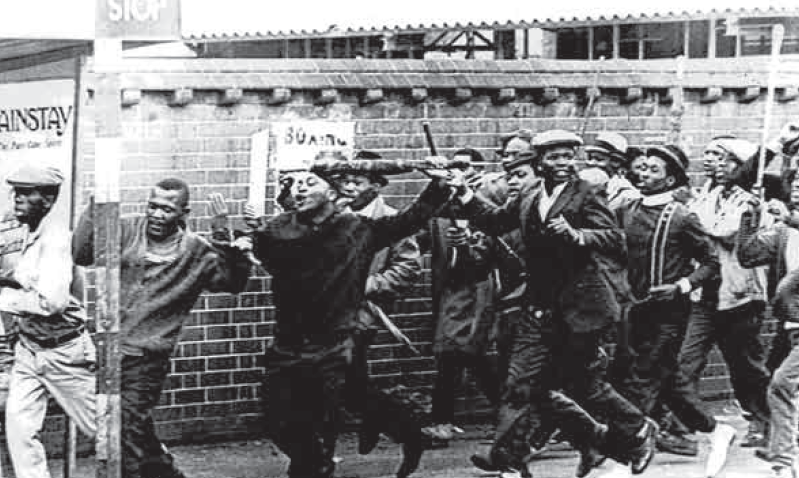
The 1973 strikes in Durban re-launched struggles and the strength of the workers’ movements ushered in a new phase of struggles that gave confidence to young students in their struggles in 1976. The extent to which the strike wave moved in 1973 to the East Rand and the resilience of the workers surprised the apartheid regime. Within the ruling class, elements began to call for reforms of the apartheid labour market.
The Durban strikes clearly marked a movement in which the centre of gravity moved off the campuses to the factories and streets.
What was the relationship between the trade unions and other sectors?
From the late 1970s through the early 1980s the trade union movement built and sustained the mass movement in a number of ways, despite some regional differences.
In the Witwatersrand and East Rand regions it was the shopsteward layer that established the civics that then led the community struggles against Black Local Authorities (BLAs) and other apartheid reforms. In the Eastern Cape although formations such as SAAWU, NAAWU and GAWU did not start the 1980s uprising, they linked with the struggles launched by the new civics and by the militant students. Only in the Western Cape were the struggles shaped by a student environment and not by the emerging independent trade unions but, even here, strikes at Fattis and Monis and the meat distributors and abattoirs inspired the student activists of 1980 and provided the link with struggles at the schools and campuses.
The relationship between the labour movement and other sectors was not always a smooth one however. In many instances there was a lack of joint struggles bringing together the industrial and the community arms of the workers’ movement, as well as the urban communities and the rural poor. In many ways the rhythms of struggles differed: when the student movement of 1976 emerged the strike wave of 1973 was at a low ebb, and when the strike movement surged (it peaked in 1994), the community and youth struggles (which peaked in 1986) had dissipated. Notwithstanding this weakness, the character of the relationship between the trade union and community struggles was one that mutually fuelled each other.
The reasons for this division in the mass movement arose from objective factors such as gender (women associated with community organisations and men with trade unions); to different priorities at specific times. For example throughout much of the student/community uprisings in the early 1980s, the independent trade unions were in unity talks.There were also strategic and tactical differences, for example about building a labour movement with accountable structures and seizing spaces such as the registration of unions, the use of industrial councils etc. These tensions sometimes played themselves out as being between the “workerists” and the “populists”, which at times were narrowly analysed as political differences between the ANC-aligned UDF and the independent socialism of the Federation of South African Trade Unions (FOSATU). Although political differences were not the only source of the lack of unity, much of the responsibility could be laid at the feet of an ANC political leadership who had little regard for mass struggle and often saw the trade union movement in a negative way as a likely alternative political pole.
Notwithstanding these important divisions there were many ways in which trade unions related to other sectors of the working class. Activists who had been drawn into the student movement in the 1980s re-emerged as shopstewards and union organisers. Shopstewards trekked back to rural villages over long weekends and carried stories of siyalalas and local education programmes on socialism. Union songs and the toyi-toyi re-emerged in villages and farms. The brutal migrant labour system often served as a network linking distant rural outposts with union locals. Moreover, there were instances in which joint action did take place and particularly after 1987 within COSATU, when it became central to the Mass Democratic Movement. The May Day stay-aways, the struggles against VAT and many other anti-apartheid struggles after the ban of UDF in 1986 were led by COSATU.
COSATU itself increasingly defined its political perspective as political unionism meaning that it saw its role as a broader organiser of the working class in general and that collective bargaining was not its only function. COSATU stood at the forefront of the responses of the mass movement to the possibilities of democracy after 1990. At its annual policy conferences its adopted strategic policy positions on nationalisation, African unity, international solidarity, gender and public education policy. COSATU called for a Reconstruction and Development Pact with a future government, and out of this emerged the Reconstruction and Development Programme (RDP).
Ideology and politics in the trade union movement and the broader liberation movement
The trade union movement was particularly influential in the political development of the mass movement in two important ways. Firstly, its tradition of building functioning democratic structures came to be a model for other formations in the mass movement. Secondly, its ideological commitment to socialism established a political culture, which raised the profile of socialism within the mass movement as a whole. The shop steward layer that went into the communities in the East Rand in the late 1970s and early 1980s took with them traditions of mandates and report-backs,
of workshops and elected representatives. The trade union activists of SAAWU were proud of their traditions of train committees. Whilst one can sometimes exaggerate these processes, this should not detract from the fact that traditions of accountability began to permeate community struggles and made possible the scale and resilience of struggles of the mass movement.
For much of its history COSATU was positioned politically to the left of the ANC and the SACP. Its founding principles committed it to socialism and in this it brought together different perspectives as to how socialism was conceived and how this related to immediate tasks within the labour movement. From within the ranks of the unions with political loyalties to the SACP socialism was an objective that would eventually emerge once the “national democratic revolution (NDR)” was consummated. Socialism as a vision defining tasks for the workers’ movement today was subsumed under the struggle for national liberation. At the same time the NDR current placed the issue of direct struggles against the apartheid state as the immediate objective and warned against what it called the “workerism” of the FOSATU tradition.
On the other hand outside the SACP there was a range of currents whose perspective was that socialism was an immediate objective of struggle and that the organised working class should be the leading force for liberation. These trade unionists were broadly grouped together in seeing the emerging labour movement as an ideological alternative to the Congress movement. Dominant amongst these was the FOSATU current who saw socialism as a series of processes of winning power from workers’ control of production to taking over many policy-making functions within the state. Within this current were revolutionary syndicalists and those who championed the cause of a new workers’ party.
Although these differences played themselves out in battles within COSATU and within individual affiliates, sometimes quite divisively so, the political culture within the labour movement became one of seeing socialism as the objective of struggle and that COSATU had to play a leading role in all struggles of the working class – from collective bargaining to direct campaigns against the policies of the apartheid state.
Current debates on trade unions and politics
Statements from government ministers calling on COSATU to focus on its “core business” show little respect for the history of the mass movement. But there are strange bedfellows here – lining up with these government ministers are voices within the trade unions and amongst some radical activists who view the labour movement purely from its current state of defensiveness and legalism and then draw sweeping conclusions. I refer to views articulated by some activists that trade unions are ‘inherently bourgeois’ and cannot go ‘beyond collective bargaining’ and therefore that revolutionary politics should be the prerogative of the self-styled “vanguard” of the working class (which is either the SACP, or even some future “vanguard party”).
The experience of the trade union movement over the last 32 years in South Africa gives a lie to such arguments. Whilst there may be legitimate arguments that the labour movement should go “back-to-basics” amongst some workers who want union officials to focus on doing their jobs properly or who bemoan the absence of union education and functioning union structures, such legitimate arguments reflect the desire on the part of workers to re-capture union democracy in the contexts of the defeats suffered by the movement since 1994. But this is not the same as arguments, which seek to freeze trade unions out of politics and out of seeking to fight issues such as water cut-offs, evictions and landlessness. Such arguments not only distort the labour movements’ own history of building the mass movement of the 1980s, they also seek to limit the possibilities of building workers’ unity with the emerging social movements, which are themselves the result of the failure on the part of the labour movement to defend attacks by the neoliberal ANC government on service delivery.
Lennie Gentle is an ex-trade unionist who is active in the Cape Town APF.
Leave a Reply
You must be logged in to post a comment.