
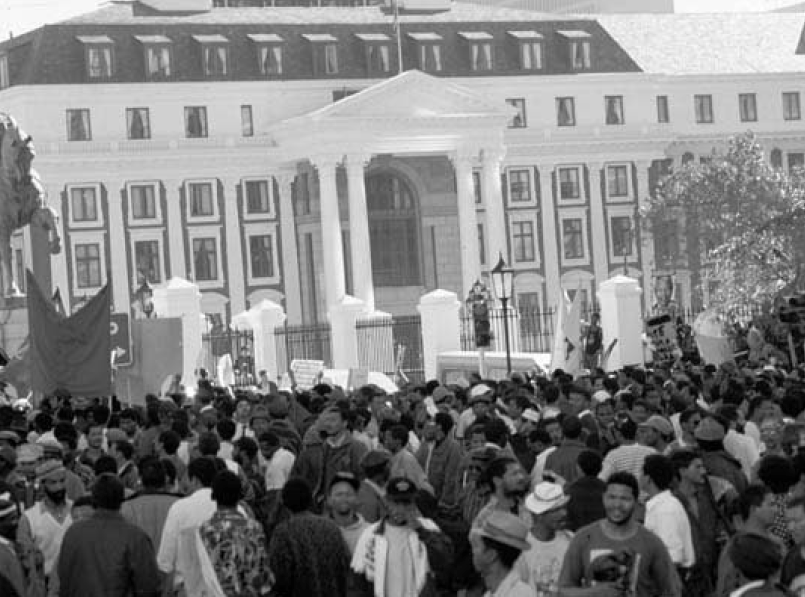
Winter School 2004 discussed the nature and the role of the state in Africa. Since our demands for social services and democracy are often directed to the state and its various arms, it is of major significance that we improve our understanding of the present nature of the African state.
This article introduces key issues and debates that concern the African state such as its emergence and its relationship to the First World, as well as the ideas of democracy and development.
What is the state?
The state is a permanent institution of class domination that is made up of state departments, the courts as well as the police and the army. Its character in any particular country is determined by the pattern of organisation of these institutions and the strengths of various contending social classes. State institutions exercise control over defined territories and populations. Depending upon the balance of class forces, the state can carry out a class agenda by either emphasizing the ideological integrative function (use of media and education) or its repressive arms (army, police and the courts).
Conversely, government refers to elected officers that drive the governance process on a day-to-day basis. Government is ephemeral and changes over time through periodic elections. When people participate in periodic general elections, they are electing a government not a state. There are instances when the role of state and government are not clear, for instance, in military rule army officials run the day-to-day affairs of the country. They make the laws, monitor the implementation of the laws and also chastise those who are perceived to be breaking their laws.
Struggles for independence and the emergence of the postcolonial state
The independence movement in Africa was based on the struggle against the colonial state, white supremacy and the general social and economic oppression of the African people. Though the independence movement did not transform the colonial state fundamentally, the new form of state did, however, make strides to improve the lives of the African people.
After independence, states such as Zambia, Mozambique, Tanzania, and Zimbabwe delivered necessary social services such as education and health to their people. In Zambia, part of the revenue that was generated out of the nationalisation of the mines was used to provide social services. Other states such as Angola, Tanzania, Algeria and Mozambique went as far as experimenting with what they regarded to be an African form of socialism. In Algeria, for example, after its independence from France in 1962, the government implemented what they called autogestion – self- management of workers in factories. Autogestion gave workers the opportunity to be responsible for overseeing their own administration by electing officials from among themselves.
The cold war and the geopolitical interests of the imperialist West have always threatened the positive developments of the independence movement in Africa. After Zaire’s (now called the Democratic Republic of Congo) independence in
1960, for example, America’s Central Intelligence Agency (CIA) and Belgium, fearing the emergence of a progressive nationalist state, installed one of the world’s most repressive and corrupt regimes. The apartheid state, acting as part of the American bloc during the cold war, played a huge role in destabilising African states politically and economically, for example, fuelling the liberation movements in Angola and Mozambique in the 1970s and 1980s. Apartheid helped to make Mozambique one of the poorest countries in the world. South Africa’s apartheid war cost Mozambique more than £11 billion in damages and lost production.
The ascendancy of capitalism and imperialist dominance throughout the world in the 1980s, and the subsequent crisis of socialism, the subordinate role of the African economies and the weaknesses of African leadership all worked to accelerate the regression of the African state. There are two main perspectives that attempt to explain this regression.
The Afro-pessimistic view of theAfrican state
There is a school of thought that argues that the African state is based on patrimonial practices, meaning that those in power use it as an instrument for personal accumulation. This theory of neo-patrimonialism follows that the state has caused war and chaos on the continent. Those who subscribe to this theory are known as Afro- pessimists because they focus on the problems of the African state without necessarily providing solutions for its present predicament.
The radical view of the African state
There are African scholars and activists who note continuing trends from the colonial state into the postcolonial one. They argue that decolonisation was not about structural and fundamental change of society in postcolonial Africa but rather, about replacing white faces with black faces. Therefore the change from the colonial to the postcolonial one was cosmetic because it entailed the appointment of ministers, diplomatic missions and national flags. They also critique the endorsement by the Organisation of African Unity (now the African Union) of colonial borders in 1964 because the resolution did not consider that colonial borders were arbitrarily determined and divided societies that shared common cultures and traditions.
The radical view of the African state also characterises the postcolonial state as a neocolonial state because it remains linked to its former colonisers. The neocolonial economies are controlled by imperialist economies by providing them with raw materials such as minerals at an unequal exchange rate.
The radical view further contends that the bourgeoisie in Africa are weaker than the bourgeoisie from the West, who use them as their agents to accumulate wealth in Africa.
The African middle classes are benefiting from Africa’s subordination in the international arena. They use trade deals, foreign aid and loans from Western countries as avenues for their own enrichment. Unlike the Afro-pessimists, the radical view points out that African workers and peasants will have to struggle against imperialist forces.
Recent struggles by popular classes in Africa are regarded as the second wave of independence. This second wave serves to free the state from being used as an instrument of private accumulation, as well as freeing the South from debt bondage and ensuring genuine democracy by social, economic and environmental justice.
Development and the postcolonial state
Development occurs in a context where the state and the political leadership are committed to the improvement of living standards for the general population. While the Western state serves the general interests of the ruling class, it remains susceptible to political pressure from other social classes, thus retaining some level of autonomy. For example, the working classes in Europe have been able to make some gains out of the state. The distinguishing characteristic of the African state, however, is that it possesses very little autonomy. This is because colonialists used the state to achieve their economic and political ends.
The African nationalist movement that fought for independence did not transform the state fundamentally. Instead, they used it as an instrument for implementing their own narrow agendas such as private accumulation and suppression of dissent. The African elite privatised the postcolonial state. Such a state is unable to mediate in conflict between different social groups and ensure peace and development. It uses violence and the same repressive instruments that were used by the colonial state to suppress those that are seen to be contesting its power.
African liberation leaders – Jomo Kenyatta, Julius Nyerere, Kenneth Kaunda and Kwame Nkrumah – argued that development required a one-party state approach, which would avoid the “confusion” of pluralist and competitive politics.
The western donor community implicitly supported these leaders. Asian countries like Taiwan, Japan, Thailand, Singapore, Malaysia, and China were often cited as examples of countries that had developed as a result of a single party state system. At that time, it was difficult to point out a country which had developed outside of an authoritative state system. Today, the West sees liberal democracy and states that support capitalism as a precondition for Africa’s development.
Democracy and the African state
With the exception of a few countries, a wave of democratisation and multiparty politics has swept through Africa since the early 1990s as African countries strive to match up to Western standards. However, the breakdown of dictatorship in Kenya, Zambia, Cameroon, Burkina Faso, Nigeria, Ghana, and the Central African Republic has not altered the authoritarian nature of the African state. In Ghana, Burkina Faso and Nigeria, the transition from military rule to democracy was accompanied by constitutions that reproduced the concentration of power within the military.
The colonial powers implemented ‘indirect rule’ in rural areas by making chiefs and headmen of various ethnic groups responsible for the running of the affairs of their particular communities. These chiefs and headmen were responsible for collecting tax, distribution of land (which was not fertile), and recruitment of cheap black labour. With few exceptions, the African wave of democracy did not transform the ethnic structures in rural areas. Power in rural areas is still concentrated in the hands of the chiefs, headmen and other traditional rulers.
The recent movement against presidential third terms in Malawi, Zambia and Namibia is an attempt to curb the use of the state as an instrument of private accumulation. According to comrades from these countries who attended the Winter School, presidents Frederick Chiluba, Sam Nujoma and Bakili Muluzi wanted to extend their tenure to keep their hold on power.
Structural Adjustment Programmes and the role of the African state
The structural adjustment programmes (SAPs) of the International Monetary Fund (IMF) and the World Bank were a further attack on democracy and the fragile African state. Balance of payment problems emerged in most African countries in the mid 1970s and early 1980s. Deteriorating agricultural production and terms of trade with industrialised countries, escalating oil bills and high interest rates on foreign debt all contributed to bringing about a problem with the balance of payment and Africa was trapped in foreign debt in the 1980s. The external debt doubled between 1973 and 1977 and almost doubled again in the following four years to US$56 billion according to the IMF’s report of 1982. The foreign debt crisis meant that states had to divert limited resources from social services such as health, education, food, water and sanitation to servicing their foreign debt.
The IMF and the World Bank imposed structural adjustment programmes on the indebted countries in Africa. These conditions included devaluation of national currencies, reducing the role of the state in the economy, cutting down the size of the public sector, privatisation of public companies, elimination of subsidies and introducing trade liberalisation policies. The SAPs meant a fundamental change in the role of the African state.
The African state aided by the World Bank and the IMF led an assault on workers and peasants by cutting wages, agricultural subsidies as well as expenditure on social services. Public and civil society dissent against the policies of the IMF was also attacked by the state in countries like Zimbabwe in the late 1990s.
After a sustained criticism of the SAPs, the IMF and the World Bank introduced the Poverty Reduction Strategy Papers (PRSPs) process and the Highly Indebted Poor Countries Initiatives
(HIPC). The IMF and the World Bank argue that to determine poverty reduction strategies. According to the IMF and the World Bank, the PRSPs are supposed to be a consultative home- grown process within the poor countries, and the state is supposed to use this process to develop poverty reduction strategies within the neoliberal framework of the IMF and the World Bank. The HIPC initiative was established in 1996 with the objective of writing off the debt of heavily indebted countries which had followed the neoliberal prescription of the international financial institutions.
According to the African Social Forum held in 2003, the PRSP and HIPC processes have not positively delivered to the African people. Just like the SAPs, these polices have continued to subordinate the African states to the West and their institutions. For example, in Zambia, which implemented these policies, living conditions for\ most Zambians have worsened, the national debt is now about US$7.2 billion, 47 percent of the national budget is donor-funded, interest rates and inflation are high, and the public service has been cut to almost half over ten years.
Does NEPAD offer the African state and her people anything?
The failed policies of the West such as SAPs, PRSPs and the HIPC Initiative have been integrated into the New Partnership for African Development (NEPAD) policy. Since its adoption in 2001, mainstream media and analysts have hailed NEPAD as a rescuer of Africa. However, a mere browse at its policies reveals that it will not transform the African state to the advantage of the African working class. NEPAD contends that the African state should facilitate the following processes: integration into the globalisation process, privatisation, multi- pronged poverty reduction programmes that are championed by a number of multi-lateral development agencies and donors, support for private enterprise. They also advocate that the African state should commit to developing a shared vision with international business, creating favourable conditions for capital inflows. NEPAD continues to absorb the African state to Western interests and also legitimises the gobbling up of other African economies by South African multinationals. It is acting as a force, which submits the African state to the forces of globalisation.
By Mondli Hlatshwayo
Leave a Reply
You must be logged in to post a comment.