
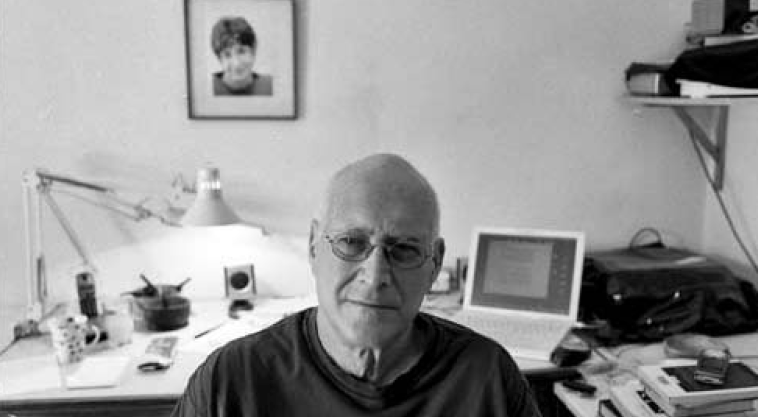
Poet Aharon Shabtai discusses the influence of the Occupation on Israeli culture with Nir Nader (NN)
In this interview poet Aharon Shabtai discussesthe influence of the Occupation on civil society
and on artists, this includes the privatisationof social issues and the co-option of artists.
NN: How would you describe the relationshipbetween today’s Israeli culture and theOccupation?
Shabtai: Israel is a country whose options for change are shutting down one by one. In the past it
had the chance to become a healthy nation-state by settling its relationships with the Palestinians
and the neighbouring countries. Yet the longer it persists with the Occupation, and the more it relies on force,
the narrower are its political options. Israel is turning into a colony under American control, like the former Rhodesia or South Africa
under Britain. Oligarchs and the army rule this colony. The land is a prison. It contains three and
a half million native inmates, who are penned up in territorial cells, in camps and ghettoes, while
Israel implements a racist policy aimed at ethnic cleansing. The prison has special facilities for the
Israeli jailers. These live in bubbles, cut off from the reality of the inmates. We have golf courses,
coffee shops, residences, and cultural institutions for the families of the rulers. In the colony, political
conversation is limited to the economy and security, to questions of how to accumulate capital and how
to eliminate the natives. Today, in a period of global imperialism, politics is privatised. The tools of politics—the media, the
parties, and the unions—whose function is to bring about change, to heal, to repair solidarity, have been
emptied of content and sold into private hands. Culture and higher education are privatised, “free
of politics” – you go along with the consensus. This
is a nationalistic society whose heroes are Ariel
Sharon or Ehud Barak.
The ancient Greeks had a term for the citizen
who cares only for his personal interests and stays
out of political life. The term was idiotes. People
here are idiotai, not politai, citizens in the true
sense. They have no part in political organisation or
in political struggles.
One scholar accused me of debasing the great
love poet, Sappho, who wrote that the most beautiful
thing is not battalions of soldiers, or cavalries or a
navy, but the person one loves. In my poem (below) I
update the theme, offering (with humour) something
that suits our time and Israel: to view working-class
solidarity and freedom as beautiful.
No, Sappho
The most beautiful thing, Sappho said, is the one
you love.
No, Sappho, I say. The one you love will not be
beautiful
As long as a contractor or a corporation or a
manpower company sucks his blood-
For 15 shekels (R25) an hour there’s no future for
beauty.
Let me get the crap they’ve fed you out of your
head.
Anaktoria (a woman) will not be beautiful if
forced to work as a call girl,
Attis will not braid flowers if the plant is shut
down and transferred to Cairo.
Therefore, the most beautiful thing, the
precondition for beauty, is the class struggle.
You were right. Not horsemen or armed forces,
not battle ships,
But the workers’ solidarity, cooperation and
equality
When these will prevail
Then the skies and the earth shall kiss in my
lover’s eyes.
Therefore, also not amongst writers, not in the
university, not in a concert
Will you find beauty today, but in the workers’
union -?
The garbage workers, the garbage trucks,
Sappho, are the most beautiful thing.
(Translated by Adva Levin)
By the way, all ancient Greek poetry is political;
it is the poetry of citizens. In the poem Archilochos’
“Some Saian mountaineer…,” talks, without a blush,
how the poet threw his shield away in the midst
of battle when the fighting got hot. This is a poem
that defines the ethical and civic function of poetry.
Here, the poet overrules accepted heroic values
and exemplifies the right to exercise judgment
and formulate a new principle: the refusal to die a
pointless death is presented as a proper value for a
free citizen.
In today’s Israel, literature and culture have
nothing to do with a civic ethos. It’s a culture of
idiotai, everyone is out for himself, and all problems
wind up on the back of the individual. Privatised
art, deals with the lives of idiotai, and becomes a
branch of psychology. This happened in the United
States too where poetry used to be involved and
activist, especially during the Vietnam War. In a
few short years, after the Johnson Administration
founded the National Endowment for the Arts, it
became poetry of campus writing workshops.
In Israel too, writing workshops are encouraged.
They make up a thriving economic nook in art
therapy, guiding people to adapt themselves.
Psychology has become an ideology. All the
traumas of a society characterised by military
murder and exploitation are internalised,
resurfacing as the problems of the isolated
individual in a nationalistic mass. These problems
are always private; the person becomes a patient.
In this way individuals receive their privatisation
as a gift and everything goes to the clinic. Art as
psychotherapy serves an ideology in which all are
individuals, without a political space: without a
space where personal problems that are political by
nature reach consciousness as such, finding their
true solutions. Art without political space is like
clay that is given to mental patients and children
– those who have no responsibility in relation to
political space are slaves and children. The political
belongs to the citizens, that is, to adults. Nowadays
art and literature keep those who do not want to
grow up, or can not, in kindergarten.
NN: That strikes me, though, as a generalisation.
After all, the Occupation is recognised as a major
issue by the entire Israeli mainstream, including
establishment writers.
Shabtai: You’re referring to intellectuals and
mainstream writers that Nimrod Kamer, calls “the
soft Left”: Amos Oz and David Grossman, for
instance. In their case, the principle of co-option has
applied.
The establishment adopts, co-opts them—that’s
its method. They oppose the Occupation generally,
and this gives them credibility when they support
the regime on every issue of any importance. For
example, they backed the Oslo Accords, the Camp
David deceit of July 2000, the measures taken
against the Intifada, and the second Lebanon War.
The writers of the soft Left do not give literature a
political content: instead of pushing for decision
or action, they sublimate the political into culture.
Even Ariel Sharon and Ehud Olmert said they’re
against the Occupation. The Occupation has
been normalised, a branch of culture, material
for endless narcissistic self-flagellation, for films,
readings, doctorates and academic careers. The
Occupation has been expropriated from the realm
of struggle and squished into a psychotherapeutic
kindergarten. People are fed up of hearing about
the Occupation. For this reason no important
Poet Aharon Shabtai* discusses the influence
of the Occupation on Israeli culture with Nir
Nader (NN)
KHANYA: a journal for activists No. 17: March 2008
— 46 —
KHANYA: a journal for activists No. 17: March 2008
— 47 —
literature has developed in Israel since Oslo.
For literature does have an ethical and political
task. The test of literature is the extent to which
it does or does not cooperate with the regime in
forging a consensus. Culture is an ideological
laboratory, which uses agreed narratives to create
a picture of reality; it invents definitions and
partitions (Jewish/Arab, for instance) that supply
the individual with an identity. What distinguishes
the great writers and poets is the fact that they
create resistance and offer an alternative ethos. In
times of emergency, such writers relate directly to
the political.
Resistance belongs to the essence of life.
Everyone feels the force of gravity, inertia and
friction when he moves forward or acts as an
individual. On the other hand, there is enormous
pressure, open and concealed, to be “a good boy,”
to conform.
A true poet has the courage and judgment to
create resistance in the broad ethical sphere, precisely
where it presses the individual to adapt to the norm.
This puts pressure on his taste, on his standards, on
the language he uses. Under the present barbaric
conditions, which are reminiscent of those that once
prevailed in Germany, Russia, France and America,
writers are required to open their mouths, take a
clear and moral political stance, resist.
NN: Give me examples of some who did this, who
resisted.
Shabtai: Socrates. He stood against his society,
ready to die. The dominant ethical commandment
in Athens was to harm your enemy and benefit
your friend. Socrates does not agree. He gives
priority to what is right: it is better to suffer evil
than do it. After the fall of the Athenian democracy,
the dictators made it their practice to send citizens
to arrest those they identified as opponents or
whose property they wanted to confiscate. Socrates
and four others got an order to bring them a man
named Leon. He refused, endangering his life. He
was saved only because of a change in regime. Later
he was accused of blasphemy and of corrupting the
young, and sentenced to death.
Most of the major writers were oppositionaries
in one sense or other. There are quiet periods when
the opposition is not overt. But in special cases – like
oppression, trampling of human rights, Fascism –
writers must take their stand.
In Israel, they toe the line with the regime. Amos
Oz, Yehoshua Sobol, A.B. Yehoshua and David
Grossman supported the Lebanon War, in which
the air force killed more than a thousand civilians,
destroyed villages, destroyed neighbourhoods in
Beirut. Moments like that test the writer and artist.
One can bring many examples of great writers, and
not necessarily leftists, who refused to cooperate
with their regimes.
NN: Can Israeli Hebrew culture survive in
a region that is Arab, a region so completely
different?
Shabtai: That is of course the main problem.
The Occupation, the army and capitalism are
destroying the country, both the landscape itself
and the human landscape, part of which consists
of the Palestinians, who are rooted here. The
monument that best represents Israeli culture today
is the separation wall, wedged into the nation’s
consciousness and into Hebrew literature. The wall
is the fixation that the literature keeps recycling.
This literature does not function as a means for
creating opposition, as a means for changing life. So
there is no change in life, rather only in lifestyle.
NN: Among the dark clouds you describe, can you
see any light?
Shabtai: If the society has an instinct for selfpreservation,
then change will take place. There will
be revolution. It will happen sooner or later. In this
regard, Israel’s failure in the second Lebanon War
is an encouraging sign. It may sound odd, but the
cries of defeat we hear today are preferable to the
triumphant exultation of 1967. Israeli militarism is
destined to fail in a society of growing exploitation
and poverty.
The revolt of today is not yet political, because
consciousness and solidarity are limited. A few
exceptions exist – for example; some young poets
opposed the Lebanon War. But for now, most of
the young pose no threat to the establishment.
Chauvinism and hatred for Arabs still make it
possible to exploit the young and the poor.
As a writer I work in a system. Poetry is no
private correspondence. It is done within a system
that relates to other systems. Only in this way does
poetry have a function and a place within the public
domain. Within these political and cultural systems,
a debate is underway, thinking is underway, and a
struggle is underway for change and renewal. In the
present situation, the political and cultural systems
do not function. Either you’re a good little boy who
sits in the clinic with everyone else, or you become
a dissident, active from the margins.
* Aharon Shabtai published 18 books of poetry in
Hebrew and prize-winning translations of Greek drama.
Edited and Syndicated from Challenge, Issue 104, July/
August 2007.
Challenge is a leftist magazine focussing on the Israeli-
Palestinian conflict – www.challenge-mag.com.
Leave a Reply
You must be logged in to post a comment.