
Sharon Smith argues that the US anti-war movement should remember that the main enemy is at home and that any resistance to that enemy needs unconditional support.
Resistance increases
The Iraqi resistance to United States occupation is growing, as is its support among ordinary Iraqis. Iraq’s interim government recently admitted that the insurgency involves at least 40 000 ‘hardcore fighters’ and about 200 000 active sympathisers. This is a far cry from the isolated 5 000 ‘Baathist remnants’ and ‘foreign fighters’ the Pentagon initially claimed to be fighting.
According to the newspaper, USA Today, Gallup poll results, conducted in March, the insurgents were gaining broad acceptance, if not outright support. According to the poll, if the pro-US Kurds (13% of the poll), are removed, then more than half of Iraqis believe that killing US troops can be justified, at least in some cases. Support for the resistance has grown with US occupation.
Why support resistance
Iraqis support the resistance against the US occupation of their country for one simple reason: they want the Americans to get out – now. Yet many in the US Anti-war movement have difficulty accepting this black-and-white reasoning. Some see the Iraqis as jihadis involved in a holy war. ‘If we are truly to stop the terrorists, the world must take sides against both,” wrote New Left veteran, Steve Weissman, recently on Truthout.
Weissman’s argument is faulty on two counts. First, Weissman equates the 500-pound bombs and high-tech weapons used by the world’s biggest superpower occupying Iraq (at the cost of $7.8 billion per month) with the rocket-propelled grenades and roadside bombs of those resisting the occupation. One side aims to control Iraq, to fulfill its grand plan to dominate the Middle East and its oil. The other side merely seeks the right for Iraqis to determine their own future. Some 100,000 Iraqi civilians are now estimated dead because of the war and the occupation. Another 1 million Iraqis were killed from the deprivation caused by more than a decade of economic sanctions (under Saddam Hussein). During the Gulf War in 1991, 200 000 died. Choosing sides should not be so difficult. Without for a moment endorsing the tactic of targeting civilians, (used by some), the sheer magnitude of the death and destruction inflicted by the US upon ordinary Iraqis should dispel any myth that the two sides in this war deserve equal condemnation.
Who participates in resistance?
Weissman accepts at face value the Bush administration’s absurd characterisation of the insurgency as dominated by “terrorists” and Islamic “extremists.” On December 15, the Boston Globe published a report by Molly Bingham, who lived from August 2003 until June 2004 in Baghdad, researching the resistance. Bingham observed that the composition of the Iraqi resistance was not what the US administration had been calling it. She said that she met Shia and Sunnis fighting together, women and men, young and old as part of the resistance. The people were from all economic, social and educational backgrounds. Bingham said that the original impetus for almost all of the individuals was a nationalistic one. They all had a desire to defend their country from occupation, not to defend Saddam Hussein or his regime.” Bingham’s conclusion was that the resistance would continue until US influence has disappeared from the Iraq political system. This should help focus the aims of every Anti-war activist in the US.
Beyond abstract principles
Support for the right of Iraqis to resist occupation must extend beyond an abstract principle for the US anti-war movement. While recognising the Iraqi people’s right to resist as a point of principle, Phyllis Bennis (Institute for Policy Studies) argued that people should not support the resistance because we do not know who the resisters are, and what they stand for. However, to be meaningful, supporting the “right to resist” must include support for that resistance once it actually emerges.
The Indian writer and global justice activist, Arundhati Roy, got to the heart of the issue in her speech in San Francisco in August. Roy said: “It is absurd to condemn the resistance to the US occupation in Iraq, as being masterminded by terrorists. If the United States was invaded and occupied, would everybody who fought to liberate it be a terrorist? If we are waiting for the ‘ideologically pure’ movement to emerge, we could be waiting forever. Roy explained that most resistance movements, including the Iraqis, combine a motley range of assorted factions. Hence it was not uncommon for former Baathists, liberals, Islamists, fed-up collaborationists, and communists to part of the resistance in Iraq. Of course, the movement is riddled with opportunism, local rivalry, demagoguery and criminality. But if we were to only support pristine movements, then no resistance will be worthy of our purity. Besides, we prescribe how a pristine Iraqi resistance must conduct their secular, feminist, democratic, and non-violent battle, then we must shore up our end of the resistance by forcing the US and its allied governments to withdraw from Iraq.
Us anti-war movement
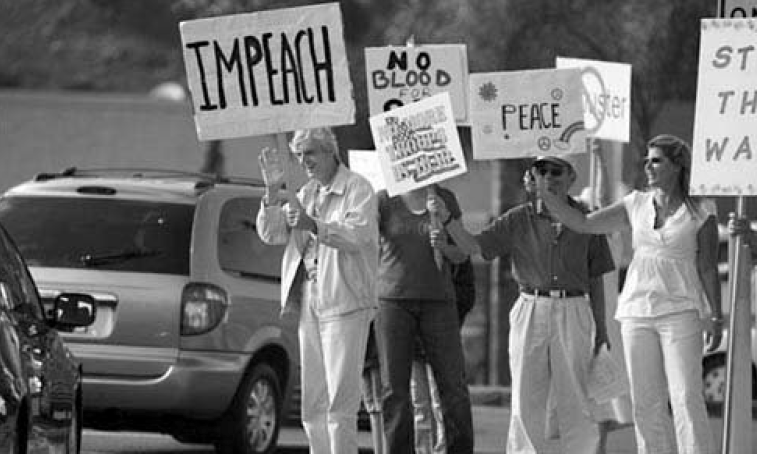
The US anti-war movement should heed this advice and expend less energy on judging the character of the Iraqi resistance and more effort on building a visible resistance to the Iraq occupation from inside the US.
When the US invaded Falluja and the Abu Ghraib torture scandal broke in the spring of 2004, the US anti-war movement was already ensconced in its misguided effort to elect pro-war John Kerry, and declined to mount a visible response to these and other atrocities committed by the US in Iraq. This effectively spared the Bush administration from the need to account for its war crimes.
The main challenge for anti-war activists in the United States is to rebuild a visible, national anti- war movement and support the resistance that exposes US utter hypocrisy. This strategy is not too ambitious since a majority of Americans continue to oppose the war. US troops are also divided, and we need to actively support those troops who, at great personal risk, are resisting.
The anti-war movement must not lose sight of the fact that its main enemy is at home, and that any resistance to that enemy deserves our unconditional support.
*sharon smith is a member of the us International socialist organisation (Iso). syndicated and edited from Socialist Worker, issue 527, 2005. http://socialistworker.org/
Leave a Reply
You must be logged in to post a comment.