
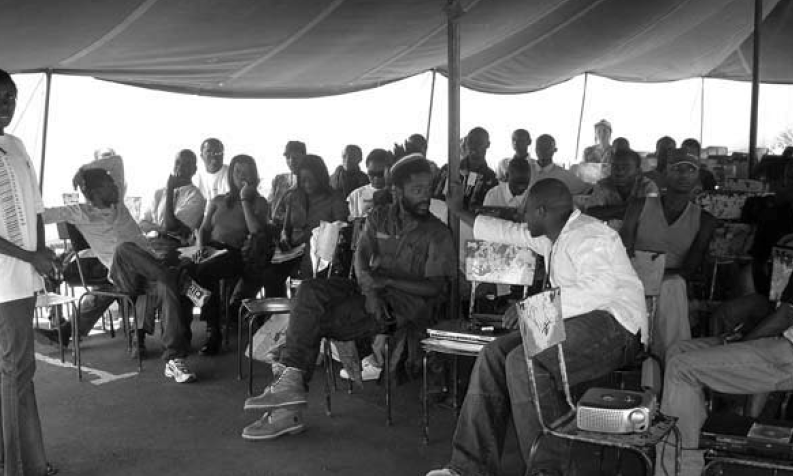
Mzi Mngeni* reviews the recent SASF encounter held in Malawi in october 2006. he argues that the event was politically successful, and that the key challenges is for movements in the region to ensure that they build on this success.
The spirit in which comrades from other countries welcomed South African delegates at SASF has shown that many SADC countries are looking at SA as a role model in terms the manner they take up struggles. The manner at which South Africans behaved in the forum was very encouraging to other people, as they showed leadership qualities without any sign of domination. Comrades at the forum were also shocked to hear radical views against GEAR and the South African government, and this has entrenched their thinking on SA activists as role models.
It is out of this analysis that I believe the SASF was politically successful in general, even though there were minor pitfalls. The fact that many participants could understand that the forum is geared towards activists and social movements sharing experiences of struggle is a great achievement. Moreover, the interaction between movements from different countries and the interaction between activists from different countries was a great experiment. This is not the first time that movements and activists interact or meet in SASF or WSF, but this time it was a different interaction with less NGO’s dominating the proceedings. The notion of Joint Actions (outcome of resolutions at SASF) and joint facilitation at the WSF is also grasped clearly by many comrades in different countries.
What needs to be done is to consolidate, through the networks that we’ve built at the SASF and make sure that we really make use of our networks and take the resolutions that were agreed upon to the WSF. An example of the kind of resolutions we need to take at the WSF is the one that was taken in Porto Alegre, Brazil on the Invasion of Iraq by the US. The resolution led to the organisation of a joint international Day of Action in 2003, which was very successful. It is this kind of consolidation that can be brought into existence if we really make use of our networks.
Achievements and successes
The SASF was great success, especially with the regards to content and politics.
Sessions were facilitated smoothly, except that there was not enough time allocated for the sessions. Translation in many sessions was done smoothly and it did help to accommodate local people.
Resolutions that were taken in different sessions were adopted at the plenary as a general understanding of the Forum. Many of the resolution taken were aimed at informing the preparations for the WSF in Nairobi January 2007. Network building was understood to be the basis of organising the forum, and the aim was to facilitate joint planning for the similar areas of struggles for different countries. This is most the important area that needs to be consolidated, and we need to start from consolidating joint plans with our fellow SADC comrades.
All the resolutions taken at the SASF should also be part of the proceedings and agenda of the WSF in Nairobi, and possibly form part of the broader resolutions of the WSF. The most important thing that came out of the SASF is the resolution on an International Day of Action against Privatisation, to be taken to the WSF. This resolution together with others is the reflection of the state of preparedness to forge solidarity links and actions with each other as SADC and as the African Continent as a whole.
Notwithstanding the success of the SASF, comrades must not think that the new social movements in Southern Africa are strong; they are weak and continue to fight isolated and scattered defensive struggles. Our movements are at an embryonic stage of development and there is unevenness in the nature of the development of the working class between the countries. One can see that in some countries the level organising and struggles is strong as compared to others.
It is out of that analysis that I view the SASF as a success irrespective of the problems that were there. Comrades from the whole SADC region should and will learn from their mistakes, and we need draw many lessons from the 2006 SASF.
Attitude of movements to governments in the region
The impression that I got from the Forum is that while many of the SADC comrades realise that there is lot of corruption among Southern African governments, they still see their government officials as the only channel for transformation. They also see the MP’s as the people who can be recalled and taught about good governance. Many of these countries including some new movements in South Africa still have hope to transform our corrupt neo-liberal governments. The voting system is generally seen as most important site where you can exercise your strength and transform the parties that are in parliaments so that they respond to people’s needs.
Some comrades went further to say WTO, IMF & WB needs to be transformed so that they reflect on people’s needs even though they acknowledge the fact that these institutions are the source or bearers of the neo-liberal agenda. While the emergence of the new social movements is acknowledged, the politics, nature and the character of these movements is not known, hence the direction at which struggles are taken is not clear. This is not only the case in Mozambique, Zimbabwe, Malawi, but it is the case also with South Africa as it is not clear to many South Africans the nature and the character of the new movements. Moreover, the nature and character of this period is not clear to many activists in the Southern African region.
These are some of the issues that emerged in the SASF and we need to engage each other as we are building the movement in this region.
We can only build the regional movements if we begin to consolidate our joint actions through the engagement and interaction built between movements and activists in Malawi.
The Importance of SASF to South African Activists and Movements
We have all known about SASF, ASF & WSF’s in the past, but these forums have never been in our daily consciousness as compared to 2006. What does that mean to us? It means there is great recognition that the World Social Forum is to be held in the African soil for the first time in history. It also means that from all corners of South Africa, Southern Africa and the Continent as whole that there is a great concern about the success of the World Social Forum. The concern is not only with the success of WSF, but also with the way that Southern Africa movements can use the SASF as a buildup to the WSF.
The SASF and WSF’s is not about big politicking only, but a combination of politicking and sharing out experiences in struggles so the we all together are in a position to chart a way forward for struggles and prepare our cadres for future battles. The resolution taken at the SASF should be a stepping-stone and shape the programme at the World Social Forum. International Day of action against Privatisation is one of the major such resolutions that need to inform the WSF.
Conclusion
The 2007 SASF has been a success and a step forward in the sense that it was more inclusive and more social movements were represented, especially from South Africa. The South African delegation was the most social movement orientated with few activists working at NGO’s, and these were also active in their communities. At SASF Malawi there was also great accommodation of the local people, especially unemployed and landless women.
While there were a number of loose areas and weakness in organising and coordination the Malawi comrades need to be saluted for making the 2006 SASF a success. The 2006 SASF has achieved its task and it is up to us to consolidate the outcomes and resolutions taken at the SASF. It is out this analysis that I believe that the manner in which Malawi SASF took place is evidence that together we can change Southern Africa.
*Mzimasi Mngeni, is Co-ordinator of the SMI in the Western Cape.
Leave a Reply
You must be logged in to post a comment.