
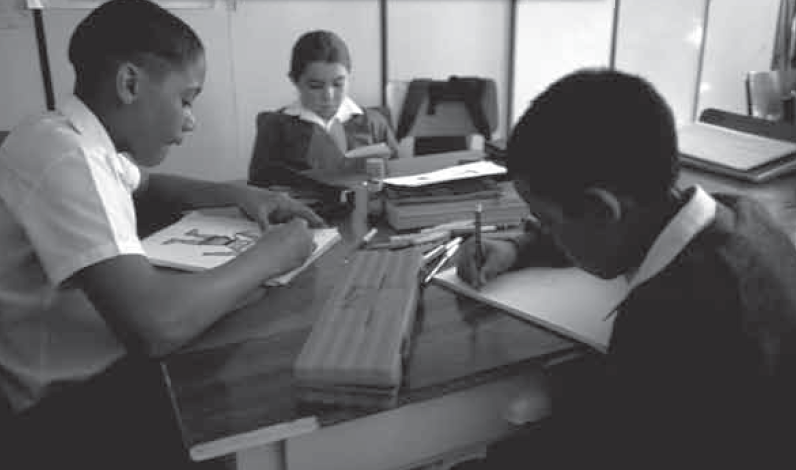
Tshepo Nkosi puts the arguments for and against outcomes based education. This article is partly based on a discussion Tshepo held with school students about their attitude to outcomes based education (OBE)
Outcomes based education is practiced in all South African public schools from grades 1 – 9. The OBE is supposed to be about learning and teaching which does not just lead to students knowing things, but also learning and gaining useful skills.
OPPOSITION TO OBE
Most of the students who are against OBE say that it is a waste of time and energy because learners and teachers in classrooms achieve very little through OBE. Students pass when they show obedience and respect to authority and not by working hard on their sums or writing or reading.
The truth is that people need more than respect to get through life. To get to higher education or to get a job one must be able to read and calculate complex things. One will not be able to do this with the minimalist and simplistic projects coming out of OBE classrooms.
Learners also say that in OBE it is the teacher who decides whether a student goes to the next grade. Teachers often make the decision to promote a student even when such a student is unable to calculate simple sums. It appears that simply because the learner is showing interest, determination to succeed and a lot of respect she or he is promoted to the next grade.
The problem with such a ‘pass one pass all situation’ is that students are getting the idea that they do not have to work for their marks, but that they will always be pushed to the next grade. This is not helpful because sooner or later students will have to write a matriculation examination where real thinking, writing and reading skills are needed, and where subject content knowledge is needed to succeed.
SUPPORT FOR OBE
Not everyone disagrees with OBE. Some students believe that OBE is a positive development, for a number of reasons. For one, OBE opens up many opportunities to students, which were closed, to them in the past. OBE tries to instil hope and a positive attitude towards learning, and this goes a long way in helping students stay in school and to do well.
Those who are in support of OBE say that since it started being taught, their schooling career has become easier. They can read, understand and work better. They also feel that the OBE curriculum has a better self-image because it builds on what they already know rather than the traditional curriculum that emphasises what students do not know. The students also say that it is to be expected that there will be some problems with OBE because it is a new way of teaching and learning, and that OBE needs to be given a chance to grow.
CONCLUSION
At the end of this year we will see how far OBE has come. This year will be the first in which the ‘products’ of OBE will sit for the matriculation examination, and their performance will be an example of whether OBE is moving in the right direction.
Tshepo Nkosi is a member of the Soshanguve Community Development Forum (SCDF). He is also active in the Anti-Privatisation Forum education sub-committee
Leave a Reply
You must be logged in to post a comment.