
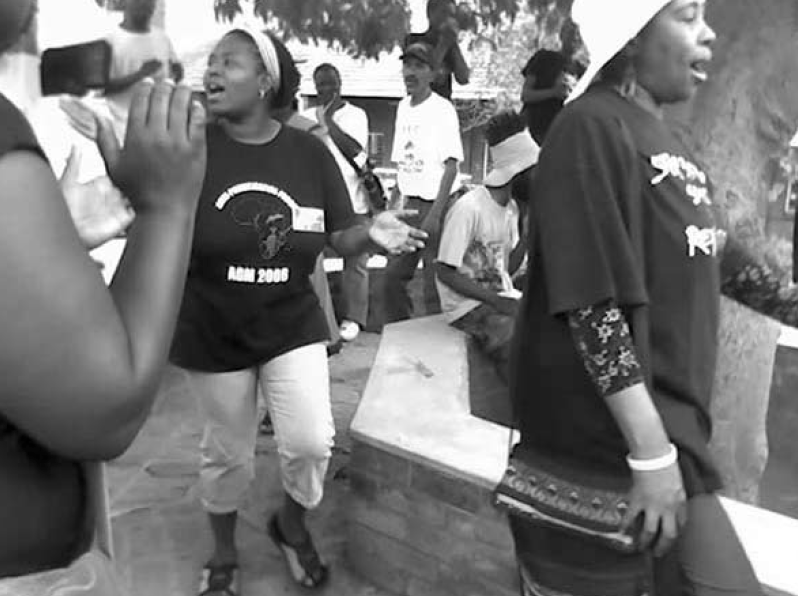
As part of the preparation for the WSF in Nairobi, 13 organisations came together in Johannesburg, South Africa, to exchange experiences on approaches to mobilisation against the hIV/AIdS pandemic. Nina benjamin* reflects on the workshop and on the plans for the WSF.
Early in October 2006 20 activists from 13organisations come together to exchange experiences on mobilisation against HIV/ AIDS in an African context. The activists were from South Africa, Kenya, Niger and the DRC. The aims of the workshop were :
- To share our experiences of organising around HIV/Aids
- To discuss forms of social mobilisation and com- munity responses to HIV/Aids that people in Africa are engaged in
- To discuss the role of the WSF in Nairobi 2007 in addressing the issue of HIV/Aids and social mobilisation
- To discuss possible joint strategies for taking up the issue of HIV/Aids at the 2007 WSF
HIV/Aids and Social Mobilisation
The participating organisations in the workshop brought together a number of experiences in dealing with mobilisation and HIV/Aids. A central feature emerging from the discussions was the importance of creating a caring, supportive environment for people infected and affected as an important starting point in the process of raising consciousness and preparing people for taking action.
Creating a “family” was the concept used by some of the organisations when describing the importance of creating a supportive and caring environment. There were a number of ways this “family” was being created. For some organisations people infected and affected were being brought together in survival projects. Most of these projects are being formed by women. The experience of the Kganya Consortium, Vukani (both from Johannesburg, South Africa) and to a lesser extent the Community Networking Forum (CNF) was that in an environment where the women feel a sense of collectivity and solidarity, where they are sharing common experiences and importantly where they feel that they are engaged in productive activities, there are more possibilities for disclosure of their HIV status. The Kganya Consortium experience highlighted how through this process women begin to feel more confident in speaking freely about their HIV status and begin to identify themselves as community activists.
The KENWA (from Kenya) experience also highlighted the importance of a supportive environment in the work towards lobbying and advocacy. A combination of providing care and support to those infected is seen as important
in involving those affected and infected in the lobbying and advocacy work.
When sharing their experience as HIV positive members of the Treatment Action Campaign (TAC), the participants from the TAC at the workshop indicated that central to their joining the organisation was the feeling of being part of
a supportive “family”. Engaging in the multi- strategies of the TAC i.e. civil disobedience, street demonstrations, use of the courts, pamphleteering putting up posters, meetings, street activism, letter writing, running a treatment literacy campaign which offers advice to people undergoing or administering treatment or being involved in a treatment project that provides medication, was from the starting point of being part of a supportive environment.
Participants at the workshop engaged in a critical analysis of the Anti-Privatisation Campaign’s (APF) (from Johannesburg, South Africa) approach to intervention in the HIV/Aids epidemic. There was a feeling that engaging in a research process as a starting point had the dangers of creating a sense of looking at the epidemic from a distance while many people in the organisation were infected or affected by the epidemic. It was felt that any research process would need to go alongside wide scale awareness raising in the organisation and the creation of a culture of openness. This could only take place through creating a supportive environment in the organisation. An important lesson from the APF experience was that the mobilisation work would need to start with the creation of a space that allowed individuals to feel secure as individuals and as a collective with the willingness to share experiences and develop strategies appropriate to their different contexts.
What to do about the Government? This was an important discussion in the workshop. LoveLife, a project of the South African Government,
came under severe criticism. All the participants (including the representative from LoveLife) felt that the South African’s role in the HIV/Aids epidemic is nothing short of criminal and that the creation of organisations like LoveLife was to perpetuate the idea that the spread of the epidemic was the responsibility of the individual only and that for Government there was no epidemic, and to justify the government’s unwillingness to spend more on public health. LoveLife awareness-raising was also seen as an attempt to remove any analysis of the socio-economic conditions within which the epidemic is spreading. For some participants LoveLife’s focus on sexual relations without locating these within power relations made the LoveLife campaign a very expensive failure. The
tactical approach to organisations like LoveLife was to publicly raise the problems with the campaign during the process of conscientising the youth
about the pandemic.
Organisations like Lungelo (Jhb, SA)and Vukani raised the importance of strengthening our analysis of how sexual relations need to be contextualised within unequal gender power relations and how this intensifies the spread of HIV/Aids. For these organisations mobilisation to deal with the HIV/ Aids epidemic involves addressing the patriarchal gender relations. Like KENWA and the Kganya Women’s Consortium, women are the key constituency of Lungelo and Vukani. To summarise their key contribution to the workshop: “mobilising against HIV/Aids means the empowerment of women to address patriarchy”.
An important debate about the differences in the response of the Kenyan and South African governments was highlighted. In Kenya, even under the dictator Moi, Aids was declared a national emergency and the government put steps in place to treat the epidemic as an emergency.
In contrast the South African government has remained in denial about the proportion of the epidemic. This has sent very mixed signals to the population and the participants felt that these
mixed signals were playing an important role in the rapid spread of the virus in South Africa. Part of
the mobilisation strategy was to intensify pressure on Governments to recognise the spread of HIV/ Aids as an emergency and to use state resources for prevention and to deal with infections. This would mean campaigning against the cut backs in social spending specifically health budgets.
From their local experience Alternatives, Niger raised important ideas for communication and awareness raising. The comrade illustrated how
using popular media like community radio was important in allowing illiterate people who in many instances are impoverished women, the opportunity to raise awareness about health issues like HIV/Aids and to begin to claim their rights
as infected and affected people. Exploring these
forms of media was identified as central to any mobilisation strategy.
Strengthening the focus on HIV/Aids and Social
Mobilisation at the World Social forum
- At the workshop a presentation was done on the WSF process. The points of preparation for Nairobi are as follows:
- Participation in the HIV/Aids discussion in
the Southern African Forum (SASF) in Malawi. Three participants from the workshop will be attending the HV/Aids discussions at SASF and will share the experiences of the workshop and prepare a report that will be circulated.
- Comrade form KENWA will follow up on the work being done in Kenya and this will be cir- culated to the participants who were part of the workshop.
- Participants from the South African organisa- tions will continue with their preparation lo- cally. This process will be led by the TAC.
- Two comrades from South Africa will partici- pate in the Niger Social Forum and share some of the reflections from the workshop.
- Comrades from the workshop will consult about a joint presentation on HIV/Aids and social mobilisation at Nairobi. This will be done in consultation with the Kenyan HIV/Aids groups.
*Nina Benjamin works at Khanya College and is the Coordinator of the Strategy Centre for Social Movements. the Centre is responsible for facilitating the workshop and the preparations of the HIV/AIDS groups for the WSF.
Leave a Reply
You must be logged in to post a comment.