
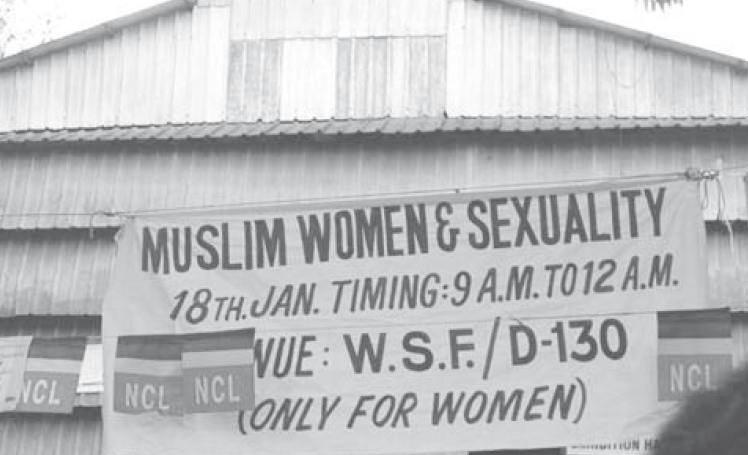
Carol Barton* analyses feminist inter- ventions at the WSF in Mumbai, and argues for the need to intersect feminist struggles and analyses with class and race politics.
Speaking from the perspective of the global feminist movements, driven primarily by women of the global south, it is our conviction that the World Social Forum is a critical space for global feminist organising. Despite multiple debates about its limitations, the WSF is a unique space for resistance to neo-liberalism and imperialist war, and privatisation. The WSF is an open, democratic space of competing ideas, and it may yet become a space where we combine the protest of Seattle or Cancun with our visions for an alternative world. Our conviction comes from our understanding of the need to get beyond the limits of the UN arena on the global level, or local organising, to build a global justice movement that demands accountability of the state, multilateral actors and transnational corporations.
It is our premise that feminist analysis is central to an understanding of the current period. It is clear that the ideological roles of women as symbols play a central role in the justification for war and imperialism.
At the same time religious fundamentalist groups use gendered images to reassert control over women’s lives. For instance when Laura Bush is used to justify war in Afghanistan to “protect women’s rights”, or when women representatives on the Iraqi Governing Council were paraded at the UN as signs of women’s equality in post war conflict. Yet occupation and warfare continue and the strengthened Shiite leadership seeks to impose Sharia religious family law on Iraqi women that will set them back 50 years.
Our Goals
Thus, feminists enter the WSF arena with several goals:
- To re-politicise feminism itself, and to create a space, separate from the UN or other state and multilateral venues, for international feminist dialogue.
- To mobilise feminism to link concerns about “body politics” and violence with macro- economic policy and confronting imperialism. This was dramatically evidenced at the WSF, when 50,000 gathered for a conference on Women Against War, War Against Women, or the panel on women and globalisation.
- To mobilise colleagues in the global justice movement to take seriously a feminist analysis as central to all of our analysis of neoliberalism and imperialism.
Building an international movement
As the WSF went global, in Mumbai we had a two-pronged strategy. We moved from a Latin American-centered initiative to the creation of an international planning group, representing international networks as well as regional networks from Africa, Asia and Latin America. Over eight months we planned a two-day Feminist Dialogue prior to the WSF for about 150 women from around the world, and collaborated on several major events at the WSF itself. Most significant of these was an “Inter-movement Dialogue” with leaders from feminist, Dalit/anti-racist, LGBT and Trade Union movements. The goal was to explore what it means to come into a broader social movement, keep our agendas, and influence the broader agenda while being open to the concerns of other groups.
The Importance of Mumbai
Mumbai was a whole new reality for the WSF, because:
- It brought in masses of poor and marginalised people and shifted the WSF from a think- festival of intellectuals to a mobilisation of many movements
- There were attempts to concretise alternative visions, like that of IBASE and the Rosa Luxembourg Foundation, exploring alternative models.
- Indian feminists demanded that feminist concerns be center stage, with one central theme and several mass events on Patriarchy
- The reality of India took us out of a protected space and forced us to confront the effects of neo-liberalism head-on
- There were many strategic efforts to come up with concrete action plans, including organising on water rights, anti-war organising, Rainbo Planet, etc, with the ongoing affirmation that the WSF is an open space which will not itself take positions. That is, concrete outcomes are emerging through multiple processes within the WSF, and do not need to be done officially.
- The process has now become internationalised, helping to shift the center of gravity from Brasil and Europe, while not losing that leadership.
- The process challenged the primacy of NGOs and made clear the role of political parties in this process, without destroying the WSF as some had feared. We need to affirm both NGO leadership and the (unofficial but real) leadership of political parties, while being honest about power and resources.
- The project right now is to figure out how to bring multiple movements together in a way that continues to recognise the significant role of traditional left parties and trade unions, while challenging undemocratic tendencies and a history of exclusion of gender and race analysis from the agenda. How do we do this without trashing the left, or ending up in identity (individualistic) politics? How do we do this without trying to recreate an International with a top-down central committee? Signs like the inter-movement dialogue, as well as the Rainbo Planet are hopeful glimmerings that feminists, GLBT and Dalits and racially marginalised groups might become essential parts of the global justice movement. We might be able to discuss visions of “another possible world” not only from their identity vantage point, but as part of a global justice movement that values and takes seriously our perspectives and contributions, as well as our concerns about historic marginalisation.
Some concerns and critiques:
- Feminists need to embrace a race and class politics in analysis and in who is part of the movement. The central agenda of reproductive rights, abortion, violence and sexual rights must be linked to working class concerns without getting sidelined. In Mumbai it was not the feminists, but Rainbo Planet, which pulled this off. Organised by South Asian activists, the issue of sexual rights linked LGBT activists, hijra, sex workers, people with HIV/AIDS and health workers. They called for sexual rights and the “right to be in public space without shame.” They took on working class issues of sex work and access to healthcare in this context.
- In contrast, our feminist project still felt like an elite crowd with an elite agenda, while tens of thousands of Dalit and poor Indian women mobilised around caste, the right to water, agriculture, the WTO, etc. Where and how do we make the connections effectively?
- Our own coalition, WICEJ, has pushed to affirm macro-economic issues as part of a feminist agenda, taking on neo-liberalism, the World Bank, IMF, WTO and transnational corporate policies, and their implications for poor women and communities around the world. We entered this alliance with sisters focused on body politics because we see these themes as part of one human rights agenda, one social change agenda, which must be integrated. We discovered that there is both great international solidarity in working globally, and also a long way to go in getting beyond regional visions and issue-specific agendas, as well as race and class divides.
- We can’t just be knocking on the door of the WSF’s International Council demanding inclusion of our agenda. We need to shape that agenda in a way that creates dialogue across sectors and builds an integrated analysis.
Carol Barton* is an activist based in the uS. This is an input to the Socialist Scholar’s Conference, Cooper union, New York City, March 13, 2004
Leave a Reply
You must be logged in to post a comment.