
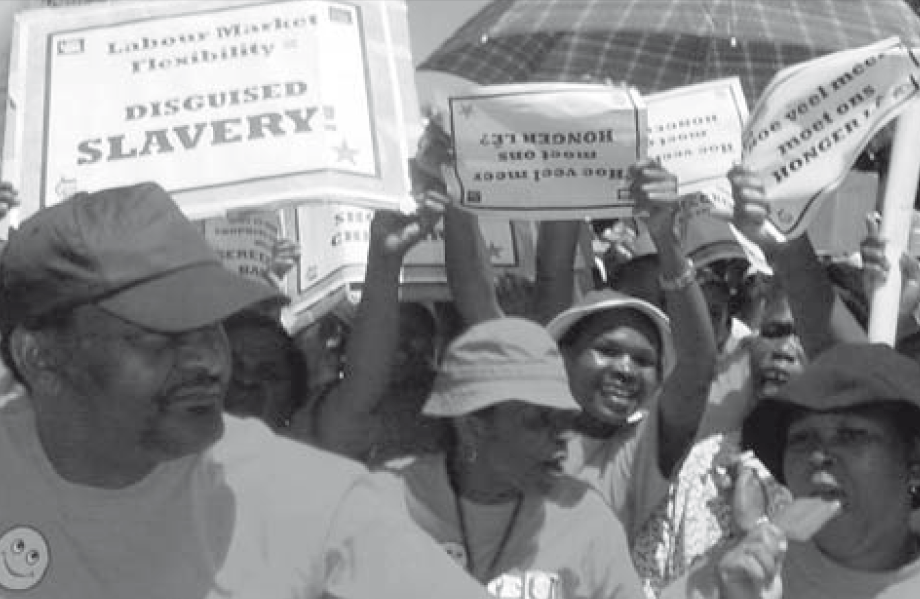
Launching the largely neo-liberal ANC election manifesto in pietermaritzburg, thabo Mbeki told the cheering crowds:
“Our people know that if I don’t have a job now, I will have the skills to have a job”.
Jobs? The formal sector has been losing jobs on a huge scale for years, and most of the supposed gains in have taken place in the informal sector. Of course, the informal sector is so beloved of the employment World Bank and others who aim to shift the responsibility for poverty more firmly onto the poor. Duma
Gqubule, writing in the Financial Mail, observes that “According to the March 2003 LFS (Labour Force Survey), 14% of informal sector workers earned nothing and should be reclassified as unemployed; 54% earned less than R500/month; 75% earned less than R1000…At worst the informal sector is near slavery or disguised unemployment. At best its underemployment.” When a magazine that crusades for the free market and GEAR speaks the language of the ‘ultra-left’ it’s clear that it takes a lot of work to deny that we are living through a deep social crisis.
A government of the rich
At the rally Mbeki said nothing about the stark empirical fact that in 1996 the ANC became the first African government to ever voluntarily seek the help of the World Bank to design and impose a structural adjustment programme on its people. Markets were opened, taxes to the rich were cut, state assets were privatised, services were commodified and social spending was reduced. The results came quickly. The economy began to grow and the rich got richer. Nicoli Natrass points out that capital, by restructuring and downsizing their workforces, has increased profitability. “Overall, the net profit rate for the private economy (that is, all economic sectors excluding community, social and personal services) was two-thirds higher in 2001 than in 1990.” The profits that did trickle down went to a smaller and smaller group of workers while most of it was ‘spirited’ out of the country. As the government’s own statistics reveal, the poor got significantly poorer and unemployment reached catastrophic levels. There was a rapid erosion of the local manufacturing economy, particularly the textile and clothing industry. Tariff barriers were dismantled at a faster rate than international norms required and cheap goods produced under regimes of terror in East Asian sweatshops flooded the country.
Although the black elite became rapidly richer and the white poor became rapidly poorer the fact is that in general whites got richer and blacks got poorer. The government’s own statistics agency concludes that in real terms, average black `African’ household income declined 19% from 1995-2000, while white household income was up 15%. Across the racial divides, the poorest half of all South Africans earn just 9.7% of national income, down
11.4% from 1995.
The ANC seeks to win consent for its policies by the twin ideological strategies of the particular discourses of nationalism – with their demand for obedience to the leaders and the party, and the universal discourses of neo-liberalism – with their demand for obedience to the market. Sometimes they are combined in novel ways like the government’s Masakhane campaign that claimed, clean water, resulted in the return of cholera. The 2000 cholera outbreak killed some 200 people and infected over 80 000. The South Africa government dutifully followed the World Bank’s ‘initiative’ and launched a campaign to persuade poor people to wash their hands more often. So people who had been forced, often at gun-point, to seek water in rivers and gutters and ditches, were sternly told by Nelson Mandela, in a television campaign, that they are getting sick because they are not washing their hands.
Then there was the State of the Nation address in parliament. It is common knowledge that the two biggest challenges facing South Africa are AIDS and unemployment. In now typical fashion both were only mentioned once. And the context was ominous: “Many of our people are unemployed…the burden of disease impacting on our people, including AIDS, continues to be a matter of serious concern, as do issues that relate to the fact that many of our people, including the youth, lack the education and skills that our country and society need.”
Once again Mbeki was careful to place the AIDS pandemic on par with other issues. And of course he offered no analysis of the fact that, despite its projections, GEAR has failed to create jobs.
*Ashwin Desai and Richard Pithouse argue that in the10 years since 1994 the ANC has proved to be a government of the rich, and that it is time for popular mobilisation and new ideas.
The decline of parliament
Ten short years after the ANC swept to power on the back of the great tide of mobilisation there is a deep seated ‘disrespect’ for that very institution, parliament, that we had placed so much hope on. Very few of us have any real confidence in political parties.
The majority party, the ANC, has absolutely no respect for organisations that are not in an alliance with it and refuse to kow-tow to its dictates. Its response to doctors’ march on parliament is just one more example of a party that arrogates to itself the monopoly of all truth. Manto Tshabala- Msimang’s return to her lemon juice and olive fantasies, and Nkosazana Dlamini-Zuma’s scurrilous defence of the crushing of remaining press freedom in Zimbabwe, are further indications that we are dealing with a political elite gripped by in the language of Ubuntu and in the context of entrenched and worsening unemployment and poverty, that the good person is the person who pays for services. And then there was the government’s WASH campaign. In South Africa, as in other countries, mass exclusions from access to megalomania.
The ANC has no stomach for opposition. In the Western Cape it is in alliance with the Nats, at the national level and in KZN it is in alliance with the IFP and the Minority Front. At the same time COSATU and the SACP form part of a separate alliance. So the DA is in cahoots with the IFP, the IFP is bed with the ANC and the ANC is in a simultaneous alliance with the NNP and the SACP. No wonder the ANC is referred to as the African National Consensus. Our benediction is ‘One Nation’, ‘One Leader ’, and ‘One Soul’ in ‘One GEAR’.
Why do we have to wonder why people are cynical about the vote, when those we vote for can simply cross the floor? When those we vote for never report-back to their constituencies or bother to listen to the people they purport to represent. How can we not question the whole machine of politics that churns out these pathetic little politicians who pretend to be the carriers of human interests?
Isn’t it strange how before the elections our vote supposedly has such immense value again? One of the reasons politicians can even bear to govern us in these brutal, structural terms is because the revolution has not happened in their hearts. None of them has had their psyche altered by liberation.
Mbeki, Leon, Buthelezi, Ginwala are all cut from the same sari. They do not live in a state of passion. We see them on TV, the living dead, lifting their hands with as much independence as docile sheep. At least there are some surprises (and passion and risk) on the game shows where people make their own decision about when to press the buzzer.
Popular mobilisation and new ideas
Capital and the state have clearly run out of ideas. They have to come from elsewhere. It is because of TAC that the AIDS was placed so high on the national agenda. It is because of Jubilee South Africa that the issue of reparations continues to be a struggle. It is because of organisations like the APF that evictions and electricity and water disconnections are resisted. It is environmental organisations that have raised the ante on the destruction of the Wild Coast and the oil companies that give us cancer and asthma. It is the LPM that has challenged the lie of land redistribution. In all of this do you notice how political parties have been largely absent? It is here the nation has come alive and fought to broaden our democracy.
Is not the present conjuncture a time to imagine once again? There are histories and traditions to be drawn upon in our recent past. Was the UDF not pointing in a promising direction when it declared: “Not only are we opposed to the present in many ways the beginnings of the kind of democracy we are striving for.”
Is it not time to take to the streets and demand a reform to the present system of governance? What is the role of the National Council of Provinces?
Provincial governments? What about a constituency based system? What about real ‘local’ government? What about issuing challenges to authoritarian managerialism in the universities and the factories and the newsrooms and the NGOs?
If the government is going to spend millions on skills training to create jobs shouldn’t we take ten streets in every township, make lists of the skills
on offer and institute a system of exchange? Doing the plumbing in return for school uniforms being sewed? Child-care for fixing a leaking roof?
It is up to us to build a better life.
This is a shortened version of their article.
Leave a Reply
You must be logged in to post a comment.