
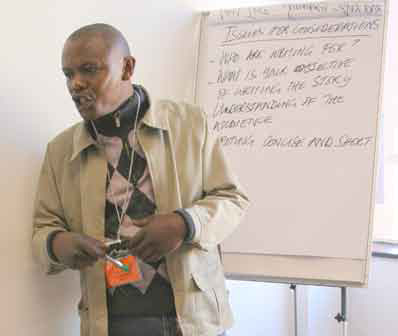
Bonagni Bunyonyo* reports.
Writing Skills and Movement Building:
Write your own stories
The workshop was attended by 15 delegates from different organisations. The workshop focused on two aspects, the technical and the political part of writing as social justice activists. Most of the discussions focused on the need for activists to develop the skill of writing so that they can write stories and articles about their own experiences as activists and the communities they come from.
Technical aspects
There were certain elements that were identified that the writer should take into account before writing. The writer must have a structure of the subject matter that he/she wants to share. He/she must be able to identify the target audience and how the message would reach the audience. There is a need for activist writers to edit their work. This will assist in ensuring that the message is not compromised.
The workshop also discussed what is expected from the writer when writing for different publications such as newspapers, journals, newsletters and pamphlets. Activist writers can also put food on the table by writing for commercial newspapers. There was a debate on whether activist writers should compromise the content of their pieces to meet the requirements of editorial boards of commercial newspapers whose main objective is to make profit.
Activist writing
Participants identified the need to write the stories and issues that communities are struggling around. This intervention is necessary because activists and their communities are best placed to write about their experiences and the histories of their societies. In many instances the stories of working class communities are written by people who do not reside in those communities.
Orientation
The writing of activists must be biased towards advancing and articulating the interests of their organisations and communities. Sharing of experiences by communities through the art of writing also promotes solidarity between struggling communities. Through the sharing of experiences, activists from different communities and organisations learn from each other and generalise their experiences.
The writings of social justice activists should promote the culture of critical reading and discussion in the organisations and communities. This also means that organisations must create a space in their organisational structures for free debate and tolerance of different views. By so doing the organisation should be able to handle conflict and ensure that everybody move together.
Conclusion
The discussion on the importance of writing and the need to develop activist writers in communities was very interesting. Participants recognised the absence in communities of community writers and this results in stories and events in communities not being told or recorded. This robs communities of their histories and heritage. Community newspapers in areas where they exist, do not reflect issues of concern to the local community or are written by people coming from outside the communities.
This is also compounded by the fact that organisations are weak and do not have resources to produce their own newspapers. Participants understood the need to have their own media teams and produce their own newspapers or newsletters. Community organisations should link up with progressive NGOs that can assist in developing a layer of activists trained in media skills. There are still some organisations that access funding and offer such services to communities.
Although participants started from different wave lengths, everyone shared the same vision of the role of writing in movement building and the role of activist journalists in building strong social movements.
Leave a Reply
You must be logged in to post a comment.