
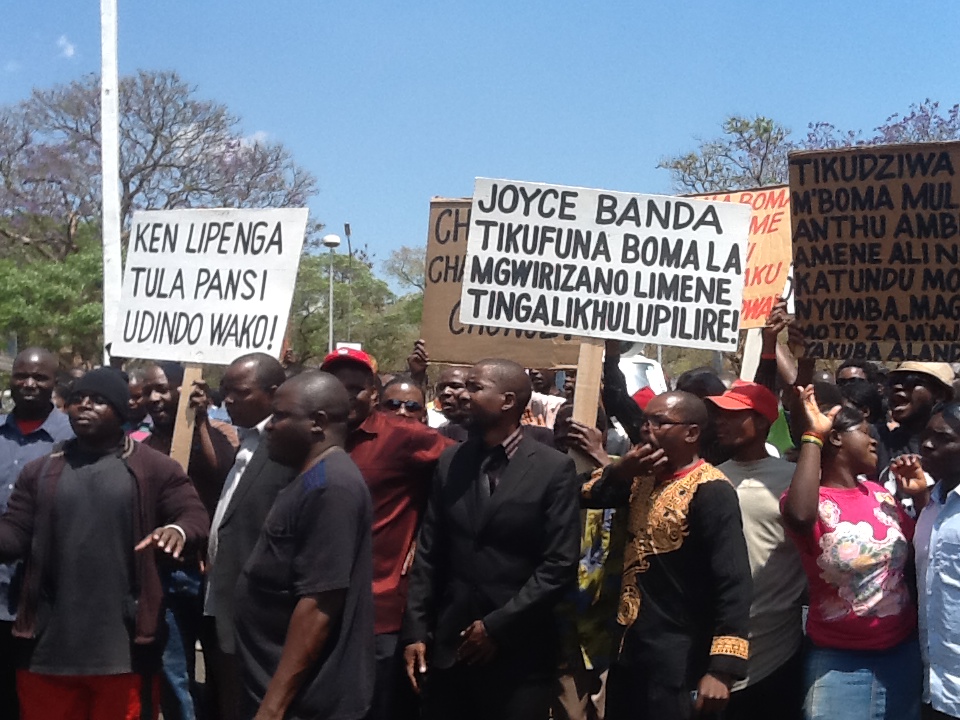
Grace Chawezi Hara* gives an account of the mass demonstrationd that took place in Malawi in July around issues of poor governance and economic injustice
Malawians take to the streets
On July 20 2011, Malawians took the world by surprise when they staged mass demonstrations across the country. What had always been seen as a peaceful country exploded, much to the annoyance of the country’s leaders who always paint a good picture of the nation to the outside world.
Poor governance and economic injustice
The truth is that people had enough and it was now time to act. Civil society leaders together with the blessing of some opposition political party leaders and faith leaders, had been preparing for the July 20th peaceful demonstrations for months. Luck seemed to have been on their organisers’ side as a majority of the people in Malawi supported the demonstration against poor governance and economic injustices.
Government’s role
All along government used the state owned television and radio to trash the peaceful demonstrations. The government paraded traditional leaders and leaders of defunct non-governmental organisations (NGOs) to speak against the march. Similarly, press releases were issued in the press by the Minister of Information against the march.
In an attempt to make the civil society leaders conform to their plans, a group called the Concerned Citizens announced that they were going to march in support of the government on the same day. The funders of the Concerned Citizens are unknown but they had access to state owned media while civil society organisations had to use the independent media for publicity.
Malawi became the centre of attraction on the 20th of July because two major events were expected to happen – the peaceful demonstration and a public lecture on issues affecting the country by President Bingu wa Mutharika. While the public lecture was open for everyone to attend, civil society leaders chose to stay away. The venue for the lecture was State House in the capital city of Lilongwe, and in such an atmosphere people would not have been free to ask questions and offer solutions to the problems facing Malawi.
Court injunction
As Mutharika met with his cabinet at State House, thousands of people gathered in Malawi’s cities dressed in red, ready for the peaceful demonstration. The demonstrators had met all the needed formalities and the police had also promised security to the marchers.
But to everyone’s surprise there was a heavy police presence in all the townships and some blocked the roads and told those dressed in red to go back home and listen to the president’s public lecture on television. It was also announced that a little-known man called Chiza Mbekeani had obtained a court injunction to stop the march at midnight. The marchers were annoyed and wanted to proceed despite the injunction. Concerned lawyers went to the High Court to have the Injunction lifted.
Violence
Meanwhile the marchers’ patience was tried and they clashed with the police who tried to stop the demonstration. Some police were stoned and overpowered. Government-owned shops and businesses belonging to ruling Democratic Progressive Party’s (DPP) property was looted and burnt.
What was supposed to be a peaceful demonstration ended up being a day of bloodshed, violence, teargas, arrests and the loss of property. A total of 18 people died in Malawi, with the highest number of deaths (11) in the Northern Region. President Mutharika condemned the looting and the damage to property.
Rights violated
Meanwhile, a number of international and local organisations have condemned the DPP-led government for its continued abuse of human rights. Despite pledging to safeguard the constitution of Malawi, President Mutharika has been in the forefront of denying people’s right to assembly and freedom of expression. Mutharika has ordered all organisations that intend to hold any demonstration to pay Malawi Kwacha 2million.
Leave a Reply
You must be logged in to post a comment.