
ANC Government Responses
Struggles and responses
Throughout 2009 the working class in communities across South Africa has been engaged in struggles. Prior to these working class community struggles that forced themselves into the public news, communities engaged different levels of government through meetings and in some instances protest marches that culminated in the submission of memorandums that summarised community demands. Due to the failure of the state to meet the demands and concerns of working class communities, working class communities embarked on different methods of struggle to realise their concerns and demands. One of the methods common in all the recent community struggles is the blockading of busy roads and creation of barricades with burning tyres and stones. These direct methods of struggle forced those in positions of influence – from media to the different levels of government and also the ruling party, the ANC – to pay attention to and engage with the community struggles and their demands. The engagements by the ruling party have taken various forms, from acknowledging that communities’ demands and needs are real, agreeing to some of government failures and initiating various reviews of their systems, to insisting that the police must maintain law and order and condemning militant forms of struggles. In what follows we briefly summarise some of the demands that came out of these struggles and also look at the ANC government response.
The demands
2009 witnessed a record number of service delivery struggles nationally. The demands flowing from these struggles can be categorized as follows:
- Decent houses, in response to lack of housing and shoddy small houses built through state housing subsidy. Some communities have also called for an increase in the size of the house and plot.
- Provision of services like water, sanitation and electricity. These demands feature in all the struggles that emerged in many informal settlements in the country. Some in certain informal settlements, for example in BT sec- tion in Khayelitsha, Diepsloot Extentions One and Seven, also demanded to be relocated to a serviced site. This demand is viewed as an interim measure to deal with their immediate situation in the settlements and is not counter- posed to the demand for decent houses. In fact, the demand for decent houses also feature in the demands of these communities.
- An end to forced removals. Other informal settlements, for example, Joe Slovo informal settlement in Cape Town and Kennedy Road settlement in Durban, have been in the forefront of this demand.
- The right to erect shacks in open spac- es. Backyard dwellers, for example, in Masiphumelele in Cape Town, demanded to be allowed to erect shacks in such spaces. This demand is viewed as an interim measure to overcrowding in many working class house-holds and also as a form of pressure on authori- ties to address their housing need.
- No rent electricity tariffs increases.
- An end to corruption and nepotism in the tendering process and also in the allocation of houses. This call has also been directed against unfair allocation of jobs in some of the commu- nity projects.
- The resignation or dismissal of councilors and council managers. This was a popular demand in Sakhile, a township in the Lekwa municipalaity in Mpumalanga. A demand for ward coun- cilors to step down also featured in Duncan Village community demands in East London.
- Accountability of councilors in response to lack of accountability and disregard that councilors show towards community concerns and demands.
These community demands are directed to the state in general even though the struggles find expression in localities and their immediate target tends to local government. ANC responses As indicated above, the ANC’s response to community struggles has taken various forms. We had Mr Sicelo Shiceka, Minister for Cooperative Governance, who is responsible for local government and provincial government, making an overview of the state of local government in South Africa. In the context of the growing struggles in working class communities, he proposed a “Turnaround Strategy” that seeks to address challenges faced by local government. Among other issues that the proposed strategy aims to address are the community struggles and the breakdown of trust between the ANC government and the people. Due to the intensity of struggle and the high level of involvement of Sakhile residents in it, the ANC sent Fikile Mbalula and Malusi Gigaba to investigate reasons behind community struggles in Sakhile. The outcome of the Mbalula and Gigaba visit led the ANC National Working Committee to recommend the dismissal of the Mayor, the Speaker, Chief Whip and all members of the mayoral committee of Lekwa municipality, and for the Lekwa municipality to be administered through Mpumalanga provincial government. While the ANC response ignored the community demand that all counsellors in this municipality must either resign or be dismissed it had to make some concessions to the angry masses. The ANC response avoided the by-election that would have been the consequence of resignations or dismissals of all the councillors.
Drawing from its investigation the ANC claimed that one of the reasons behind 2009 community struggles is factionalism and divisions within the ANC itself. It has set up a Task Team to do further investigations into this. The ANC issued a call to its non-functioning branches to hold public meetings in communities. It made a similar call to councilors to convene regular feedback meetings so as to detect discontent in advance.
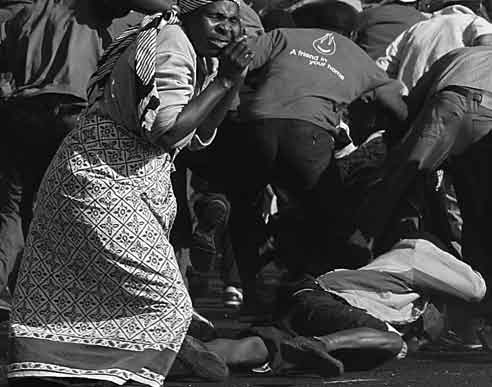
The ANC also appealed to communities to utilise formal structures to raise their concerns and demands and to “constructively” engage in dialogue, despite the fact that such structures failed to respond to the needs and demands of working class communities. The ANC condemned militant forms of struggles and insisted on the rule of law and called on police to maintain law and order. Indeed, the police teargassed, used rubber bullets and arrested some of the activists involved in the community struggles. The ANC has not condemned the brutal manner in which the police have conducted themselves when dealing with community struggles, instead it welcomed the swift action by the police.
What do we make of ANC government response?
The ANC feels the pressure of community struggles and is forced to respond. It is due to this mass pressure that community struggles feature on the agenda of the leading bodies of the ruling party and why it acknowledges problems experienced by the working class communities. It is also due to these struggles that it makes some concessions, for example, the dismissal of the Lekwa municipality mayoral committee. Through the limited concessions that it makes the ANC government seeks to contain community struggles and to pacify communities who resolve to engage the ANC through struggles. The ANC response is also aimed at demobilising working class communities that are leading their struggles and organising outside the ANC . This is what lies behind the appeal to communities to use formal structures that thusfar have failed communities. The ANC also seeks to demobilise and undermine the community struggles when it uses the police to harass and arrest activists at the forefront of the unfolding struggles. The intention is to instill fear among those involved in these struggles. Arresting activists also helps the state to distract the focus of community struggles as those involved in struggle are forced to put their energies into raising funds for lawyers to assist arrested activists. ANC calls to its members to revive the ANC branches so as to detect discontent in advance is intended to disarm the working class of its most effective weapon of collective struggle and cause divisions within working class communities which could lead to conflict among the poor.
The events in Diepsloot, where the ANC branch organised some community members, small business people in the area, taxi associations and Pikitup (the outsourced cleaning service) to clear streets where barricades were created and to threaten citizens arrest of those involved in community struggles, can only lead to conflict among the poor. The ANC response is also aimed at winning hearts and minds and the confidence of the poor in the build up to the 2011 local government elections. The ANC leadership walk abouts and unannounced visits to areas that the ANC calls “hot spots” and all the rhetoric about “working together to speed service delivery” is about winning hearts and minds and is also about demobilizing the organising efforts of the working class that are happening outside the Alliance structures.
Some Challenges
The way the ANC government is responding to community struggles poses challenges to activists and working class communities. One of the challenges is how to sustain struggles and remain mobilised. This is critical because if communities are not organised and mobilised, the state undermines working class communities and ignores their concerns and demands. As the current community struggles show, it is only when communities are mobilised and engaged in collective struggles that those in power are forced to respond. The other challenge is to reflect on the ANC response with the intention of developing an approach on how to counter it. For instance, we must ensure that the concessions made by the ANC do not weaken struggles. We must celebrate victories made through collective struggle, however small such victories, as a way of preparing each other for future battles. While celebrating such small victories we must measure such concessions or small victories against demands that the community has put forward. We must also reflect on how we conducted our struggles with the objective of strengthening them. This raises another challenge for those involved in community struggles in different parts of the country, of finding ways of sharing ideas and experiences about their struggles to consolidate their forces. The related challenge is how to broaden support for the community struggles and demands within communities and the public in general. Part of meeting this challenge would be to avoid targeting soft targets (stoning passing motorists) and government buildings that serve communities. Attacking state buildings that serve the community could easily be used by the state to discredit community struggles and to sow divisions among working class communities. Overcoming some of the challenges raised here could strengthen working class forces and consolidate struggles.
Leave a Reply
You must be logged in to post a comment.