
Draft Platform for United Action of Social Movements in the Current Political Situation
Preamble
On the 29th and 30th of November 2008 various social movements came together in Johannesburg, South Africa, to debate the present political situation in South Africa today and to find a common approach to respond to this new situation. The movements that came together are bound to each other by a common commitment to end oppression and exploitation in South Africa, and they see themselves as part of a worldwide anti- capitalist movement aimed at bringing an end to neoliberal globalisation and capitalism.
After extensive discussions and deliberations, including within the various movements, the movements hereby agree to form a united front based on the following platform:
New political spaces are opening up
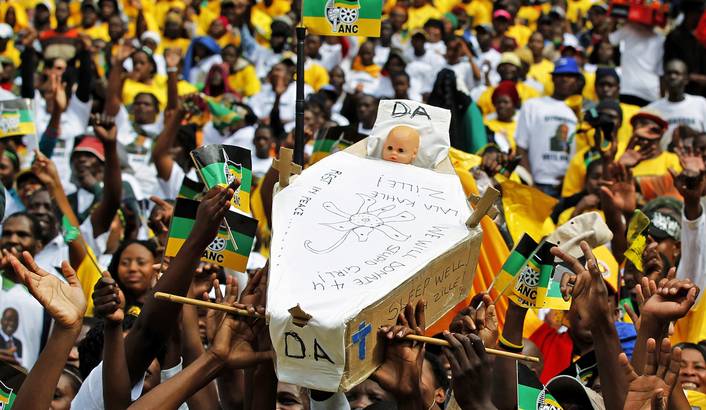
The period since the ANC conference in Polokwane, and in particular since the outbreak of the crisis in the ANC and the formation of the Congress of the People Party, has opened up new political spaces in South Africa. A few months ago the dominance of the ANC appeared unquestioned, but with the crisis in the ruling party this is no longer the case.
The split in the ANC has also coincided with the decline in the legitimacy of the ANC among the working class and the poor. A few years ago, despite its lack of delivery since 1994, the masses were prepared to give their support to the ANC. Today this has changed, and many more people are now critical of the ANC, including of the Jacob Zuma faction in the ANC. Many now realise that the new group installed at Polokwane does not represent the aspirations of the poor, but is rather a group brought together by greed and aspirations of personal enrichment.
While new political spaces are opening up, it is important for the movements to analyse these spaces, and to be critical of all the existing political parties in parliament. Further, the new political space poses a number of challenges as well as dangers. Firstly, there is a strong possibility of repression increasing as the new ruling groups entrench itself and defend its own interests. Secondly, with the emergence of the COPE party and the new spaces there will be many attempts by these groups to use the movements and their constituencies for their own political ends. Thirdly, the new political spaces do not mean that the problems facing communities are over. On the contrary, evictions from the land are continuing, electricity and water cut-offs still continue, the housing backlog continues to increase, exploitation is widespread, and repression is still rife.
Fourthly, the political space that is opening up is accompanied by the resurgence of a deep (social and political) conservatism, which in particular is propagated by the new ANC leadership under Jacob Zuma. This can be seen, for instance, in the calls for the reinstitution of the death penalty; in the threats to freedom of expression; and in the threats to democracy itself. This conservatism poses the danger of an increase in violence and repression.
An unfolding economic crisis
The new political spaces opening up come against the background of a deepening economic crisis. This crisis, which is both global and national, can already be seen in the rising retrenchments, rising food prices, in growing indebtedness of masses of the people including the middle classes, and in growing poverty and inequality. While a deeper analysis of the crisis is needed, it is clear that this crisis will be deep and thoroughgoing, and that movements need to develop a serious and determined response to this crisis.
The ruling class and its political parties will and are attempting to shift the costs of this crisis onto the working class and the poor. Against the background of this crisis, the ruling elite is not going to ‘tighten its belt’ but will continue to spend freely on its projects, like the 2010 World Cup, on which billions will be spent in the midst of poverty. The crisis will mean less delivery of social services, more job loss and therefore more poverty. For the social movements and the constituencies they represent, the working class and the poor, this crisis shows that the source of the problems we face is the capitalist system itself, and that no sustainable solution to our problems can be achieved without a fundamental change in the system itself.
The movements need to intervene in the new political spaces
The social movements need to seize the political space that is opening up. An intervention in the new political space will not only ensure that we deepen our struggles, and build unity in struggle, but also that we create more political spaces for the movements to act and intervene. Against the background of the threat of more violence and repression, the movements need to acknowledge that the space created is temporary and can be closed as quickly as it opened up. The movements therefore need to act quickly and energetically to both utilise and preserve the space that exists.
The movements are weak and face many challenges
The social movements have failed to respond effectively to the unfolding political and economic crisis in the country. The new space therefore comes at a time when the movements are weak and fragmented. These weaknesses range from organisational weaknesses, to lack of political clarity on certain important issues, as well as lack of mass support in our communities and at a national level. The weakness of the movements could be seen in the outbreak of xenophobia early this year: our lack of political work in our communities made this outbreak possible. As we intervene in the new political spaces, these weaknesses need to be borne in mind.
Our intervention in the new political spaces, however, gives us the opportunity to build and strengthen our movements; to build a strong activists cadre within the movements; to build unity among ourselves; to raise the levels of political consciousness in our communities; and to build a national political profile for the social movements.
The basis of our intervention in the new political spaces
The objectives of our intervention in the new political space must be seen at a number of levels. Firstly, the movements seek to defend the mass of the people against the attempts by the ruling class to off-load the costs of the crisis onto the working class and the poor. This means that the movements will continue with, and intensify their struggles against the lack of service delivery, against cuts in social services, and against the impoverishment of the masses in general. Secondly, the social movements need to defend the political spaces now opening up, and to defend the gains of the 1994 political transformation. This will ensure that we defend the space to organise, to propagate the views of the movements, and to roll back and defeat the rising tide of intimidation, political intolerance and violence.
Thirdly, the movements want to intervene in the new political spaces and use them as a vehicle to build links with other constituencies within the poor that we have not yet reached or organised.
In particular, we want to build links with workers, with immigrant communities, and to deepen our organisation of women and the struggle against patriarchy. In taking up the task of deepening our organisation and linking up with organised workers, the movements need to highlight the regressive role played by the SACP, which continues to provide ideological and theoretical justification for the neoliberal policies of the ANC. We need to engage with COSATU and call on the federation to break the alliance with the ANC and therefore with neoliberalism.
Fourthly, the social movements need to put on the national political agenda the struggle for a more humane society that is responsive to the needs of the people rather than to search for profits. While we need to continue to debate and to clarify our understanding of socialism as an alternative and egalitarian society, we need to be committed to spreading a revolutionary educational programme that continues this search for a just society in which we can all live a life in dignity.
Fifthly, for many of us in the social movements it is clear that the present established political parties do not serve the interests of the mass of the people. All these parties support the present capitalist system, and are tied to the interests of corporations and profits. The movements therefore see intervention in the present political spaces as a building bloc towards building an alternative political vehicle that is controlled by and serves the people; towards building a political party with strong roots among the working class and the poor.
Our programme and demands in the present period
The programme and demands of the movements today is informed by the objectives that guide our intervention in the present political situation. Firstly, our demands should address the need to defend the conditions of life of all working people and the poor. Secondly, we need to advance demands that defend and extend the political space within which the movements operate. Thirdly, our programme needs to deal with the task of building our organisations. Fourthly, our programme must deal with the tasks we must set ourselves in order to develop a vision and practice of an alternative society.
- Our immediate demands to the government
We demand that the government implements the following demands immediately:
- That the government immediately announces a concrete plan, with timelines and backed by a budget, of implementation of the social clauses of the constitution. This plan should be done in consultation with civil society organisations and should cover the following –
- Free education for all up to tertiary level
- Affordable, adequate and quality houses for all working people and the poor.
- The government must ensure an end to all evictions of people from their land and homes, and ensure that court rulings to this effect are implemented immediately.
- The provision of a healthy environment and the implementation of measures to prevent pollution and ecological degradation, and put in place measures to promote ecologi- cally sustainable development and social development. This should include measure to ban GMOs, terminator technology, nu- clear power and other technologies that are not ecologically sustainable.
- The provision of universal health care, including reproductive health care. The government must put an end to the privati- sation of health care, and all private services must be incorporated in a universal and state-controlled and managed health care system.
- In particular, the state must ensure a uni- versally accessible and free programme that deals with the HIV/AIDs pandemic, includ- ing free anti-retrovirals and nutritional sup- port for those who cannot afford.
- The provision of clean water and sanitation to all the people.
- The provision of adequate, universal social security for all, including for the unemployed.
- The government must immediately implement measures to ensure food security and secure livelihoods for all the people. This must include legislative changes to facilitate secure livelihoods for fisher-folk, subsistence farmers, and other small producers and traders.
- Ensure the right to decent work by establishing state companies to supply social services and social infrastructure, putting an end to labour brokers, strengthening union powers of oversight in the workplace, and legislating for decent conditions of employment.
- The government must take measures to deal with crime in a manner consistent with the rights enshrined in the constitution.
- The government must immediately embark on an extensive programme of social protection for women. This programme must include:
- Measures to ensure payment for house-work and care-work done by women
- Measurers to make violence against women, including domestic violence punishable of- fences, even if women do not lay charges.
- Legislative measures to promote the participation of women in decision making both in society and in the home.
- Measure to ensure that in the implementation of the social goals of the constitution, special attention is given to the conditions of women.
- In order to realise the just demands of the people, and to generate resources for the social programmes the state needs to generate, the government must:
- Cancel all apartheid caused debt, and demand reparations from all companies and governments who benefited from apartheid.
- End all privatisation and corporatisation of state assets, including state owned land
- Re-nationalise, under popular control, enterprises and companies, like Sasol, Telkom, Iscor and others.
- Legislate a wealth tax to fund social programmes
- Expropriate unused land.
- Redistribute land to the poor in the rural areas and put in place measure to support the productive use of the land by rural com- munities.
- Defending and extending democracy
The movements demand that the state and the government undertake a transformation of the political institutions of the state that is aimed at defending democracy and extending the political space for free political activity. These measures shall include:
- Abolishing the present proportional representation system and replacing it with direct election of members of parliament at a constituency level.
- Take measures to ensure that disruption of political meetings, incitement to violence, and propagation of hate speech in political campaigns in particular, is a criminal and punish- able offence. In general, the government must ensure that the constitutional provisions for free political activity are enforced.
- The reform of the electoral act in order to facilitate participation in the political process by parties and other organisations. In particular, the requirements for large financial deposits as conditions for participation must be abolished.
- Initiate a public process aimed at developing a system of direct participatory democracy and people’s power at all levels of government.
- Developing a vision of a socialist future
The immediate demands advanced by the social movements are only stepping stone towards building a new society that is responsive to the needs of the people. This vision of this new society shall also inform the practice of the movement in daily political struggle. The programme of the
movements shall include:
- Initiating a series of discussions in the movements and in the broad society about our vision of a democratic and egalitarian socialist society.
- Developing proposals and campaigns to nationalise factories that are closed down and to use them productively and on a cooperative basis as a stepping-stone towards a new society. These proposals and campaigns must be linked with a slogan for an end to retrenchments.
- Developing programmes to promote gender equality and participation in decision making by women in our organisations, an end to gender violence and an end to patriarchy in our movements and organisations.
- Developing programmes to deepen direct democracy in our community organisations and social movements
- Initiate campaigns to remove the private property clauses in the constitution, and to bring an end to private property itself.
The need for a united front
In order to intervene in the present political space, in order to strengthen and to buildi our movements, and in order to realise the political and organizational objectives we have set ourselves, we need to come together and unite in a front of action and defence. Such a united front must be controlled by the movements, and it must be orientated to the grassroots and the masses.
Leave a Reply
You must be logged in to post a comment.