
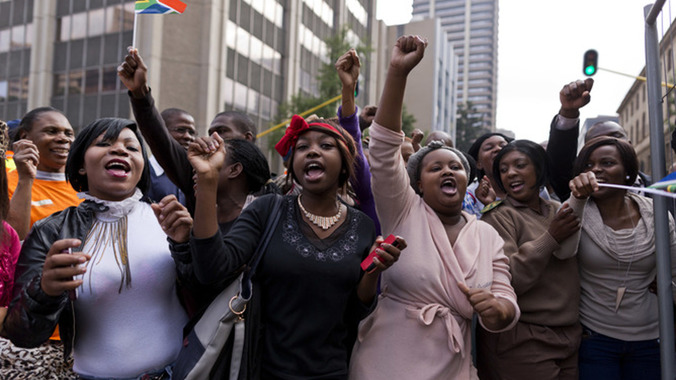
In this article Albertyn argues that while women won the right to choose whether to have children or not in law, this right still needs to be won in their communities and in their homes.
Traditional society
Throughout history, women have sought to control their fertility. In the 19th and 20th century, women used many different herbs to induce miscarriages. These include meidjieblaar, the bulb of Sekanama (Sotho) or uhlunghlungu (Zulu), the roots of isaquni (Xhosa) and siluvari (Shangaan). Khoisan communities used some of these herbs in pre-colonial times. Women of all classes and colours in South Africa used herbs and drugs to terminate pregnancies in the 19th century – often alone and at risk to their lives and health.
In traditional societies, women were not always in control of the decision to seek an abortion. Often the man/boy or his family would provide the medicine to avoid being sued for impregnating the female ‘property’ of the patriarch (male leader). In some instances, abortion was an offence against men in traditional law. When white colonial officials and missionaries discovered abortion was a common practice amongst Xhosa women, a law was passed to criminalise abortion, as a crime against the colonial state. According to the Roman- Dutch common law, abortion was permitted to save a woman’s life. In the 20th century, doctors were sometimes prepared to assist white women to terminate their pregnancies ‘on medical grounds’. Black women were forced to use more dangerous methods, such as soap, washing powder, Epsom salts or chemicals.
Apartheid
In South Africa in the 1970s, the medical profession advocated for legal regulation of abortion. This was largely to get legal certainty in the face of vague common law provisions that made them vulnerable to criminal prosecution. The 1975 Abortion and Sterilisation Act placed abortion squarely in the hands of the male medical profession and the Apartheid public hospital bureaucracy. Committees (largely white men) sat in judgment of women seeking abortion, to decide whether or not they qualified in terms of the Act’s strict criteria.
Access to abortion under this Act was extremely limited and was determined by colour, class and geographic location. In 1975, 85% of the 570 legal abortions were performed on white women. In 1995, just over half (54%) of 2463 legal abortions were performed on white women, 92% took place in two urban centers and just under half in private clinics. The majority of women, especially those who were poor, black and lived outside of major urban areas, were still forced to resort to illegal and usually unsafe abortions. The apartheid state did not keep accurate records of maternal mortality arising from such abortions. However, a 1994 national study by the Medical Research Council estimated that each year 44 686 women went to hospital with incomplete abortions and 425 women die in hospital from a septic abortion. The majority of them were black, working class women.
New democracy
When the ANC came to power in 1994, the Reconstruction and Development Programme committed government to transform the health system to meet the needs of all South Africans. The new health policy identified women, especially poor women, as a priority group. An important part of this policy was the recognition of reproductive rights, including giving women the right to choose an early termination of pregnancy according to one’s individual beliefs.
A few months after coming into power, Parliament appointed an ad hoc parliamentary committee to investigate the 1975 Abortion and Sterilisation Act. This started a long process of consultation that ended with the passing into legislation of the 1996 Choice on Termination of Pregnancy Act. Unlike the previous law, which made abortion a crime in all but very restricted circumstances, this law stated that the right to decide when and whether to have children was a fundamental human right. Abortion was now seen as a right not a crime. Women no longer had to die or lose their ability to have children because of back street abortions. The racism and sexism of previous laws was replaced with the idea of women’s rights.
In the meanwhile, women voted with their feet to obtain safe and legal terminations at state hospitals and clinics. After five years, 220 888 women had exercised the choice to terminate their pregnancy, nearly three quarters of these in the first 12 weeks (73%) and many on socio-economic grounds. About one in eight abortions (12%) were provided to women and girls under 21 years. Research also showed that while women are still obtaining backstreet abortions (largely a problem of uneven access), there was a reduction in unsafe abortion. Overall, the Act had improved women’s health and saved women’s lives.
Intolerance an obstacle
However, not everyone agreed that women should be able to choose to terminate their pregnancies. Soon after the passing of the Act it was challenged by the Christian Lawyers Association and other groups on the basis that it violated the right to life of the fetus. In rejecting this challenge, the High Court recognised the importance of women’s rights to make decisions concerning reproduction (if, when and how many children women want to have).
Despite the obvious health advantages to termination of pregnancy, those opposing abortion have continued to go to court to try and strike down sections of the Act. In a second case, the Christian Lawyers Association challenged the provision that minors did not require parental consent to terminate a pregnancy. Again the court rejected the claim, noting that the idea of ‘informed consent’ meant that the minor should understand the nature and consequences of the abortion. The Court noted the constitutional commitment to choice:
compared to…foreign jurisdictions… ours is the most explicit provision concerning the rights [to termination]. The specific provisions of section 12(2)(a) and (b) …guarantee the right of every woman to determine the fate of her pregnancy. The constitution of this country in explicit language affords “everyone” the right “to make decisions concerning reproduction” and “to security in and control over their body.” This is quite clearly the right to choose whether to have her pregnancy terminated or not, …[in] short, the right to terminate her pregnancy. (From the case of the Christian Lawyers v Minister of Health 2005 supra 526 H-J). In 2008, South African women celebrate twelve years of choice, of being recognised as moral agents, of improved maternal health and of saved lives. However, the road has not been a smooth one and problems of implementing the Act have meant that some women have struggled to exercise this choice.
Access is particularly difficult for women living in rural areas, as well as for poor and unemployed women, who cannot afford to get to abortions facilities. Facilities are often far from where working women live – in informal settlements, townships and rural areas. This is partly due to delays in designated clinics and shortages of health-workers. In fact, staff-shortages, especially for second trimester abortions, have meant that these are particularly difficult to obtain. Problems of implementation have meant that women have continued to access backstreet abortions, although new drugs and technologies have meant that these are ‘safer ’ than in the past.
The Department of Health has tried to improve access to abortion and reproductive health services. In 2004, the Department introduced a law that aimed to improve the safety and efficiency of abortion services – the Choice on Termination of Pregnancy Amendment Act, 38 of 2004. This law was taken to the Constitutional Court in 2005 by the anti-choice lobby group, Doctors for Life. The complaint was a lack of public hearings. The Court agreed and found the Act to be unconstitutional because the Constitution required the participation of the public during its passage of the law through Parliament. The Court kept the law in operation to allow Parliament to hold proper hearings. These were held last year (2007) and the amendment was passed early this year (2008).
The public hearings revealed the extent to which women are still judged harshly by their communities for choosing to terminate their pregnancy. This denies women their right to be equal citizens and to have control over their bodies and lives. This is troubling in a country where so many women are hurt and abused, just because they are women.
‘Reproductive choice’ is part of the right to freedom and security of the person. It means that the individual women should decide whether abortion is right or wrong for her in her particular context, and that others should respect this decision. It also means that women should be able to be secure in their bodies, free from all forms of violence. Such freedom rights are fundamental, allowing women to be free to make other choices in their lives: to finish schooling, to keep a job, to feed her existing children, to leave the man that is abusing her. Women have won their rights to equality, dignity and choice in the Constitution and in the law. They now have to win them in their communities and their homes.
Leave a Reply
You must be logged in to post a comment.