
Dear comrades and friends,
The World Social Forum (WSF) arrived in Kenya amidst much anticipation on the part of African social movements. With Nairobi as the venue, the opportunity would be afforded the African movements to draw much greater international attention to their struggles. And to the fact that imperialism continues to regard the continent as a vast treasure trove to be pillaged at will, content to leave behind unprecedented levels of starvation, poverty, disease and degradation.
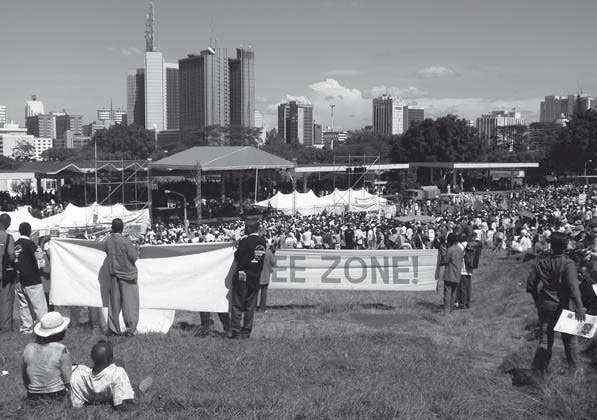
The expectations of the African social movements were met instead with a politically questionable World Social Forum, at best tepid at worst representing something of a lurch to the right, with brazen commercialization of the Forum, a relatively active and vocal Christian right, and the virtual exclusion of local Kenyan social movements from the event. This edition of the Khanya Journal focuses almost exclusively on the event, and provides political analyses of the event as well as reports of sector and issue based activities, in some instances with some analysis of the state of the particular sector or issue-specific struggle.
Maria van Driel and People’s Parliament, a Kenyan organization campaigning around working class issues, provide political analyses of what the Forum represented and was moved to organise an alternative to the Forum. Van Driel argues that the problems of the Forum, such as the relatively small attendance of international organizations, the dominant role of NGOs, the commercialization of the Forum and the absence of local, Kenyan movements have their roots in a decline in working class struggles internationally. The People’s Parliament article, reproduced here in edited form, points to an even longer list of problems with the Forum, from what it calls ‘pre-event awareness’ to the inaccessibility of the venues and events for local working class activists.
While critics of the WSF, such as Mumbai Resistance, might argue that some of the problems are only to be expected, and further support the need for a working class alternative to the WSF, Van Driel and People’s Parliament argue instead for a consistent struggle inside the WSF to overcome the problems and take the organization forward. Van Driel argues that the Forum needs to be anchored within social movements, while People’s Parliament offers a list of 13 suggestions for how to overcome the problems.
Onyango Oloo, the convenor of the Kenya Social Forum and a member of the Organising Committee of the Nairobi WSF, acknowledges some of the above problems but provides some insight into how Kenyan social movements were involved in the preparations for the Forum and the role they played in the actual event.
Nancy Castro looks at the participation of women within the WSF itself and surveys some of the debates and discussions that took place there, also including Feminist Dialogue, which met over several days before the start of the Forum itself. While acknowledging the significant presence of women from a large range of organizations, she concludes that the WSF nevertheless contributes towards the ghettoizing of women’s struggles.
The rest of the edition is taken up mainly with reports of activities of various sector or issue based struggles. Many of these contributions echoed the criticisms of the Forum made by Van Driel et al, although much of it was omitted in the editing process, simply to avoid repetition. As can be seen discussions and debates around the fight against HIV/AIDS and concludes that the WSF Nairobi has made an important contribution to it.
Two further articles in this edition are not directly tied to the WSF. They have been included because they provide useful further insight into the different sector and issue based struggles. The first, by Adamos Zachariadis, Vasianna Konstantopoulou and Elisabeth Lountou gives an account of national students struggles in Greece in 2006. The second is a report on a workshop on farm dwellers held in South Africa in December 2006. The resolutions adopted a call, among others, for a new framework for land reform, including nationalization of the land, and for a national campaign on farm dweller issues.
The Documents section of the edition contains the final statement of the WSF Assembly of Social Movements and the global call of the Anti-War Assembly. A book review is a welcome innovation in this edition of the journal. Lucien van der Walt reviews All my Life and all my Strength, by Ray Alexander Simons, the veteran South African Communist Party member who died in 2004. He contrasts her support for and enormous contribution to the struggle for democracy in South Africa with her simultaneous support for ‘a brutal Soviet regime…’ and ‘unswerving loyalty to…official Communism.’
We look forward to carrying book reviews in future editions of the Khanya Journal.
Leave a Reply
You must be logged in to post a comment.