
Dear Comrades and Friends
This is the second special edition of the Khanya Journal focusing oneducation struggles in post-apartheid South Africa. Most of the writers involved in this edition are school students from communities in Gauteng. The writers came together to discuss the role that the Khanya Journal can play to assist in organising students and to identify key themes for this edition. Two writing workshops were held where students assisted each other with planning and writing up the articles for the Journal.
Two key themes emerged during the planning for this edition, i.e. the politics and state of education and the organising initiatives high school students are involved in. The edition is therefore divided according to these two themes.
The politics and state of education
As Vally points out very little has changed since last year ’s Journal edition which focused on the state of education in post apartheid South Africa. If anything conditions have worsened.
Lukhele highlights the impact that collapsing infrastructure at schools has on the quality of teaching and learning. What is particularly disturbing is government’s neglect of rural schools forcing parents to make huge sacrifices sending their children to schools in the suburbs.
- Mthembu criticises government’s response to this flight to suburban schools. Instead of arresting the collapse of schools in the townships, government’s response has been to merge township schools where enrolment or performance has dropped and to retrench teachers.
It is not the first time that mergers are seen as a solution to the problems in education. Mati discusses the impact of mergers at universities. For students from historically black institutions, mergers have meant an increase in fees leading to an increase in financial exclusions.
While even the government has recognised that HIV/Aids has reached pandemic proportions and that sexual violence intensifies the spread of HIV/ Aids, little is being done to deal with sexual violence at schools. Maolombane paints a very bleak picture of the conditions that girl learners are faced with at schools. Sexual harassment by teachers and even rape seem to be regular occurrences.
Nkosi raises an interesting debate about the teaching and learning that is taking place in schools in his article on Outcomes Based Education (OBE). While some learners believe that the OBE model makes school “easier”, others believe that the present system does not prepare them for tertiary studies.
The Department of Education (DoE’s) focus on a reduction of spending on education and a recovery of costs from students Sompane argues, is part of the government’s entrenchment of the Growth, Employment and Redistribution (GEAR) policy.
This entrenchment of GEAR, Johnson and Benjamin argue, is being done behind a smokescreen of “Opening the doors of learning and culture”.
While continuing to entrench its neo-liberal policies the DoE has rolled out it’s propaganda machinery and in May launched its “Freedom Charter” campaign. The “Freedom Charter” campaign is a cynical election ploy to hail the supposed victories of the department and silence its critics as shown by Benjamin and Johnson.
Organising Initiatives
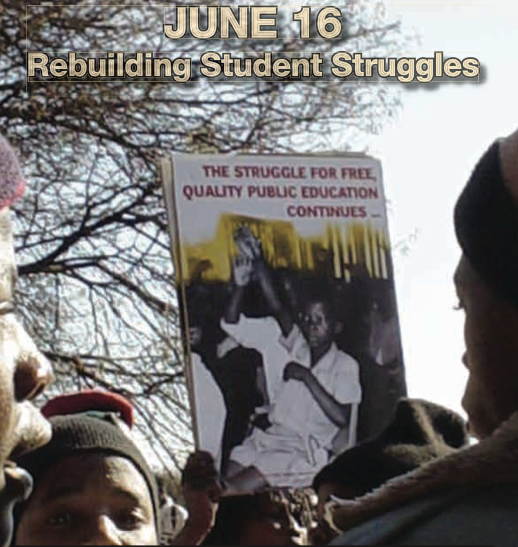
As writers in this edition show, increasing numbers of students are refusing to be fooled by government propaganda and remain passive recipients of neo-liberal education policies. June 16 is a fitting time to discuss students’ responses and organising initiatives in 2005.
Mphuti, Tamane and Mthembu go to the very heart of the education system by questioning the role of education in society. In this article the writers describe education as a tool for empowering people to be direct agents for changing their circumstances.
Radebe takes this discussion further by arguing that existing school education entrenches ruling class ideologies. What is needed is the building of organic intellectuals, themselves built in struggle and who will be in the forefront of challenging the existing education system.
In the article on study groups Schroeder proposes using reading and writing processes in study groups to assist with the development of organic intellectuals.
Mosinki, Moiloa, Zatu and Yende all discuss how youth based cultural groups can assist in organising students both in school as well as in the community. Mosinki and Moiloa’s article highlights the importance of culture as a tool for education and not just entertainment. Through using a petition Moeketsi and Nkosi provide an interesting insight into how school students can be organised outside of school. In an environment where the principal and School Governing Body refuses to allow learners to have an independent voice, using a petition outside of the school gates provides an organising space.
The Representative Council of Learners (RCLs) have been institutionalised to provide school learners with an independent voice at school. Thekiso, Tshabalala, Moeketisi, Nkosi and Ndlovu question whether this independent voice really exists. All three articles speak of how RCLs at many schools have become no better than prefect structures
School students are experimenting with new forms of organising, for example through culture, and drawing on tactics used in the past, like boycotts. In response to cases of sexual violence at school, Maolombane speaks of a weeklong school boycott by students. Engaging in a weeklong boycott is not only an indication of desperation but could also be seen as a willingness on the part of students to defend their rights to be protected at school.
Outside of school young people are also attempting to organise themselves and their communities. The South African Unemployed Youth Forum initiative to organise unemployed youth and the organising through ABET project by comrades from the Vaal bear testimony to this.
June 16 is a time for commemoration but also for celebration. A time to celebrate the commitment and energy of a generation of students who took South Africa into a cycle of struggle that brought us to our first democratic elections. What the articles in this edition illustrate is that we have the beginning of the makings of a new generation of student activists. Against all odds students are searching for ways of organising and building a student resistance against the government’s neo- liberal policies. It is for this reason that we titled this edition “Rebuilding the Student Movement”.
Nina Benjamin Silumko Radebe Molefi Ndlovu Guest Editors
Leave a Reply
You must be logged in to post a comment.