
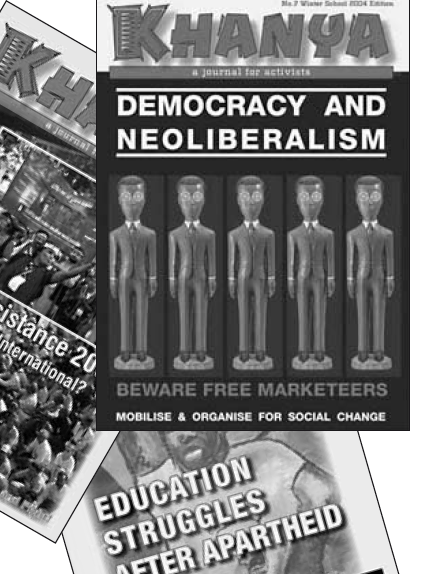
5 years of “Khanya: a journal for activists” and our future tasks
2007 marked 5 years since the launch of the Khanya journal. The journal was launched at the height of the mobilisation against the
World Summit on Sustainable Development in Johannesburg 2002, and it followed hot on the heals of the mobilisation during the World Conference Against Racism in Durban, 2001. Five years later and 16 editions later, the Editorial Collective of the Journal met for four days in Johannesburg (17-20
January 2008) to take stock of where we are as a journal, and to map out a way forward.
why the journal was formed
While the establishment of the journal was triggered by the WCAR and WSSD mobilisations, the fundamental processes that led to its formation can be traced to the immediate post-1994 period
in South Africa, and the rise of the new social movements signaled by an equally important event in 1994 – the uprising in Chiapas, Mexico. Within SA, it had become clear by 1996 that the dream of
a revolutionary transformation of the lives of the majority would not just be deferred, but it would be betrayed. The adoption of market fundamentalism as a state religion by the recently elected ANC government was a watershed, and henceforth its policies were to be more and more capital friendly, and by the same token led to the impoverishment of the previously oppressed majority. By the end of the
1990s new movements of resistance to neoliberalism had began to emerge in South Africa, and it was these new movements that gave the launch of the journal its historic ground.
Against this background the first edition of “Khanya: a journal for activists” – in an editorial titled “Khanya: a space for debate”, set out the basic role of the journal as being the rebuilding of the organisations of the working class, building a new activists cadre, revitalising radical theoretical analysis of society and social change, and providing a platform for debate among activists committed to egalitarian social change.
The first phase
In order to realise the aims outlined in the first edition Khanya College and the Editorial Collective positioned the journal in the heart of the mobilisations against neoliberalism that were
unfolding both in South Africa and internationally. And so the first five editions of the journal deal
with the key social and political mobilisations of the time, and indeed its nature and content is driven by these mobilisations. These included reflections of WCAR in the first edition; reflections on the WSSD and the movements it had given birth to following the historic march of August 31 2002 in the second edition; debate and analysis of imperialism and
war, and the mobilisations that followed the US invasion of Iraq in the third edition; the reflection of the continuing mobilisations against the war, and the mobilisations against neoliberalism in the shape of NEPAD in the 4th edition; and the debates and mobilisations around the WSF in Mumbai in the 5th edition.
What tied these first five editions together was their positioning within the political mobilisations that had been building up since Seattle in 1999. Although the journal related to these mobilisation through the prism of theoretical analysis of these events and the mobilisations they gave
rise to, it was nevertheless driven by the need to respond to these events and to provide theoretical generalisations about their significance for the struggles of the working class and other dominated classes.
weaknesses of the movements and shifts in the journal
As we moved towards the end of 2004 the new movements began to show signs of weakness and of exhaustion: weakness of organisation, of cadre development, and of capacity to sustain the mobilisation of the previous two years. This weakness was consistent with the relatively new
character of the movements, and was not restricted to the South African movements. Following
the heady mobilisations in Seattle, Genoa and Johannesburg, and the massive anti-war rallies in many cities across the world in 2003, by the time of the strategy sessions of the Anti-war Assembly in Mumbai (2004) many activists from across the world reported on the difficulties encountered in sustaining the scale of mobilisation that had been achieved at the beginning of the war.
This retreat in the movements can be seen in the shift in the journal. As against the first five editions, the following five editions of the journals have an historical-retrospective and educational character. The key feature about them is that while they continue to report on some ongoing social mobilisations, they are not dominated or driven
by social and political mobilisations. From this period Khanya’s own initiatives, like the annual Winter Schools, its work on the history of the labour and students movements, and its work around building a women’s emancipation movement, exercise a strong imprint on the content and form
of the journals. In general, with the exception of the special edition debating the so-called ‘New UDF’, and the editions anchored by the preparations for the World Social Forum process (three editions
from no 12) the drift of the journal has continued to reflect the weakness of the movements and
the absence of large and sustained political mobilisations.
An important feature of the evolution of the journal that the Editorial Collective noted was the distance of the journal from a host of “spontaneous” struggles that unfolded in South Africa’s township during this period, especially from 2003. These struggles, while they featured prominently in the theoretical debate around the so-called ‘New UDF’ at the end of 2005, are not
captured or analysed in the journal. We identified
two sources for this problem. Firstly, the journal’s life and rhythms, as well as those of Khanya itself, were tied to the established organisations among the new movements. These included, besides other similar movements, the APF in Gauteng and the SMI nationally. These movements, on the other hand, were not connecting with these instances
of resistance against the effects of neoliberalism, and in the main continued to be preoccupied with their own weaknesses and internal struggles.
We must recall that in this period, from 2004/6, the weaknesses of these established movements reached a state of crisis – with major internal squabbles and splits. Secondly, the Editorial Collective failed to act as a counter-weight to this drift in the movements because of weaknesses in its own capacity (it depended on a few overstretched individuals), and thus it got carried along with the drift of the established movements.
These weaknesses in the movement and in the journal were also reflected in other activities of the journal, including the Study Group initiative, the seminar programme, the failure to produce study notebooks for militants, and so on. Thus, while the journal was able to host more than 16 seminars, 4 conferences, a number of Study Group meetings, among other activities – the underlying tone and tempo of these activities reflects deep structural and historical weaknesses of the new movements. In
the EC discussion these weaknesses were brought down to the weaknesses in the development of the leading activist cadre of the movements.
the strategic positioning of the journal in the coming period
The resolution of the structural weaknesses of the new movements will take place over an extended historical period, and will be primarily driven by the combination of the ongoing struggles against instances of neoliberal injustice (the township
‘service delivery protests’ so-called), on the one hand, and the continual formation of new layers of activists out of these struggles, on the other. While the journal will not be the primary motive force in the resolution of these historical weaknesses, the EC felt that it had an important role to play in “giving history a small push”, in facilitating the historical process of cadre formation within the working class.
The meeting therefore argued that the journal must position itself at the intersection of the ongoing protests or mobilisations, and the process of cadre formation. The EC saw this strategic positioning playing itself out in a number of ways:
The journal must emphasise its role as an educational tool for the new cadre. This is a shift in emphasis from the journal as a space for ‘debate’.
While these two roles are not in contradiction to each other, the EC came to the conclusion that
the historical weakness of the movement can also be seen in the political exhaustion of the old left activist cadre, and the general weakness of debate on strategic questions within the movements.
The journal will re-embrace its role as a space for
‘debate’ as the new cadre is consolidated and its theoretical capacity is deepened.
The journal must strive to reflect the struggles taking place within the working class, in particular the so-called “social delivery protests”. The EC will take a more active role as writers and will focus on providing an analytical framework within which these struggles may be understood. This active role of the EC will act as a counterweight to the isolation of the established movement from these struggles against neoliberal injustice, and will hopefully
lay a basis for connecting these struggles to the established social movements.
More than in the previous period, the journal as a publication must be seen as one among
many other interventions in the process of cadre- building. Attention will be paid to producing short publications, occasional papers dealing with more extended theoretical topics, a more structured
and consistent seminar programme, an annual conference dealing with the theory and practice of movement building, and so on.
In particular, the EC decided to put a lot of energy in ensuring the formation and functioning of Khanya Journal Study Groups. These groups, made up primarily of activists in the movement, will provide a stable readership for the journal and
its other publications, and will also provide a space for consistent deepening of the theoretical capacities of the new cadre.
The journal needs to be given a depth of implantation within the new movements and cadre. This requires a more systematic integration of the journal into Khanya College programmes in general and its appropriation as a flagship programme
by the institution as a whole. On the other hand, without turning ‘inwards’ the journal must provide a space for reflection on Khanya’s varied movement building work.
The regularisation of its production so that it can help provide rhythm and structure to the process
of cadre education. The present tendency for the journal to appear irregularly must be overcome, and the EC mapped out a schedule for all four editions for 2008. Tied to this regularisation is the creating
of a national distribution infrastructure and much more target interventions that ensure that the new cadre of activists receive and read the journal on a more regular basis.
The journal needs to deepen its relationship
with other support organisations similar to Khanya
College (for example Ilrig, SCLC and so on), so as to ensure a broader base of writers, among other things, and to enable the journal to reflect developments within the movements at a deeper national level.
The journal must intensify the work of building a strong subscription base and a stronger financial base so as to make its extensive and varied programme possible.
In addition to these basic tasks in the coming period, and the new emphasis which underlies them, the EC also made two other key decisions. These were:
In collaboration with the Strategy Centre of Khanya College, the journal decided to produce an annual periodical (or almanac) on “The State of Social Movements in South Africa”. This publication in three parts will comprise, on an
annual basis, a volume on theoretical perspectives on key questions facing the movements, a volume on key documents of the social movements and
a barometer of resistance, and a third volume that will be a register of social movements and organisations in South Africa. A more extended motivation of this almanac will be given in the first edition of the almanac, which is due in the first half of 2008.
In February 2009 the journal will host the first consultative conference of “Khanya: a journal for activists”. The conference’s aim is to provide a space for the EC to share strategic perspectives on the future of the journal and its various activities with regular contributors and other activists in the movements. An invitation outlining the concept of the Journal Consultative Conference and its role will be send out to activists in the second half of
2008.
In ending its lengthy deliberations on the past and future of the journal the Editorial Collective thanked its many readers and contributors, and pledged to reconnect with those we had lost contact with, and to deepen our relations with those we had managed to keep contact with during these last five eventful, difficult and fruitful years.
In Solidarity
Khanya Journal Editorial Collective.
Leave a Reply
You must be logged in to post a comment.