
Anita Khanna* discusses the effect of climate change in Africa and argues that the South African government must act immediately to invest in renewable technology.
The climate scientist James Hansen described the Earth as the ‘Goldilocks Planet’ – not too hot and not too cold. The moderate climate that the earth has enjoyed for thousands of years has seen the proliferation of millions of species. It has put fish in our seas, given us the means to grow sufficient quantities of nutritious food and the raw materials that we have cone to rely on.
The fact that so many people do not have access to basic things we need to survive has to do with how the ownership and distribution of the planet’s natural resources are organised. Climate change, as a result of greenhouse gas emissions presents the world with an immediate challenge.
Climate change in Africa
The evidence shows us that Africa is warming faster than the global average and that people are already dying as a result. One third of Africans live in drought prone regions. We are all familiar with images of people struck down by famine, desperate and starving. Until recently, such disasters. The argument was that overgrazing by livestock and people gathering firewood had destroyed the thin covering of vegetation. With no plants to transpire moisture into the atmosphere, the rain forming clouds had failed to gather, and lengthened this man-made ‘ drought’. In 2003 a group of climatologists from Colorado proved that the reason for the lack of rainfall is the rising sea surface temperatures in the Indian Ocean, caused by greenhouse gases. The Indian Ocean is the most rapidly warming ocean on earth.
Climate change in the Sahel
the 2003 study mentioned above showed that as the Indian Ocean warms, the conditions that generate the Sahelian monsoon weaken. The Sahelian ‘drought’ began in the 1960s and it has been five decades since the changes to the patterns of rainfall in the Sahel region first began. The affected area is an enormous part of sub0Saharan Africa extending from the Atlantic Ocean to Sudah. There is no sign that the life giving monsoon rains will return. Instead, what has occurred is a rapid shift to a new, drier climate that has directly resulted in famine and war as people fight over a shortage of fertile land and water sources.
Climate change in other regions
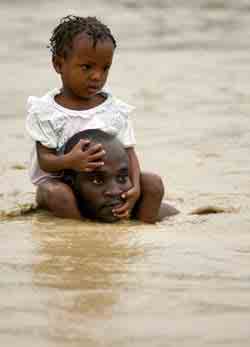
With warmer temperatures, some areas are seeing an increase in rainfall and floods due to heavy downpours. These are likely to become more common. Even in drier regions, there is likely to be more intense downpours that create flooding. Heavy rains and thunderstorms caused the floods in the Sahel, in the summer of 2007. The much needed rain was useless as the land was dry from years of drought that instead of the water penetrating the earth, it rain off the surface, gathering at the lowest ground levels and causing floods.
As temperatures warm, sea levels begin to rise to thermal expansion. In recent decades the increase in flood damage across the globe has been severe. This places populations in low-lying coastal areas at risk. In the 1960s around 7 million people globally were affected by flooding each year. Today that figure stands at 150 million. In Ghana, 25 per cent of people live on the coast and so even relatively small rises in sea levels could have serious consequences on life and economy. Even a sea level rise of one meter is likely to be the Nile Delta where a one-meter rise could affect six million people. If Global warming is not stopped, it will lead to the complete melting of sea ice and the rising of sea levels.
What South Africa can do?
Climate change is already devastating the continent, impacting on water resources, agriculture and increasing vector born diseases. While many Africans face extreme living conditions, rising temperatures will see increases in food prices.
It may seen unfair to call on individuals to cut back on consumption, but people also have to take some responsibility. South Africa is a significant producer of greenhouse gases and is number twelve on the list of top polluters. While calls are being made on richer countries to make immediate cuts in carbon emissions and to invest in clean technologies, there is also a need to recognise that South Africa must act immediately to lead the continent in investing in lifesaving, job creating, and renewable technology.
Leave a Reply
You must be logged in to post a comment.