
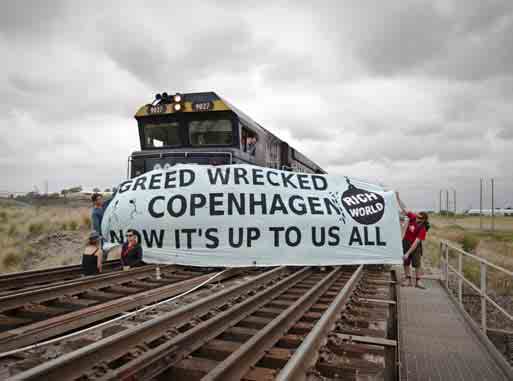
In this article Adam Booth discusses environmental issues in the context of a transitional programme. This is a programme that can shift economies under capitalism in an anti-capitalist direction.
A transitional programme is a set of demands to shift society from its current situation under capitalism, towards a final goal of international socialism. The idea of a transitional programme was first developed by Leon Trotsky, a key leader of a Russian Revolution in 1917. in 1938 Trotsky argued that socialists must go beyond the ‘minimum’ demands put forward by traditional social democratic parties. What demands should socialist make regarding the climate change? The seven major demands are outlined below.
No to market-based methods
the free- market has never been able to provide even most basic of material needs to majority of the world’s population. Instead of alleviating poverty, capitalism has worsened inequalities, and is unable to eliminate famine, drought and disease. Why then should we think that market- based methods will be any more affective at solving the equally large problem of climate change.
Society must oppose carbon taxes. A tax on energy use or emissions would be a regressive tax (like VAT), and would hit the poorest hardest. Socialists believe in progressive taxation, aimed at big-business and profiteering middle-men. Energy prices must not rise for the large number of ordinary people who already have trouble staying warm during the cold winters.
No confidence in capitalism ‘treaties’
Whilst we condemn imperialist countries that refuse to reduce their carbon emissions, there is a need to recognise that environmental treaties are doomed to failure if they attempt to operate within the confines of capitalism.
Pro-capitalist countries will not sign up to anything that damages the profits of businesses in their country. The problems of the nation states have resulted in the failure of international treaties over the years, from world trade development aid. International co-operation is clearly needed to solve what is an international problem. However, this can only happen under agreements that are made by delegates who are accountable and who represent the interest of people and the planet.
Nationalised, democratically owned transport, industry, and housing
In Britain, the main contributors to energy demand (and thus carbon dioxide emissions) are transport, industry, and buildings. As individuals, we have neither the money nor the control needed to reduce the waste and inefficiency of these polluters. What is needed, therefore, is the nationalisation of these major energy users, under the democratic control of the workers, trade unions, and elected representatives. Taxies in South Africa also put workers in South Africa at risk on a daily basis. The state should provide a publicly owned, fully integrated transport system. Buses, trams, and trains across the country must be nationalised under workers control, and the closure of rail and bus routes must be reversed. Transport fares must also be slashed. Industry and the commodities it produces are subject to inefficiency at every stage of production. Raw materials and resources are extracted with little regard for the environment. In each case, this is due to the insatiable appetite of big business for profits, which results in cost-cutting at every opportunity. What is needed is a democratically planned economy, which could eliminate unnecessary damage to the environment. The government should initiate a mass programme to improve the insulation and heating systems off all buildings. It should provide new, affordable, energy efficient homes. Such a plan would reduce energy demands and create thousands of new jobs. The construction industry must be nationalised and be forced to meet more stringent building regulations.
From fossil fuels to towards green industries
Power companies currently make huge profits by charging consumers high prices for electricity and gas, whilst making little investment into renewable technology. These utility companies must be taken into public ownership, under democratic workers control, enabling a large-scale transition away from fossil fuels, and towards alternative energy sources, such as wind, wave, tidal, and solar.
Nationalisation and democratic control of the banks and investment
Banks hold the real control over the economy. Despite much talk about investing in renewable energy and creating green jobs, governments and businesses have in fact spent very little thus far. Due to the bailouts over the last few years, the British government already owns a large stake of many banks. What is needed now is to place the control of these banks into the hands of workers and trade unions, so that public money can be invested in green industries.
Democratic control of the media, education and research
The media is filled with various adverts and programmes that attempt to shift the blame for ecological disaster onto ordinary individuals. In some cases, the media attempts to deny climate change altogether. These instances are normally funded by powerful lobbying groups, such as the oil and coal industries, and are in complete contradiction to the vast majority of scientific studies. The fight against such propaganda must begin with the fight for a media that is socially owned and democratically controlled. (for instance big business has a large influence in environmental education and research. Fro example, the Centre for Energy Studies at Cambridge University is located in the Judge Business School, and is generously founded by Bp and ExxonMobil.)
Stop using food as fuel
Growing biofuels has been encouraged by many governments in recent years as a sustainable source of fuel. The downsides of biofuels are often overlooked. By turning over agricultural land to biofuels, food prices increase, hitting poor people hardest. A pro-working class programme rejects the current us of biofuels, and demands genuinely sustainable energy sources. A planned economy could distribute food far more rationally, rather than relying on market forces that prevent millions of people from having enough to eat.
The need for socialism
The above provides an outline for regarding climate change and the environment. Socialism is not inherently green and even if all of the above measures were implemented, the safety of the planet would not be guaranteed. A greater consciousness of environmental issues is needed by everyone. These behavioural changes, however, can only occur alongside systematic change. By placing the means of production in the hands of the majority, the separation of workers from the fruits of their labour would dissolve, and people would no longer be alienated from environment.
Leave a Reply
You must be logged in to post a comment.