
In this article Assaf Adiv* discusses the recentteachers strike in the in Israel, an important step in the struggle for social change in Israel.
Two-month strike o f Israeli high school teachers, their longest ever, ended in December 2007 when the independent High School Teachers Organisation (HSTO) reached a compromise with the government. The strike went beyond a labour struggle, for it had features of a civil revolt against establishment priorities. Ran Erez, HSTO chairperson, expressed this spirit when he stood before a huge demonstration in Tel Aviv’s Rabin Square on November 17 and said, “This is a social struggle for a welfare state.” The agreement ordained an immediate wage hike of 10%—not much when we consider that mostteachers earn between 4000 and 7000 shekels (NIS) per month (between $1000 and $1750). The average wage in Israel is 7514 NIS. An additional increase, accumulating to 26%, is conditional: the teachers will get it if, in the coming half year, they reach agreement with the government on reforms. Prime Minister Ehud Olmert promised that within 45 days he would present a plan to lower the number of pupils in the classroom (currently there are about 40) and to restore classroom hours that were cut in the last five years. The teachers will receive back pay for the days of the strike, on condition that they make up for lost lessons by shortening vacation times in the spring and summer of 2008.
It is too early, therefore, to judge the strike’s results. Yet because the teachers may need to walk out again, and because their strike had significance for the social struggle in Israel, we shall attempt an interim summary.
What were the teachers fighting for?
Public schools have deteriorated in recent years as a result of government cuts in public spending. Mr. Shlomo Weinberg, the secretary of HSTO in the Haifa-Carmel Region, stated that the education budget was cut in the last five years by NIS 4.5 billion. Some 285,000 hours were slashed from the high schools – about 8.5 hours per week per student! The cut is reflected in the poor performance of Israeli 15-year-olds. In a recent international exam testing reading, maths and scientific skills: among pupils from 57 participating countries, Israelis ranked in the bottom three. Three years ago, amid former Finance Minister Binyamin Netanyahu’s neoliberal programme, the government proposed educational reform. The plan came out of a committee headed by businessman Shlomo Dovrat. This “Dovrat Plan” was never implemented, largely because the two teachers unions opposed it.
After the elections in March 2006, the new Kadima-Labour coalition pledged to soften the draconian measures of Netanyahu and implement a policy attuned to the needs of the poor. This has not materialised. In education, the government exploited the fact that the leaders of the elementaryschool teachers’ union (Israel Teachers’ Union, ITU) are Labour Party loyalists. It struck a separate deal with ITU Chairperson Yossi Wasserman. Signed last September and dubbed “New Horizon,” this was a milder version of the Dovrat reform.
After ITU consented to New Horizon, HSTO was expected to swallow it too. When the high school teachers refused to accept the reform, the government prepared for a fight, in subsequent negotiations, New Horizon became the yardstick.
From the government’s point of view, any concession would rupture the agreement it had already reached with ITU. But the high school teachers refused to budge. The similarities between Dovrat and New Horizon were just too obvious. Mr. Ghazi Ayub, Secretary of HSTO’s Triangle Region (Arab schools), put it this way in a talk to Challenge: “We will not accept New Horizon by any means. It is an attempt to bring the Dovrat Reform in through the back door after we kicked it out the front. We are fighting for a change that will allow us to attract young teachers with better job conditions and better salaries.”
The strike’s secret source of strength The strength of the teachers’ strike consists in a gut feeling among Israelis that something is awry in the government’s priorities.
In recent years, Israel’s economy has gone global, bringing a big leap in the GNP and foreign investments. The elite’s living standard has risen dramatically. In contrast, wide sectors of the lower and middle classes have remained without
union representation. Growing numbers work through personnel (“manpower”) companies or
subcontractors. The poverty rate has risen. It now
includes many who have jobs. The teachers’ strike
put on the agenda a simple question: Whose land is
this? The fat cats’ or the working people’s?
This public question was the teachers’ secret
weapon. The Finance Ministry never imagined
that teachers would be so determined. Teachers are
considered an obedient, self-sacrificing lot, without
fighting spirit. Moreover, their strike shuts down no
harbour or airport, turns off no lights. Finance also
understood that when high school students sit at
home, production continues: both parents can still
go to work.
Determined
The teachers proved that the government’s
calculations were wrong. They created momentum
in public opinion, maintaining solidarity and
enthusiasm for as long as it took. They refused to
be pressured, and defied restraining orders from
the Labour Court. Many announced that they
would resign en masse rather than return to work
under orders. Their determination gave enormous
leverage to the negotiators, enabling them to
compel the government to reach agreement for fear
of an all-out civil revolt.
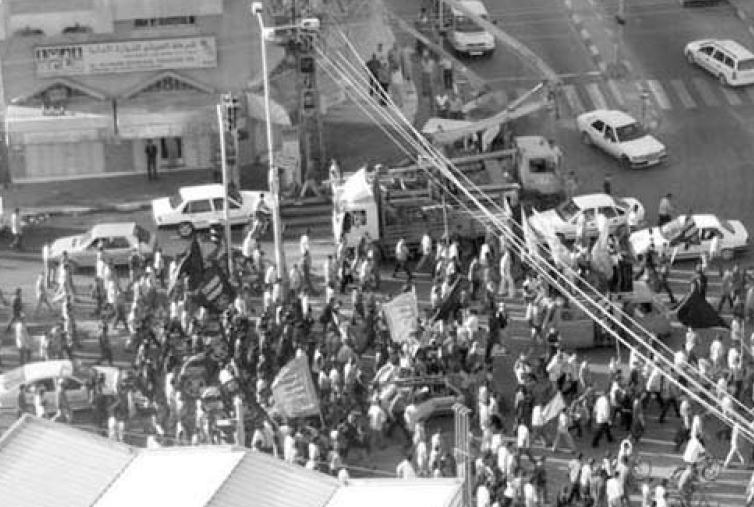
The crucial event of the two-month strike was
a huge demonstration on November 17 in Rabin
Square with a crowd of between 70,000 and 100,000.
No trade union or social movement in Israel had
ever organised so large a turnout. The square has
held big crowds on issues of war and peace, but
never have so many gathered over a social issue. In
recent years, when the Histadrut (General Labour
Federation) organised labour disputes, these
usually involved a particular industrial branch.
Even when it has called a general strike, never have
the workers gone into the streets for weeks on end
all over the country.
The decision to take to the streets was not made
by the leadership of HSTO. It was a spontaneous
initiative. Tens of thousands participated: teachers,
high school students and the parents’ associations.
This direct-action struggle set the tone for a new
social movement, which discovered itself in the
process. It may again raise its head in the future to
oppose the globalised capitalist elite in Israel.
Challenges
Some negative factors in the strike, included
the Histadrut. Ofer Eini, its head, who offered
himself as mediator, was a Trojan horse to prevent
concessions to the teachers. His motive was
understandable: the Histadrut, as the ITU, had only
just negotiated a miserable deal for the elementaryschool
teachers, and this would explode if the
HSTU (which is independent of the Histadrut) got
more. Eini’s various compromise proposals always
suited the Finance Ministry.
Another negative factor was the Labour Court,
founded to defend worker rights, including the
right to strike. In the strike the Court supported
the government’s position and issued restraining
orders, claiming that the strike was of a “political
type” and not purely economic. When the Histadrut
allies with the government, workers do not have
a chance at the Labour Court. The court’s decision
to force the teachers back to the classrooms, even
without an agreement, expressed its bias in favour
of the employer. Legally, restraining orders are a
sanction to be applied in only two cases: an illegal
strike or an emergency in the supply of vital
services (electricity, water, lifesaving, etc.). Since the
teachers’ strike falls into neither category, the use of
restraining orders must be seen as a grave blow to
workers’ rights.
The strike surprised the government. It must
be admitted, however, that the union was also
caught off guard. It was not prepared for a long
struggle. The union was unaware of the grassroots
frustration. The union had never before seen itself
as a leading factor in the social struggle. It had
never taken initiatives during labour disputes.
In the strike itself, no voice was given to the
special claims of the Arab sector, which suffers from
systematic discrimination in the field of education.
No Arab spokesperson appeared in the media or
at the rostrum in Rabin Square, although the Arab
teachers took part in the strike.
Social change
The hostility of the government, the Histadrut and
the Labour Court raises the question: what coalition
of forces can support the teachers in the future—or
workers in other sectors?
We, the relatively young teachers, need to run
as candidates for positions in the union. We need
clear positions – not just on wage issues – on what
is happening in the society. The task is to create a
socially-conscious labour union.
There is a long way to go, it is clear that before
workers can restore power to their organisations
and create the kind of solidarity that overcomes
boundaries of nation and class. The teachers’ strike
showed the reluctance of existing organisations like
the Histadrut when it comes to resisting neoliberal
capitalism. We may take courage, however, from
the fact that the strike created new models of
struggle. It raised the consciousness of many Israelis concerning the harmful consequences of neoliberalism. It showed that resistance is possible. From the ranks of the teachers came voices calling for a socially-conscious labour union. The strike may turn out to signify an important step on the road to social change.
Edited & syndicated, Workers’ Advice Centre, an independent Labour Association in Israel. www.workersadvicecenter.org/teachers_strike3.htm
Leave a Reply
You must be logged in to post a comment.