
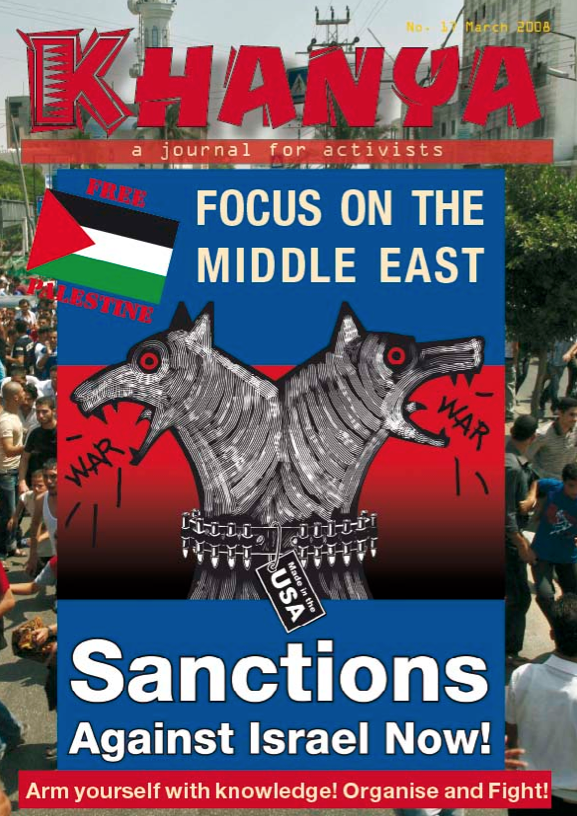
Celebrating 5 years!
At the end of 2007 we celebrated the fifth anniversary of the Khanya Journal, which arose out of the struggles and the needs of the emerging social movements in the World Summit for Sustainable Development (WSSD) 2002. The need for a journal for activists was to assist in the clarification process, of the struggles affecting the working class. The Journal has been linked to the ebbs and flows of the emerging social movements. Our stated aim then and which we reconfirm, is
to assist with the building of a new cadre, steeled in the theory and practice for social change. This is necessary in the struggle against neoliberal capitalism internationally, and as it is being implemented by the ANC government in South Africa today.
In January this year, the Editorial Collective (EC) met to evaluate its work over the past five years and to develop new perspectives and tasks for the future. In this edition, we include an editorial, highlighting the EC’s perspectives and future tasks.
special edition Middle east
The Journal’s first discussion on the Middle East, on the eve of the United States war against Iraq, was on ‘War and the Struggle against Imperialism’ in March 2003. In that edition we debated the sources of the war, and US imperialism’s need to control the region particularly because of its interest in the quality Iraq oil.
Notwithstanding the might of the US Army, there is resistance in Iraq to US occupation; and Palestinian youth have consistently kindled our own humanity against injustice, with their struggles against Israeli aggression and Occupation.
The aim of this Special Edition on the Middle East is to give activists a sense of the issues, the struggles and the challenges in that region. While a large part of this focus is on the struggle for Palestine – the struggle of our times – we pick up on some of the related struggles in Lebanon, Iraq and in Israel.
Palestine
In Palestine, despite the recent ‘peace talks’ in Annapolis, in the US in December 2007, Israeli occupation continues.
The first article, a speech by Ronnie Kasrils to the South African Parliament in June 2007, gives an overview of the historic origins of the struggle in Palestine and the birth of the Zionist Israel state in 1948.
The Study Groups are encouraged to read this article together with the Education Section first, to get a clearer understanding of one of the key conflicts, if not its axis, in the Middle East.
Suren Pillay discusses the fragmentation of Palestine and the role of the US in undermining Palestinians’ choice, Hamas, democratically elected in 2005.
Ali Abunimah, in his interview argues for the ‘one-state solution’ for all the people of Palestine, Jews, Muslims and Christians.
Lamas Andoni’s tribute to George Habash, founder of the Palestinian Front for the Liberation of Palestine, and raises key struggles within the PLO, including the ‘one-state solution’.
Islah Jad’s discussion on women’s rights in Occupied Palestine looks at the different ways in which women are portrayed in the struggle.
Omar Barghouti discusses the need to support the boycott, divestment and sanctions campaign against Israeli Apartheid.
lebanon
In 2006 Israel invaded Lebanon, unleashing violence on the civilian population. Jonathan Cook discusses Israel’s attacks on civilians in Lebanon. Yacov Ben Effrat discusses the influence of the invasion and the political rivalry between the contending ethnic-religious groups – Christians (Maronites), Druze, and Shia and Sunni Muslims, (including the intervention of Syria and Iran).
Iraq
Despite brutal occupation and the Interim Government, the US has struggled to get its hands on Iraq oil. In a rare interview with resistance leaders, Seumas Milne reveals the resistance initiative to form a united front with a political programme. Key aspects of their political programme, which is different to Al Qaeda, is also outlined.
The Joint Statement (2006) by five Iraqi Trade Union Federations, reflects the opposition to the World Bank and the IMF, including privatisation, from Iraq unions. Sharon Smith raises issues for debate in the US anti-war movement about Iraq’s right to resist occupation, and is relevant to how we build solidarity.
Israel
While the focus has largely been on military expansionism, little is discussed about the struggles within Israel. Gabriel Ash argues that its military defeat in Lebanon and the internal tensions have made Israel unstable. Daphna Baram picks up on this and argues that neoliberalism – cuts in benefits to single mothers, the disabled and the unemployed is bringing the ethno-socialist foundations of the Jewish state to an end. The recent teachers strike in 2007 against neoliberalism – was an example of struggle from below. Aharon Shabtai shows that this struggle won’t be easy as he reflects on the influence of the occupation on culture in Israel.
The education section
This section focuses on the historic origins of the conflict in Palestine – from 1948 to the present period – and is accompanied by a chronology of the major events in this history.
new!!! study group Corner
We are excited about our new section, Study Group Corner, written by members of the Journal Study Groups (SGs). This section focuses on the experiences and debates of the SGs. We encourage all study groups and book clubs to use this space. In this edition, Letsele Lathuto Book Club, based in Soweto, discusses their aims, the books they read and their plans for 2008.
documents & glossary
This edition ends with the Documents section some of the historic documents related to the Palestinian-Israeli conflict – and a Glossary of some of the terms used in this edition.
Best wishes for 2008. Forward with the struggle for the emancipation of women and the working class. Aluta continua!
yours in solidarity savera Kalideen – guest editor
Maria van driel
Convening editor
Leave a Reply
You must be logged in to post a comment.