
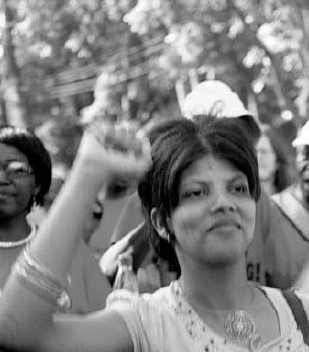
Maria van driel* reflects on the discussions and debates on gender and women’s emancipation at SASF.
The 3rd Southern African Social Forum (SASF) was held at Civo Stadium in Lilongwe, Malawi, from 13-15 October 2006. 2006 is of historical importance because it was a year of preparation for the first World Social Forum to be held in Africa, in Kenya, in 2007. The SASF drew about 3000 activists of all ages, who travelled in minibus taxes and buses, many spent sixty hours travelling. The activists came from all the countries in the subregion, except for Namibia and Mauritius. Among them were many women, some with children, youth, NGOs, the informal sector, community based organisations, trade unions, the churches and the social movements. The labour movement was very poorly represented.
The SASF was well organised and the main theme was ‘Unite against Poverty and Oppression’, to build solidarity, build organisations and to mobilise all working people. Inside the Stadium ten tents housed the different sub-themes and/or sectors, including gender, the trafficking in women and children, Hiv/Aids, illegitimate debt, governance and democracy, and traditional leaders. A defining feature of the SASF was that a significant number of working people, drawn from grassroots organisations and the social movements and with significant representation of women, were vocal in the different activities. The SASF gave one an opportunity to reflect on issues of gender and women’s emancipation.
- Putting women’s emancipation back on the agenda
Historically, there have been debates, struggles and expectations in this subregion – although uneven – on issues related to liberation from exploitation and oppression, including the need for women’s liberation. This can be traced to the national liberation struggles in the subregion. Later, under independence, many of these struggles and expectations were ‘sold out’, ‘forgotten’, and watered down. Here and there they were included social movements. The women participants were generally very vocal, and participated in the different activities. This is important in the struggle for gender equity, although there is the need to ensure that this does not end with women’s representation.
Besides the presentations on ‘women and gender ’ by women, there were a number of women who did presentations on sovereign debt, on housing and so forth, but we still have a long way to go in this respect.
- the composition of the SASF
There is a growing awareness of the need to integrate women’s emancipation centrally in the struggles of the social movements. This is uneven, however, and is related to movements’
overall perspectives. Thus far organisations and movements are becoming more self-conscious, taking into account the composition of their delegation to ensure that women are included. While this reflects the general composition of the movements, it has to some extent also been assisted by funding-conditionalities. The composition
of the SASF comprised women from different sectors, including grassroots organisations and social movements. The women participants were generally very vocal, and participated in the different activities. This is important in the struggle for gender equity, although there is the
need to ensure that this does not end with women’s representation.
Besides the presentations on ‘women and gender ’ by women, there were a number of women who did presentations on sovereign debt, on housing and so forth, but we still have a long way to go in this respect.
- Developing gendered analyses & perspectives
At one level the SASF reflects the rebuilding of social movements, after a period of some quiet, following the liberation struggles in this region. There are two aspects that are relevant here:
- a) On the one hand the emerging social move- ments reflect the unevenness in perspectivesin the development of a comprehensive under- standing of neoliberal capitalism, and women’s oppression today. To a large extent the SASF activities did attempt to make the links and connections of specific issues of neoliberalism, but this link did not always include an inte- grated understanding of women’s oppression and social class. For instance, the SASF theme:
‘Unite against Poverty and Oppression’, to build solidarity, build organisations and to mobilise all working people was a general focus. In the context of Southern Africa, we did not focus on important aspects such as colour, social class and the gendered nature or the femi- nisation of poverty. That is, that the dominant face of poverty is all too often a black woman,
or a black girl child. And the question we must try and understand is why is it that women and children are the most vulnerable, and the most impoverished in society? The aim here is not to ensure uniformity but to develop diverse perspectives to assist social movements and activists to make sense of the world and to un- derstand the broader picture: the trafficking in women together with sovereign debt, the HIV/ aids pandemic and women’s increased labour in the home.
- b) Similarly, to advance the struggle for women’s emancipation, the content of our analysis needs to go beyond the generality of specific issues such as the struggle against the IMF/World Bank debt or the privatisation of water. It is important to illustrate specifically how these issues affect working people, and specifically how they affect men and women differently. This will enable movements, both men and women, to understand and confront patriarchy (male dominance) and the subordinate position of women as a united social force. This will strengthen the social movements’ understand- ing of the issues, and help to develop strategies and organisational methods to respond to these issues and struggles comprehensively. A similar shortcoming can be seen in almost all the sectors or subthemes: while all the issues taken up in the subthemes affect women and men different- ly, we dealt with them in general and we failed to sharpen our understanding of the gendered nature and the gendered aspects of these struggles. This is important as these key sub-themes reflect some level of organisational work in the subregion, and constitute important lessons of the past. We cannot leave the emancipation of women to a second stage, we need to under- stand it and struggle for it as one struggle with the emancipation of all working people.
We also need to revisit what we mean by women’s emancipation. Through many of the UN-related activities, aid-related activities, and particularly through some NGOs and project-related activities, the emphasis has been on ‘gender equality’ and ‘gender-mainstreaming’. That is, the gradual changing of men and women’s attitudes through NGO activities. This approach has taken us very far from our initial goal of women’s emancipation.
In one of the key women’s discussions at the SASF, the discussion focused on developing an ‘African approach’ to gender. What become clear is that we need to go back to our history, before the arrival of the colonisers, and to understand previous societies comprehensively, the wealth, the developments, the civilisations, the social divisions and the inequality that existed. This will enable us to appreciate more concretely the debates on an ‘African approach’ to women’s emancipation. Some women also believed that we should not ‘exclude’ men, and that this was a ‘western approach’. It would seem that the focus and the organisational practices around ‘gender and gender mainstreaming’ has to some extent watered down the initial concept of women’s emancipation.
While the SASF in Malawi had these and other shortcoming with respect to the development of a concept of women’s emancipation in the Southern African context, it was an important step forward in the struggle for women’s emancipation.
Maria van Driel* is member of the Editorial
Collective of the Khanya Journal.
Leave a Reply
You must be logged in to post a comment.