
Maria Van Driel* argues that a downturn in international struggles mainly accounted for a low-key WSF in Nairobi.
The 7th World Social Forum (WSF) took place in Nairobi, Kenya, in January 2007. This was the first time that the WSF has ever taken place on African soil. The WSF brings together the global justice movement in an open space for solidarity, debate, diversity and the search for alternatives internationally. The WSF also brings together new forms of social activism, and is an important space to transform, engage and shape the global justice movement.
who came to nairobi?
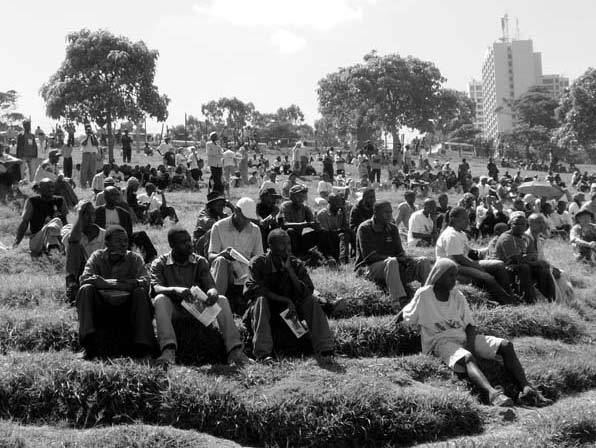
The capital city of Kenya, Nairobi is home to three million people. This East African city is a thriving pulse of vendors, Masai markets, multinational companies, dense housing slums, traffic congestion and traffic pollution. Between 20 000 and 30 000 people – academics, activists from social movements, ngos and religious institutions – converged from all over the world. The organisers expected more participants given that previous WSFs comprised of between 60 000-100 000 people.
The single biggest delegations were from Asia and South Africa/Southern Africa. On the whole there was a small group of participants from the different countries in Latin America. This was both disappointing and surprising given their historic dominance at the WSF, and in particular, given the victory of left-wing governments on that continent at the moment. The academics, perhaps not as numerous as before, were present in their search for alternatives, and to make their contribution to the global justice movement. The labour movement was poorly represented internationally, but especially from Kenya, the host country, and South Africa and Nigeria, which have substantial trade union movements. Many of the ‘big names’ or the usual ‘WSF stars’ were also absent.
Towards an assessment of wsf
It is generally accepted that bringing together so many activists from different sectors and from all over the world would be extremely colourful, stimulating and interesting. It is fair to say that the world justice movement was generally represented; wars, Iraq, Palestine, Somalia, gender, sexuality, reproductive rights, religion, the environment etc. were raised through seminars, assemblies marches, movies, panel discussions and so forth. The dalit (untouchables’) drums, though fewer than in Mumbai, reminded us of the need to overthrow and bury all forms of oppression and exploitation.
A broader framework though is necessary to go beyond the events, to assess the WSF more soberly in terms of what it represents for the global justice movement. The WSF is not a government or a highly centralised body with limitless resources. It is a barometer of the struggles of the social movements at the global and local level, their interaction, and the social energy they bring to the WSF, which then assist in boosting the morale and the social energy of all the movements internationally. Previous WSFs have been characterised by the build up and social energy of international struggles. For instance, the struggles and social energy of the social movements in Brazil – in particular the Workers’ Party (PT), the trade unions and the landless people’s movements (MST) – gave birth to the first WSF in Porto Alegre in 2001. The first WSF also took place against the backdrop of international mobilisation at Seattle against the WTO, IMF and World Bank. In 2002/03 the anti- war movement underpinned the WSF, including the mobilisation in Genoa. But by the time of the WSF in Mumbai in 2004, the anti-war movement began to wane. The WSF Mumbai was carried instead by the mass of the social movements from India itself. At the polycentric in Caracas in 2006, the WSF took place against the backdrop of the defeat of US imperialism through the mass based victories of Hugo Chavez (Venezuela) and Evo Morales (Bolivia). This accounted for the immense social energy at the WSF. But in Kenya, the WSF took place against a downswing or decline in international struggles. Hence, despite the many successes at the WSF, the mood in Nairobi was low- key.
African Social Movements
Often, the presence of the masses compensate for organisational and other weaknesses. Their absence from Nairobi meant the WSF in Kenya was an organisational and political disaster, a microcosm of the broader society on a number of levels. In Kenya itself, the social movements failed to make their imprint on the WSF, which was dominated by NGOs and the middle class leadership. This is reflected in the high registration fees which excluded most Kenyans from social movements and community based organisations. For the first three days, while a struggle against the high fees (sit-ins, marches and arrests) took place, Kenyans were a minority at the WSF. Besides the prohibitive fees, the venue was inaccessible and the registration process reflected the corporatisation of theWSF, which many activists criticised. Registration was based on buying a starter pack of a particular cellular company. This locked participants into its network, and reflected the participation of the multinationals at the WSF. One of the organisers of the WSF pointed out: ‘in the preparation for the WSF we have also had to contend with the ‘relatives’ or the kickbacks and corruption that plague Kenyan society’. One of the WSF restaurants belonged to the Minister of Internal Security, an alleged torturer of the Mau-Mau freedom fighters during British colonialism. Activists forcibly closed down the restaurant and distributed the food to the children.
These developments raise important questions about the role of African social movements in the preparation of the Kenyan WSF. A number of papers on the process, the programme and the methodology were circulated prior to the event but this met with no engagement from other social movements on the African continent. In the context of a receding global movement, and in the absence of the Kenyan (and other African) social movements to anchor the WSF, the internal weaknesses in Kenya were very likely to be reproduced.
International Council
An assessment of the WSF Nairobi cannot ignore the role of the WSF International Council. Apparently, after some promises were made to assist with fund-raising, as it has done for all previous WSFs, the International Council informed the Kenyan organisers that they would have to raise the funds themselves. At the same time there are allegations of ‘strategic’ interventions by the WSF Council, on the use of certain consultants and the media, for example. Clearly, more information and transparency is needed, but this does not prevent one from questioning why WSF Nairobi did not build on the organisational and programmatic continuity, experience and strengths of previous WSFs. Without being dictatorial and centralised, organisational continuity and oversight is an important role of the Council. For instance, at Mumbai and Caracas, Open Source software was used, but not continued in Nairobi. It is too easy and unacceptable to dismiss this as once again, ‘an African mess’. The Southern African Social Forum in Malawi, although much smaller, was simple and well organised, and reflected the general status of the majority of people living in that country.
In terms of the programme, there were 21 themes. The Peoples’ Assemblies ran parallel to each other, which made it difficult to develop a comprehensive programmatic summing up of the WSF. The organisation of the WSF did not enable different analyses to contend and debate the complexities, interrelatedness, and the alternatives. This was a huge weakness as the ills of neoliberalism were continuously described. But assessments of the international situation and the state of international movements, how to rekindle and deepen resistance, and the importance of theory, remained elusive. In one Assembly, Boris Kagalitsky lamented: ‘We knew about neoliberalism before we came here. The point is, where to and how?’
victories and the social movements
The PT victory in the state of Rio Grande do Sul was reflected in the support for the WSF at Porto Alegre in 2001. Similarly, the victory of the masses in Caracas underpinned the WSF there in 2006. What has been the relationship of the left wing victories to the social movements in those countries, and to the WSF? Despite the huge electoral left wing victories in Latin America, this was not reflected in the delegations from Latin America. The question is: to what extent are the Latin American victories permeating the WSF and galvanising social movements internationally? Maybe one needs to take a closer look at these electoral victories in Latin America and what they mean for the movements, and for the left.
Abuse of wsf space or a space to Engage?
The WSF has been heralded as an open space to promote tolerance and for different views to contend. This WSF seemed to have been dominated by different very religious groups. While one acknowledges the role of liberation theology, of progressive spaces and struggles within different religions, this prominence might be due to the weak profile of the social movements. At the same time, an anti-abortion march was held by participants at the WSF. The question is: should there be limitations such as the exclusion placed on political parties, governments and those who adopt the use of violence in struggle? Are there not basic human rights that are not negotiable? At the same time, as the WSF is a microcosm of broader society, should we accept anti-abortionists (within limitations, given the violent behaviour of some groups in the USA) as a basis to engage and persuade, and not curtail their freedom of expression?
Power relations within the WSF operated on a number of levels; the north-south divide, horizontal power relations within the north and within the south, colour, gender, social class, ‘those who arrived and those who have not yet arrived’ and especially the dominance of the middle classes in Kenya versus the working poor, NGOs versus social movements, the dalits and the Brahmin leaders, and so forth. The ‘stars’ who often don’t represent anyone, were still present, but the numbers were somewhat reduced. These are the power relations that permeate broader society. There needs to be a more conscious theorisation about the form and content of the WSF. In this all social movements and activists have to take responsibility. A number of progressive academics/activists participated in events at the WSF. While the numbers were reduced, still, it reflected the desire to ally with social movements in the quest for an alternative society. Clearly, more academics/ activists from the south should be encouraged to participate in the WSF and the social movements. There is a need to struggle, to build the global justice movement internationally, in a way that includes the participation and contribution of all, wherever they are located.
Transforming the wsf
The importance of the WSF in the context of building the global justice movement at home, on the continent and internationally, cannot be overemphasised. While some are making the call that ‘another forum is possible’, this needs to be struggled for. The WSF is a microcosm of the movements and broader society internationally. Hence it is subjected to the vagaries of struggle internationally, and the permeation of capitalist influences. The experience of Nairobi has once again raised the importance of anchoring the WSF in the democratic participation of the masses, and self- conscious and democratic organisation. This does not mean the WSF must become highly centralised or a government, but political leadership is needed. The WSF must become a space that is imbued with and reflects the values of an alternative society. This is possible and must be struggled for as an integral part of the struggle for another world. This was blatantly revealed at the WSF Nairobi.
Leave a Reply
You must be logged in to post a comment.