
In this article Nerisha baldevu discusses the Social Forum in Mali. She argues that there are pressing issues which the WSF needs to address.
The Polycentric World Social Forum took place from the 19-23 January in Bamako, Mali.
This was one of the three polycentric events planned for January 2006. The other two social forum events took place in January 24th to 29th in Caracas (Venezuela), and Karachi (Pakistan), in March.
The Mali statement, arising from the Bamako Forum recognised the WSF was “of paramount importance to people in Africa who are victims of the neoliberal system which is itself synonymous with violence, suffering, poverty, and exclusion to over one third of the global population. This meeting was the very first opportunity, following the huge popular resistances during the nineties, to consolidate their alternatives in a global context, to construct a fair world based on solidarity and respect for people’s sovereignty”.
Themes
The themes of Bamako 2006 were shared with the other polycentric forums. They were:
- War and Militarism-Security and Peace
- Globalised liberalism
- Aggressions against the peasantry
- Alliance between patriarchal and neo liberalism systems, and marginalisation of women’s fight
- Culture, Media and Communication
- Destruction of ecosystems, biological diversity, and resources control
- International order
- International trade, debt and economic and social policies
- Social fights, social and human rights, social organisations, and political rights
- Alternatives
Political Challenges to the Social Forum Processes
- Nationalism
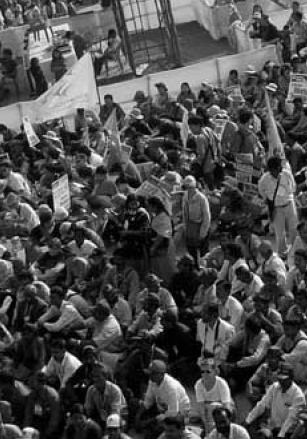
The Bamako PWSF 2006 kicked of with a march of almost 7000 participants, many with placards, posters, puppets, clothes, masks and costumes that brought to the forum the nature of their struggles at home and globally. The messages ranged from cotton farmers and their produce rights, to trade
issues, unemployment, globalisation and its effects, to countries still fighting for independence and the right to self-determination.
A group of about 100 activists, mostly from the POLISARIO Front, marched through the streets of Bamako carrying a huge flag of the Saharawi Republic (Western Sahara), the only remaining colony in Africa. Western Sahara was a colony of Spain until 1976. In November of 1975 Morocco mobilised over 300,000 civilians to march across the Moroccan border into the territory. Known as the Green March, it was successful in:
- Moving permanent Moroccan residents into the territory;
- Making way for Moroccan troops to enter the country after Spain’s departure; and
- Putting pressure upon Spain to relinquish the ter- ritory to Morocco and Mauritania.
Both Morocco and Mauritania laid claim to Western Saharawi, basing their claims on former imperial geographic borders. Morocco’s claim was based
on the borders of the “Almoravid Empire” of the 11th and 12th centuries, while Mauritania claimed
that historic tribal affiliations to this same empire stretched deep into Mauritania. Mauritania renounced its claims in 1979. The United Nations and the International Court of Justice never recognised either claim.
While Western Saharawi brought this issue to the Social Forum, Moroccans on the march did not support the Saharawi people’s demands. Tensions erupted at the end of the march, at Modibo Keita Stadium where both groups displayed their national flags. In response to the clashes between these two groups, the organisers of the WSF Bamako called in the Malian army to diffuse the situation and asked both groups to leave the stadium.
The organiser’s response raises questions about the commitment of the WSF process to legitimately provide a platform for the creation of another world through open debate and discussion. The struggles of occupied peoples like the Western Saharawis
or the Palestinians are legitimate struggles against injustices imposed on them by occupying forces. Such confrontations require political intervention by the WSF rather than a blanket condemnation and punishment.
- Use of the Army
The Malian army was out in full force during the forum at the request of the organisers to help maintain order. They were called in on the first day, in their army trucks and with their weapons, to get WSF participants in orderly lines for the registration process. They were present along the entire route of the Opening March, and they were at the entrances to all the forum venues. Their presence caused much disgruntlement among the activists and changed
the dynamics of the forum. The WSF in Mali was
a subdued affair, more of a talk shop than activists meeting to make another world happen.
While not all activists are antagonistic to their governments, if the WSF rules of participation do not permit the participation of progressive forces such
as the Zapatistas of Mexico (because of their violent resistance to oppression), then there needs to be rules on the use of government security forces at the WSF.
- the African Agenda
An ongoing complaint from Africans about the WSF, is the lack of an African focus, even though it was taking place in Africa. Part of the problem is the weakness of the African left and its organisations in different African states. African countries do not go to the WSF with an alternative African perspective, the perspectives are more nationalistic.
Two related issues are those of who participated in these events, and who drives the processes. According to organisers, almost 20 000 people from Africa and
Europe attended the WSF Mali. With few exceptions, discussions and panels were lead by, chaired or made up of European activists. While African organisations need to take some responsibility for this, the WSF processes needs to deal with this.
A further point of consideration is the frequency of meetings – national, regional, continental and world forums all take place in the space of a year. With the extreme limited resources of most social movements and community organisations, it is inevitable that the people who participate (and dominate) in the forums tend to be NGOs rather than grassroots activists.
- Accessibility
According to organisers of the WSF Mali, almost 10
000 Malians were brought to the forum. While there were a few Malians in sessions –the WSF excluded Malians. Mali is the third poorest country in Africa, where trained teachers earn the equivalent of R280 per month. So paying US $4 for the WSF registration fee was more than most Malians could afford.
- the Women’s World
The Forum took place in 11 different venues scattered across Bamako. Taxis were required to travel between most venues. All issues related to women and gender discussions took place in the Palais de la Culture, under the title of Feminist Dialogue.
Bamako is a city undergoing reconstruction and
the Palais de la Culture was no exception. It was noisy, with hundreds of workmen, construction equipment and cement blocks, littering the area set aside for “women’s discussions”. This was besides the general disorganisation of the WSF, the lack of chairs, sound systems, translation equipment and translators.
Conclusion
The WSF Mali was a disappointing, subdued affair. Its organisation, and the challenges that arose, need urgent attention and action from the International Council of the WSF and the African Council if the WSF in Nairobi is to be a success.
*Baldevu works at Khanya College and is a member of the Regional Organising Committee of SASF.
Leave a Reply
You must be logged in to post a comment.