
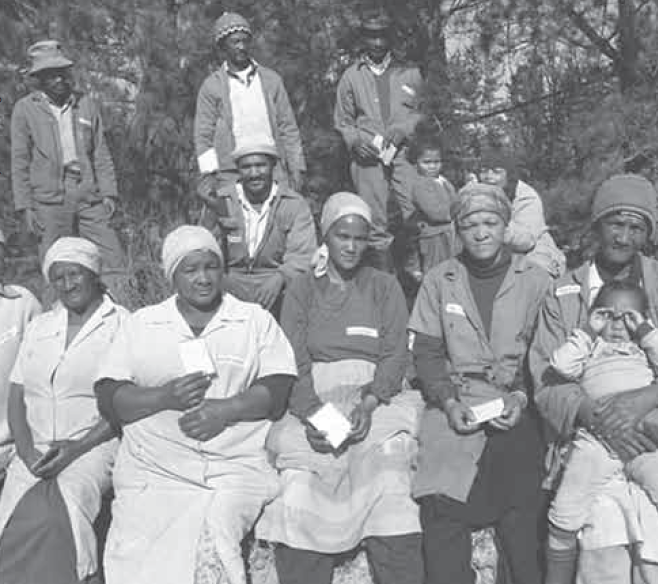
Maria van Driel discusses the changing family in SA and the need to consolidate some of these changes as part of the struggle for gender equity.
Gender refers to the social relations between men and women in society. Gender relations are not natural or based on people’s physical anatomy, rather they are socially constructed and reflect the way a society is organised, its norms and values. Gender relations have changed over time, which means they can be changed. While we have not achieved equality, let alone gender equity in South Africa, there are some positive changes and possibilities in gender relations with regard to the family.
The ‘nuclear’ Family
In South Africa, the nuclear family is the western traditional capitalist model of the family, based on heterosexual relations, two parents, a man and a woman. They are married either legally or through recognised Christian church ceremonies and only have children in wedlock. The husband is the breadwinner, and the wife keeps the home fire burning, and looks after the children. The husband is the head of the family, the decision-maker and the wife, generally ‘knows her place’. The husband and wife are sworn to fidelity to each other in a monogamous relationship, the form of relationship acceptable under capitalist society. However, in some cases it is ‘acceptable’ or society turns a blind eye to male indiscretion or adultery. But, it is totally unacceptable for women to even cast a roving eye, let alone act on their impulses. In general, sexual freedom for men and women and premarital sex is not promoted, but brothels, prostitution and adultery exist. The double standards practiced under capitalism generally favour men because of patriarchy which pervades the society.
The nuclear model of the family has changed with time due to the historical struggles of working people, and especially women. It has become more acceptable for women to work and pursue careers and to have (some) rights, although this is still within patriarchy and capitalism. The dominant gender relations in society remain. Under neoliberalism a more conservative form of the nuclear family is being promoted by the United States president, George Bush. This is to exercise control over women, and to keep them focused on the home and the family, thus undermining the historical achievements of women (and men’s) struggles.
In South Africa the nuclear model of the family still exists and is still largely perpetuated through schools, religion, and the media. However, there are other forms of the family that exist in South Africa, some more prevalent and others, that are emerging as a result of the changes since 1994.
The migrant family
While urbanisation was rapid especially after the
1992 unbannings, the migrant family still exists in SA. The husband works in the urban centres while the wife is left in the rural areas (Bantustans). The migrant family has its origins in the rise of capitalism in SA. This has had a significant impact on the family and gender relations in society as a whole. Traditional societies were uprooted, communities and families ripped apart as men were forced to work in the cities where they lived in single-sex compounds. Apartheid consolidated this – black people were only allowed in the city to work. Wives, children, and the aged were forced
to stay in the Bantustans. The separation between husbands and wives, the forced separation of families, must have impacted on gender relations in the family, and relations between children and their parents. For example, the long absences from home and from loved ones must have impacted on people’s sense of security, values, self-esteem and their dignity. The extent of the impact still needs to be investigated.
The continued existence of the migrant family indicates that patterns of work that existed under apartheid have endured. For example, the mining sector is still based on migrant workers. Domestic workers and many other unskilled and semi-skilled migrant workers continue to work as migrants, separated from their families. Despite promises to upgrade the notorious single-sex compounds, this has not occurred significantly.
The housing backlog is a further deterrent as many continue to provide their own shelters in squatter camps. Many migrants claim that the cost of living in the cities is too expensive, while wages have not increased enough to enable them to bring their families to the cities. (Interestingly, apartheid justified low wages because men had ‘access’ to land in the Bantustans.)
Within the migrant family, the patriarchal relations remain. Although women run the household in the absence of the men, the male or husband is still head of the family. In the cities, husbands resort to ‘girl friends’ or additional ‘wives’. This is acceptable within patriarchy and the double standards that generally exist. On a human level, a ‘second family’ and/or a relationship in the city is understandable (even if temporary), given the harsh isolation and loneliness under apartheid. Here one is not condoning some migrants’ behaviour, just merely trying to understand it. Domestics are often single women, often separated from the fathers of their children and/or were never married. They continue to support their families in the rural areas.
‘Vat en Sit’ or common-law
The ‘vat en sit’ or the common law family of two heterosexual (and later homosexual) partners living together has been around for some time, and has become quite common place across social classes but especially amongst the working class. Previously it was rejected as morally wrong, as ‘living in sin’, and/or represented no security for women. (Not that there was much security, especially for black workingwomen.) Partners live together without being formally married and children born into these relationships bear the name of their mother.
The origins of this form of the family has its roots in apartheid which forced husbands and wives to live apart, and gave rise to particular relationships forming. The general insecurity, uncertainty, and constant movement of people almost favoured this form of the family. No legalities were necessary which was a relief under stringent pass laws, and other draconian legislation, and it accommodated migrants who might have had families elsewhere.
While common law relationships existed before, they gained new legitimacy and protection with the new progressive constitution adopted in 1995. These partnerships have been recognised by SA law, and accorded similar rights to those of married couples. These rights and legal recognition extend to same-sex relationships, which is progressive.
This form of the family is still largely patriarchal reflecting the norms in the society. These relationships are generally monogamous, especially for the women. However, women in these relationships have relatively more freedom in their mobility and their ability to leave a relationship.
Single women family
A significant number of single-parent families are headed by women. This cuts across social class and is prevalent amongst black working women. Most of the women are their children’s breadwinners (and their parents, in some cases).
There are some male-headed households, but this is not widespread.
There are many reasons why there are single women households. This could be the result of relations with a migrant father who has a family elsewhere. Or, the migrant has moved on, or by mutual consent, has other relationships. The maintenance laws for men are not implemented and men seldom take this responsibility. Many women prefer the hardship of bringing up children than what they perceive as the humiliation of seeking maintenance from a (patriarchal) legal system.
Women do not have the same sexual freedom as men, and this is influenced by patriarchy. Often they continue the relation with the father of their children, in some cases they may have other partners, but this is rare.
Pensioners/child-headed households
The HIV/Aids pandemic has led to a significant number of child-headed households. There are numerous cases where both parents have died of HIV/Aids and the older sibling has to care for the younger ones. In these cases, the children are robbed of their childhood and forced to look after younger siblings and even older family members.
Similarly, pensioners increasingly head many families. In the twilight of their lives, after much toil, the aged are forced to head families. This is due to a number of factors such as the death of parents from HIV/Aids and the financial dependence on pensioners as the only source of income.
This is a result of the neoliberal policies of the SA state and the absence of a social net. Since
1994, one million jobs have been lost through retrenchments and the privatisation of basic services. Unemployment and the increase in user fees for school fees, water and energy has placed an enormous burden on working people. The impact of neoliberalism under the ANC government has significantly weakened the extended family. The extended family has its roots in indigenous forms of societies, which survived apartheid, but has become particularly strained and fragmented under the current regime.
Women who choose to be alone
There is an emerging tendency of young, black middle class women who choose to live on their own. As breadwinners, financially independent, they are choosing to have children out of wedlock. These women are making a choice to live on their own, to choose partners, and to choose when they want to be with their partners. These young women do not want to be in conventional married and nuclear family relationships. They are exercising some level of sexual freedom. The new SA offers a range of possibilities to these independent women in terms of their career paths and their constitutional rights. Being single is a conscious choice and not a result of the social forces beyond their control, as with many single workingwomen. This is an interesting development in SA and raises a number of possibilities for women’s independence, and gender relations.
Sexuality
There is relatively more openness to discussing issues related to sex than previously under the National Party. This is due to campaigns around two main issues: the HIV/Aids pandemic and the rights of gays and lesbians. Adverts and educational programmes encourage women and young people to take responsibility to have safe sex. Encouraging women to demand a condom before agreeing to sex is important, but this is not the same as women demanding an end to the double standards around sexual freedom that exist for men and women. While women have the right to choose whether to have children, this does not amount to sexual freedom. For example, women are still blamed if they are raped. We still have a long way to go to achieve women’s right to sexual pleasure and to express their sexuality.
Increasing violence against women
There is a significant growing awareness of, and implementation of their rights amongst young women. But these rights come at a high price. The rise in violence against women and children is a reflection in many instances of men’s response to women’s rights. Many men are finding it traumatic to come to terms with what this means for them and their changing social status in society, in the township and the family. Some men believe that women are ‘usurping their authority’, have too much freedom and are bringing down relationships.
These tensions arising from the changes in gender relations and gender power struggles, have serious consequences for women’s security, for relationships in the home, the workplace and society as a whole. The high number of women that are killed by partners because the women have left them, reflects these gender power struggles. There has also been an increase in the violence against black gay women in the townships. Rape is used as a means to ‘straighten’ gay women.
Although many of the gains women have made are related to the struggles against apartheid, they were not specifically the result of vibrant struggles arising from a mass based women’s movement.
In some ways a public mobilising, women’s movement, which achieved these gains through struggle, would have provided the public space and debate to engage men collectively. The absence of a women’s movement also accounts to a large extent for the uneven and poor implementation of women’s basic rights, especially for working class women. In effect this weakens women’s choices in the home, the workplace and society, as women are left on their own, isolated, and have to make choices as individuals without the support of the collective.
New constitution
While we still live in a patriarchal or male dominant capitalist society, the South African Constitution guarantees women their basic human rights: women are no longer minors under the thumb of husbands, fathers and/or chiefs. Women have the right to maintain their own surnames even if they get married. The backward notion of ‘an illegitimate’ child has been abandoned as judgemental and derogatory. Children take on their mother ’s names with pride and without stigma. Women have the right to choose whether to have a child. These are progressive gains compared to many advanced capitalist countries where many social gains are under attack from neoliberalism. Despite many limitations, the constitution has made a difference to society’s and women’s perceptions of themselves. It acknowledges and legitimates the changing forms of the family in SA. This must go some way to undermining patriarchy, and hence the gender struggles taking place.
The new constitution has legitimised many forms of the family in so far as it guarantees women certain basic rights. Some key, traditional norms and values have been swept aside in practice and in law such as ‘illegitimate children’ and ‘living in sin’. Recognising the different forms of the family is important in the struggle for gender equity. The different models of the family are quite fluid and hold many possibilities to consolidate women’s rights and gender equity.
However, this does not mean that these gains cannot be reversed and we need to be vigilant about them. The neoliberal agenda of the SA government has encroached on these rights as it has done elsewhere. Already we observe that women cannot exercise their ‘right to choose’ where there are no facilities close to their homes. Many of these rights are only enjoyed by the few women who are aware of them and/or are able to exercise them. Working women, particularly black women, have been excluded from enjoying these rights given the limitations of their social positions. One of the major problems since 1995 is the lack of implementation of almost all of these rights. It is therefore imperative that we struggle for these rights to be meaningfully implemented and deepened as the only way to safeguard them. This is particularly significant in the rural areas where the chief and traditional leaders are making a comeback and women are largely isolated, with little if any public and/or organisational support. Already the Children’s Bill is being undermined by protests from people who wish to continue virginity testing of children.
Conclusion
There have been some significant changes in the family in SA which are guaranteed by the constitution. Clearly, these changes are having an impact on patriarchy and on relations between men and women, in some cases very tragically.
Whether these changes will advance towards more meaningful gender equity needs to be struggled for. The fact that women have these basic rights within a patriarchal society is an indication of the resilience of patriarchy. It is imperative that the rights of women are implemented significantly in both urban and rural areas, particularly amongst working women. In this way the constitution can be consolidated in practice, the only way for us to jealously safeguard these rights. By confirming the constitutional rights of women in practice, we can begin to the deepen the struggle against patriarchy in SA. It is important that we organise women and that this contributes towards the organisation of a broadly based feminist movement rooted in mass based struggle.
Maria van Driel is a member of the Editorial Collective.
Leave a Reply
You must be logged in to post a comment.