
ABET as a Building Bloc Towards Strengthening Social Movements
This article written by ABET practitioners – Themba Mbhele, Oupa Dlangalala & Takiso Matlakala – looks at how this type of education provides a space for illiterate people in South Africa to develop organisational and life skills.
Our’ involvement in ABET is based on the high levels of illiteracy in the Vaal and the unwillingness of the government to address this growing problem. As activists we are committed to organising communities to struggle for the realisation of the government’s promise to establish adult learning centres.
Many of the people living in the Vaal came from rural areas and was employed in companies like ISCOR and SASOL. These companies were only interested in making profits and not in the development of the workers and their families. Initially the big companies ran small literacy classes to ensure that workers could understand commands made by management and the bosses. With the restructuring and privatisation of many of the companies in the Vaal many workers were retrenched and were left without access to continue their skills training or education. These workers and their families have been left in informal settlements to fend for themselves.
When the new government came into power, schools started enforcing an age restriction, further contributing to many young people being left without access to education. Many girl learners who fell pregnant were removed from schools under the promise that they would be able to attend Adult Centres. These centres however, do not exist.
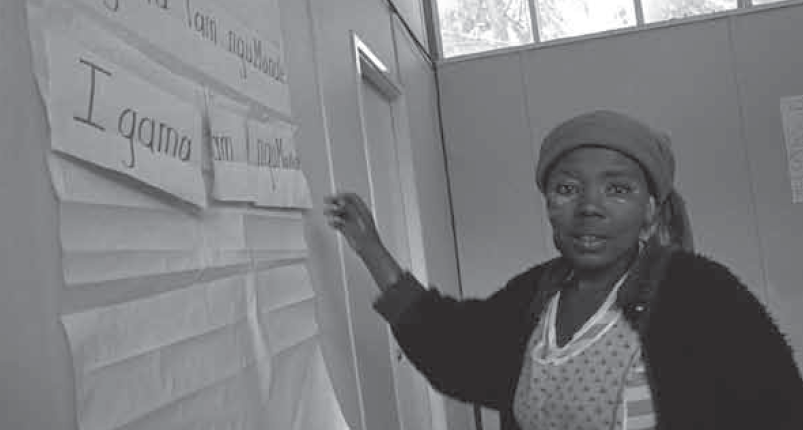
The ABET activists are organising literacy classes for adults and the training of facilitators, mentors and assessors. They are organising these Adult Basic Education classes with no support from government or private institutions. Even local school governing bodies are not allowing them access to school premises and facilities. Classes take place under trees, in their rooms, in shacks and wherever learners are prepared to gather.
THE COMMUNITIES AND LEARNERS WHO ARE PARTICIPATING IN THE ABET PROGRAMME
We are working with approximately 1000 learners, of whom 99% are unemployed women. The ages of the learners range from 25 to 75 years old. Most of the learners have no source of income. Many face not only economic hardships but a great deal of family and parental responsibilities. For many of these learners, learning can only take place if income generating activities, provision of food and childcare facilities are available. Regardless of these problems learners have shown a commitment to attend classes.
WHAT DO THESE LEARNERS AND THE COMMUNITY BENEFIT AND CONTRIBUTE THROUGH BEING INVOLVED IN ABET?
Learners in ABET not only learn to read and write, the classes also provide an opportunity to share experiences and views on the socio-economic situation in the country and what democracy is about. The classes also provide the space for the development of organisational and life skills.
THE CHALLENGES ABET FACES
The national constitution promises the right to basic education, including adult basic education but these rights remain on paper only. The Adult Basic Education and Training Act promises free adult basic education from levels one to four, which is equivalent to standard nine. But nowhere is this ABET being provided freely. Since these promises have been made, more Adult Learning Centers have closed down under the pretext of lack of funds. Even the South African National Literacy Institute (SANLI), a ministerial project, only lasted one year even though the project was supposed to be in existence for five years. The government claims it recognises the problem of illiteracy yet only one percent of the annual budget has been allocated to dealing with the problem. This is clearly grossly inadequate. The government is abandoning its responsibility to the millions of illiterate people, claiming that the Sector Education & Training Authorities (SETAs) will address the problem of illiteracy.
The SETAs are focusing on work based learning, excluding the millions of unemployed people from access to literacy. The children of the unemployed are further excluded from access to schooling through the implementation of user fees. Even when the Education and Training Development Practitioner SETA assisted with the recruiting of ABET practitioners, these practitioners are left with the task of recruiting learners who have no learning facilities, equipment or materials as they cannot access the skills development funds. The government is creating a generation of illiterate South Africans, pushing us into barbarism.
WHAT ROLE CAN ABET PLAY IN BUILDING THE SOCIAL MOVEMENTS?
The ruling elite feeds off people who are unable to read about the stories being told about them and who cannot write their own history. ABET classes provide members of the community with a space to talk about their problems and discuss ways of dealing with them. The classes also help to raise the profile of the community organisations and can assist with mobilisation. For example, assisting people with filling in indigent forms and accessing identity documents can help in mobilising people to demand basic services.
It is difficult for illiterate people to understand the rights enshrined in the constitution. Helping with literacy assists people in understanding their rights and fighting against any violation of these rights. Improvement in levels of literacy assists with raising confidence and a willingness to take charge of your life and struggle against injustices. Literate people are often more confident and willing to participate in community structures.
HOW CAN OTHER COMMUNITIES GET INVOLVED IN ABET?
It is important to firstly conduct a research study in the community to establish whether adequately resourced Adult Centres exist in the area. If these exist it is important to discuss how as an organisation you can build links with the Centre. Where no Centres exist the organisation can explore the possibility of establishing literacy units. From the Vaal we who are involved in ABET can assist with the establishment of these literacy units. In this way we can help to build a strong literacy movement that will be part of the social movements.
Themba Mbhele & Oupa Dlangalala are members of KCDF in the Vaal, and Takiso Matlakala is a member of Tsebo in Bophelong.
Leave a Reply
You must be logged in to post a comment.