
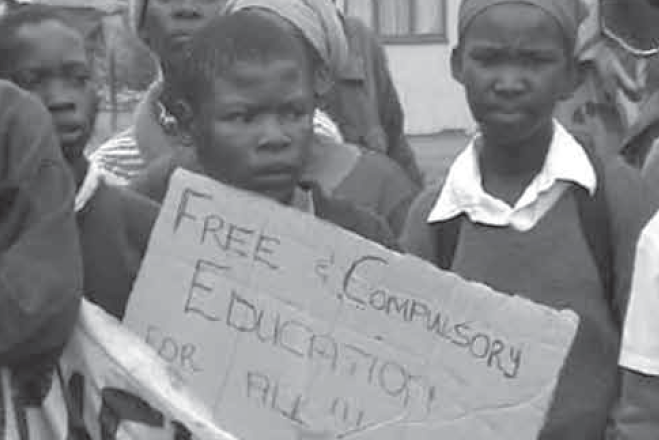
Salim Vally argues that the struggle around education provision must be located within the deepening poverty within the working class.
On 30 August 2004, Teboho Mkhonza,
17, left school early along with many fellow classmates to protest against unemployment and the poor delivery of services in Intabezwe township in the Free State province. The protest was the culmination of pleas to various authorities spanning many months. The march ended in tragedy. Twenty-five protestors, including an eight-year-old, were shot with rubber bullets and live ammunition as they tried to flee. Police beat protestors including Teboho, who later died in prison.
Two months earlier, in Kwazulu Natal, Marcel King, a boy of 19, was shot at point blank range by security guards. King was shot whilst protecting his mother who in turn was trying to protect her home from having her electricity disconnected. And in yet another tragic event in February of this year in the township of Katlehong in Gauteng, 15 year- old Nhlanhla Masuku, a grade eight pupil, and 21 year-old Dennis Mathibidi, in his last year at school, were also killed as their families resisted being evicted for allegedly defaulting on the payment of housing loans.
It is in this context of rising poverty and inequality and growing protests over ‘social delivery’ by the poor, that the analysis of post- apartheid education developments 11 years after the first democratic elections must be situated. Many communities have grasped the fact that progress (or the lack thereof) in schools cannot be divorced from poverty and its consequences.
The desperate poverty experienced by the inhabitants of Intabezwe, Phoenix and Katlehong has been known for some time. In 1998 the Poverty and Inequality Hearings captured some of the conditions in these townships and other rural areas of these provinces. Testimony from various community members provided evidence that poverty was a major obstacle blocking access to education, and because the costs of school fees, uniforms, shoes, books, stationery and transport imposed too heavy a burden on the family some pupils were forced to discontinue schooling. The lack of electricity, desks, adequate water and toilet facilities in schools were also referred to in a number of submissions. The chairperson of the Phoenix Education Forum testified that: “Together with thousands of other people I helped put up billboards declaring ‘free education’, ‘housing for all’ and ‘welfare for the people’.”
According to a United Nations Development
Programme report released in May 2004, nearly 22 million South Africans (48,5 % of the population) fell below the poverty line- R354 a month- compared to 20,2 million or 51% in 1995. Statistics SA a statutory body also noted that the rate of unemployment soared from 16% in 1995
to almost 30% in 2000. Survival strategies such as employment in precarious and poorly paid work in the informal sector are not considered in the unemployment statistics. The addition of such categories would increase the unemployment figures to catastrophic levels. Although the ruling party has claimed that government spending on welfare and service subsidies has boosted the effective incomes of the poor and ameliorated poverty, the UNDP report found that 65% of households are still deprived of access to at least one basic social service. Although the government document “Toward a Ten Year Review” lists the progress made in housing, electrification since 1994 it is silent about the number of those who have defaulted on their home loans and those who have suffered disconnections as a result of failure to pay the user fees for these utilities.
Education reform in South Africa is situated within a policy framework of cost reduction, cost recovery and fiscal austerity measures linked to a self-imposed structural adjustment policy. The introduction of user fees and other hidden education costs have rendered abstract and largely meaningless the idea of education as a “right”.
Despite attempts to equalise funding and resource allocation, material inequalities between schools continue to be stark. The most recent national School Register of Needs Survey (SRNS) conducted in 2001 indicates that while there has been general progress in educational provision since the previous survey (conducted in 1996), adverse conditions remain and in some instances such as the state of school buildings has deteriorated. The present survey estimates that 27% of schools have no running water, 43% have no electricity, 80% have no libraries and 78% have no computers. Even in schools that have toilets, 15.5% are not working.
The survey also suggests that due to overcrowded conditions over 10,700 additional classrooms are needed. The situation of other education sectors such as Early Childhood Development and Adult Basic Education is dire. Five years ago the previous minister promised to eradicate illiteracy by the end of his term, yet the functional illiteracy rate among adults is estimated at 50% while the participation rate in current provision has yet to exceed the 1% mark.”
A human rights framework recognises the link between the right to education and other human rights. This is because education operates as a multiplier, enhancing the enjoyment of all individual rights and freedoms where the right to education is effectively guaranteed, while depriving people of the enjoyment of many rights and freedoms where the right is denied or violated. The quality of education, particularly in countries like South Africa is also a human rights issue. For instance, while the high enrolment rates in South Africa are positive, this is eroded by the conditions of schooling for many young people. To put it starkly, getting young people to school is important but doesn’t make sense if the young women who get there are then raped. Also, the high enrolment rate does not reveal the ability of the system to retain learners. According to the Department of Education (2001), while about 1.3 million learners enroll every year for school in Grade 1, only about 570 000 – fewer than half – make it through to
Grade 12.
Salim Vally is based at Wits University’s Education Policy Unit (EPU). He is also active in the social movements.
Leave a Reply
You must be logged in to post a comment.