
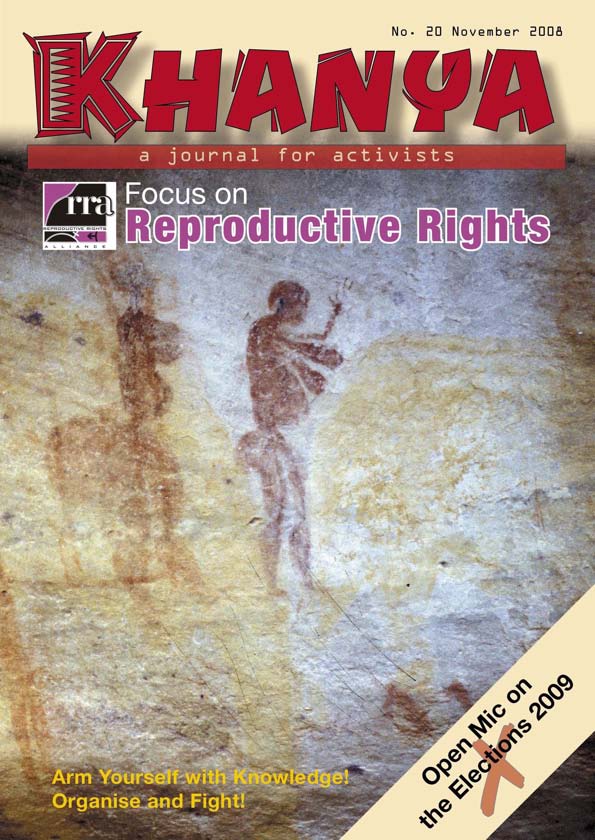
This edition focuses on Implementing Reproductive Rights – the basic right of women (and men) to decide whether, when and with whom they want to have children. This edition of the Khanya Journal is hosted by the Reproductive Rights Alliance (RRA), a national network of ngos, community based-organisations and individuals based in South Africa.
This edition of the Journal was meant to co- incide with the passing of the Amendments to the Choice of Termination of Pregnancy Act (CTOP), passed in the first quarter of 2008. However, the outbreak of xenophobia in South Africa necessitated a special focus on combating racism and xenophobia. We thank the RRA comrades for their patience.
Having said that, this edition is overdue, in terms of us focussing more closely on what is reproductive rights and raising awareness about what it means for all of us, especially black working women in our organisations and social movements, our communities, our faith-based communities and in our homes. The CTOP Act was passed in 1996, an election promise, included in the Reconstruction and Development Programme, to facilitate the struggle for gender equity in this country. Under apartheid, many women, especially black women, were injured, maimed, became sterile and/or died, from black street abortions. Once again, in the new democratic South Africa, despite this law and this right, there has been an increase in backstreet abortions. While the Amendments to the CTOP Act passed this year, will potentially deal with making these important services affordable and accessible to working women in both rural and urban areas, we need to note that the government’s macroeconomic policies – the Growth and Economic Redistribution (GEAR) – has been responsible for increasing unemployment, impoverishment and the privatisation of basic services. This has been particularly devastating to black working people, especially women and children.
In the past three years the RRA has particularly focused on raising awareness amongst black working women, within townships and communities, and with the social movements. As part of this process, the RRA participated in some of the public hearings on the proposed Amendments to the CTOP, as part of the parliamentary process. We also ensured the participation of working women in as many of these hearings as possible, as part of our own awareness raising programme. We have also trained a number of grassroots women to assist in the training of communities.
Reproductive rights are an important aspect of the struggle for women’s rights and while they must be spear-headed and fought for by women, these are working class rights, vital to building working class solidarity.
The first article in this edition is based on extracts from an RRA pamphlet, that explains who the RRA is, what we mean by being ‘pro-choice’ and the work of the RRA. Cathi Albertyn follows with an overview assessment of ‘Twelve Years of Choice’, in which she argues that while women won the right to choose whether to have children
or not in law, this right still needs to be won in their communities and in their homes. Mosotho Gabriel argues that the ‘Abortion law cuts down women’s death’s by 91%’, and she calls on all South Africans to support the needs of others. Lesley Doyal and Margaret Hoffman discuss women’s health in the context of continuing poverty and gender inequality. Marion Stevens critically
reviews the predominance of funding for HIV/ Aids at the neglect of other important and related areas affecting women’s health. Stevens follows this up with a discussion on women’s health in a democratic South Africa, the new legislation, the challenges, and the role of leadership of civil society. M.K. Morar’s is an historical reflection of religion and the position of women. Morar argues that people have a right to follow their individual conscience, and that women must unite and lead the struggle for their own liberation, actively supported by the Church. Kathleen Monareng then argues that reproductive health must include both men and women if these rights are going to be significantly achieved. Ms. X, an anonymous Muslim woman, gives her view on abortion. Noluthando Ntlokwana discusses the issue of conscientious objection in relation to the CTOP, and what it means in terms of the country’s Constitution and how it affects health workers. In the last article in this section, Tichaona Chikowore argues that women in Africa die of backstreet abortions because they do not have access to safe, legal and affordable abortion facilities.
Open mic
This edition carries a special focus on the forthcoming national elections in 2009. This section opens with Jubilee South Africa’s – the debt movement – national call, inviting social movements to a national conference later this month. Oupa Lehulere, in a speech to the Jubilee NEC, outlines the current political situation and the tasks of the social movements. John Appolis discusses the issues of participation in elections through his review of the OKM Experience and the lessons for the 2009 elections. Dale McKinley argues why the APF should not participate in an electoral front. The focus on the elections is brought to a close with Oupa Lehulere’s discussion on the strategic and tactical options facing the movements in the forthcoming 2009 elections.
The Open Mic section then moves to a brief focus on Jubilee South Africa starting with its 2008 National Conference Statement. This is followed by George Dor and Phillipos Dolo’s overview of the community struggles against the mine companies’ expansion into local villages in Limpopo, desecrating graves and relocating schools. Brand Nthako then gives a brief report of Jubilee South Africa’s solidarity action with the International Week of Action against the International Financial Institutions. The Open Mic section closes with Ahmed Dawlo’s article on Xenophobia and the plight of Somalis in South Africa. This article picks up some of the debates raised in the previous edition of the Journal on ‘Combating Xenophobia’.
Education section
In keeping with the theme of this edition on implementing reproductive rights, Christi van der Westhuizen in a brief overview argues that the women’s struggle in South Africa is not over.
NEhanda
In this section we reprint a paper by Helen Bradford on 150 years of abortion in South Africa. This historical overview article will run over three editions of the Journal. Here we begin with part 1, ‘Swallowing Something,’ c. 1840-1910.
Barometer of resistance & documents
In the Barometer Mhlobo Gunguluzi gives a brief overview of the current struggles in the subregion of Southern Africa. In the Documents section we include a list of the RRA members and their contact details, and the obituary of Nopasika Mboto.
Dedication
This edition is dedicated to the memory of a fallen comrade, Nopasika Mboto, an activist of the Social Movements Indaba and the RRA. Comrade Nopasika was a fearless comrade in the struggle against all forms of oppression and exploitation.
hamba kahle comrade nopasika!
Finally, this was a collective effort and our sincere thanks and appreciation to the many comrades – from RRa and beyond – for assisting with this edition
We trust that our readers and study groups will find this edition informative and engaging.
Yours in the struggle for working class and women’s solidarity
Leave a Reply
You must be logged in to post a comment.