
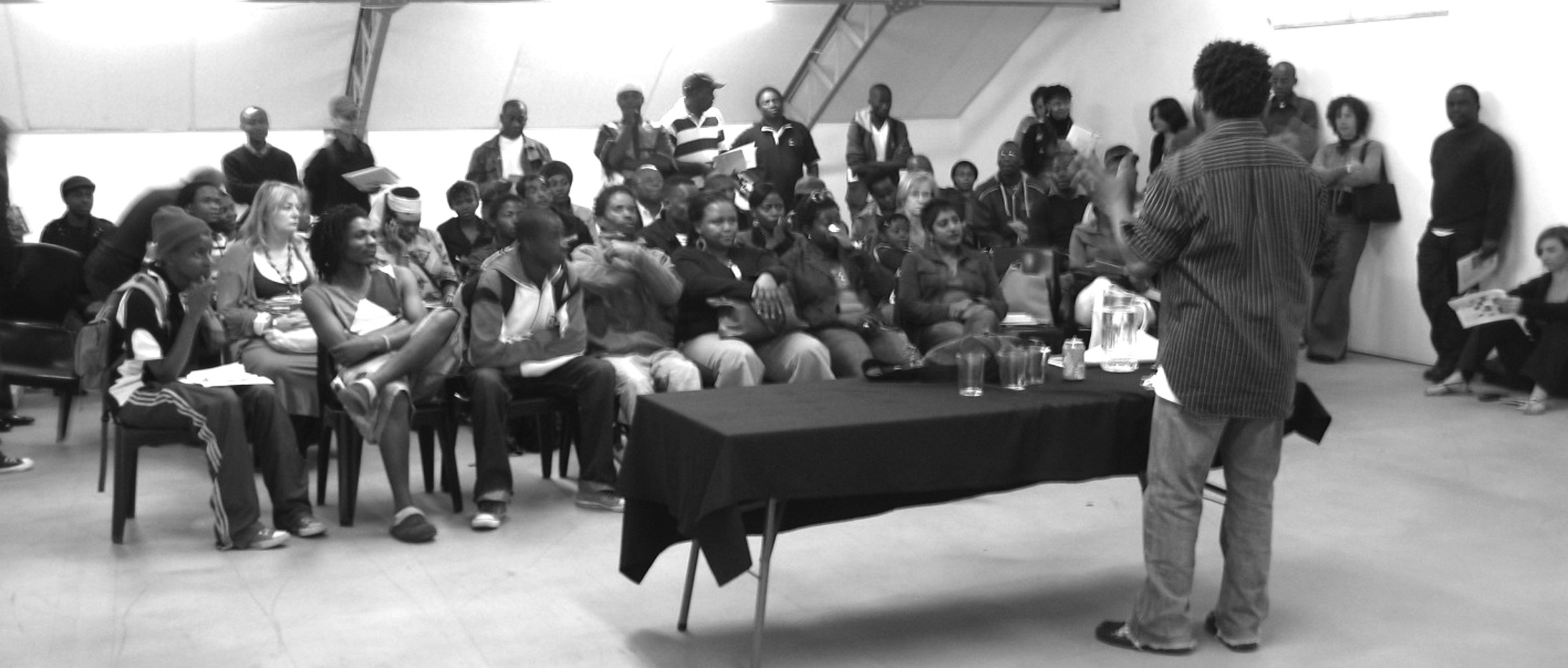
Searatoa van Driel* discusses the profiles of authors who will attend the August 2010 Jozi Book Fair.
The second edition of the Jozi Book Fair, to be held from the 7th to the 9th August 2010, will see a number of authors who will be taking up critical issues facing social justice movements today. The Jozi Book Fair also seeks to build relationships and cooperation with other publishing initiatives internationally, and the authors profiled in this article reflect this commitment.
Lindsey Collen and social justice struggles in Mauritius
Lindsey Collen is this year’s Guest of the Book Fair. Collen, a political activist has won the Commonwealth Writers’ Prize twice. She has worked as a teacher, nurse’s assistant, community worker and potato harvester. Born in Umtata, Transkei in South Africa in 1948, Collen studied at the University of Witwatersrand, where she became an active anti-apartheid activist. Collen later studied at the London School of Economics and lived in New York and the Seychelles before moving to Mauritius in 1974, where she has since lived.
It is in Mauritius that her books are set.
The Rape of Sita, published in 1993 and longlisted for the Orange Prize in 1996, won the prestigious Commonwealth Prize for Best Novel in Africa. The novel is about the rape of a woman and her struggle to overcome it. It was banned in Mauritius within hours of publication because it was considered blasphemous. Mutiny, published in 2001, is set in a Mauritian prison. It is both a human drama and an analysis of the global political climate of the time, told through the eyes of three women. Mutiny received numerous awards and was named ‘one of the Best Unread Books of the Decade’ by the UK Guardian Weekly.
Collen has written several other pieces and also has a new soon-to-be-released novel, Malaria Man and Her Neighbours, which will be launched at this year’s Jozi Book Fair.
Collen has also played an important role in Mauritius’ own indigenous language publishing. She was co-compiler of the first major dictionary of Mauritian Kreole and has translated several Kreole folk stories and children’s stories into English. Collen frequently writes articles for online publications, such as the New Internationalist and continues to remain political as part of LALIT, a political party in Mauritius.
Zapiro and the struggle for freedom of expression
Jonathan Shapiro, better known to the public as Zapiro, is South Africa’s best known political cartoonist.
Born in Cape Town in 1958, Shapiro studied architecture at the University of Cape Town before switching to Graphic Design. Shapiro then got conscripted into the army in 1983 but refused to take up arms. During this period Shapiro became politically active in the newly-formed United Democratic Front and participated in the End Conscription Campaign, among many other political and progressive organisations. He was arrested under the Illegal Gatherings Act. In 1987, he became the editorial cartoonist of the anti-apartheid newspaper, South. Shapiro then applied for, and was awarded, a Fullbright scholarship to study media arts at the School for Visual Arts in New York, USA, for two years. While in New York, Shapiro studied under comics’ masters, Art Spiegelman, Will Eisner and Harvey Kurtzman. After studying in New York, Shapiro returned to South Africa in 1991. He began producing comics covering a wide range of issues, including HIV/Aids education, and democracy education. From 1994 to 2005 he was the editorial cartoonist for the Sowetan. During that time he also appeared in the Cape Argus. He has also been the editorial cartoonist for the Mail and Guardian since 1994, the Sunday Times since 1998 and has appeared in the Cape Times, the Star, the Mercury and Pretoria News three times a week since 2005.
Shapiro also participated in numerous exhibitions and received many awards for his work. These include becoming the first cartoonist to win a category prize in the CNN African Journalist of the Year Awards in 2001 and winning the Courage in Editorial Cartooning Award at the annual Cartoonists Rights Network International dinner in 2007. Shapiro has held solo exhibitions in New York, Frankfurt and South Africa and was part of many group exhibitions internationally and locally.
Shapiro continues to make political comments on current affairs’ issues locally and internationally. He is thus under constant criticism for his unwavering critique. His most recent controversy was around his cartoon on the Prophet Mohammed, published in the Mail & Guardian earlier this year.
IMA and the struggle for sámi language
Inger-Mari Aikio-Arianaick, an accomplished Finnish poet, filmmaker and journalist, will be a panelist in several events at this year’s Jozi Book Fair.
Aikio-Arianaick has always advocated and promoted Finland’s indigenous language, Sámi, through all the work she has done.
IMA studied Sámi and Finnish studies at the University of Oulu from 1980 to 1982. She then became the editor, photographer and proof reader for the Sámi newspaper, Sámi Aigi from 1982 to 1988.
In 1988, IMA completed a course on radio. Then she worked as a news journalist and producer for the Sámi radio, YLE Sámi Radio, for ten years. In 1992, IMA passed the official translator exams from Northern Sámi to Finnish and from Finnish to Northern Sámi obtaining a Translator’s Degree. IMA has also worked on Sámi children’s programmes.
The Pseudonym, IMA derives from her first poem, written at the age of ten, which she signed as Ima-71. To date, IMA has published five books of poetry.
One of them, published in 2001, was nominated for the Nordic Literary Prize and the Sámi Council Literature Prize. Her first book of poetry, Gollebiekkat almmi dievva (loosely translated to ‘Sky Full of Golden Winds’) was published in 1989. The book was written from the viewpoint of a young woman, with nature playing a large part in her poetry.
IMA has also produced poetry for other books and publications, her most recent being SOUNAT – This Beloved Land, published this year. SOUNAT is a collaborative book of poetry and photography, where IMA was asked to write poetry to compliment photographs by photographer, József Timár. Her poetry is in Sámi but has been translated into English, Finnish, Norwegian and Swedish. IMA’s poetry is detailed and often humorous, about herself and others, often exposing the prejudices people have to those who are different.
IMA’s film career began in 2004, when she completed her first short documentary-film in Sámi, about a Finnish rapper, who raps in Sámi, as a way of promoting Sámi for young people. IMA played the role of editor and director in the 6 minute- documentary. Since then, she has directed seven other short film and documentaries, all of which have tried in some way to document the Finnish experience and promote Finnish culture.
Leave a Reply
You must be logged in to post a comment.