
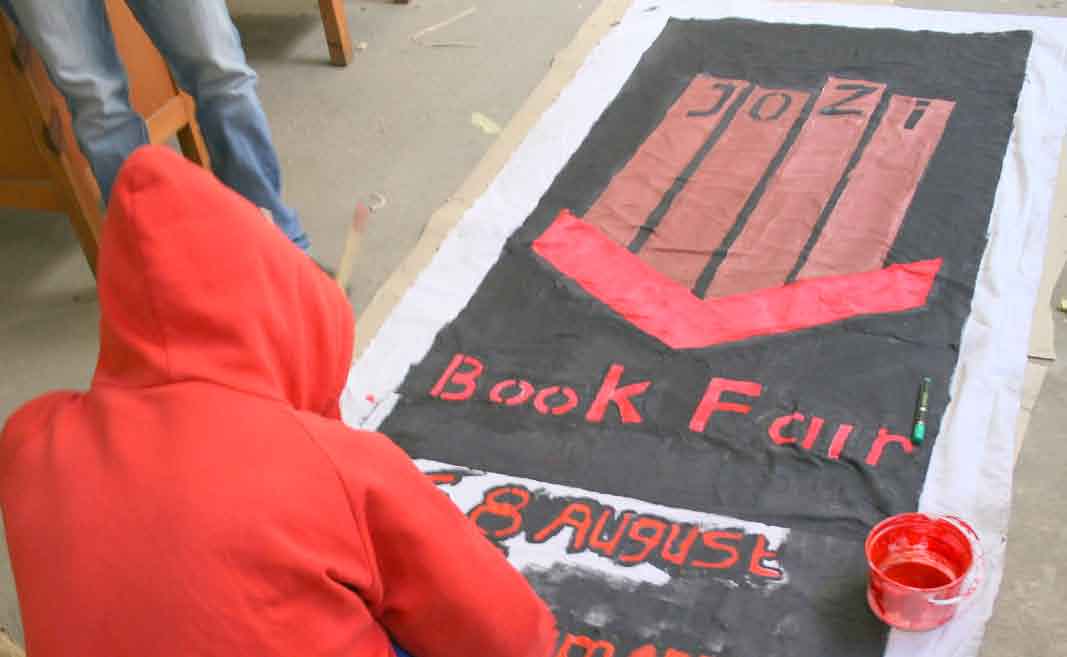
Anele Mdzikwa* provides an overview of the JBF held at Museum Africa in Newtown in August this year.
With a wide range of activities, workshops and projects presented to the public, the third edition of the Jozi Book Fair provided a unique meeting space for three key partners – readers, writers and publishers – in the promotion of reading and writing in South Africa. The Jozi Book Fair is part of an ongoing programme within Khanya College to build a culture of reading and writing, to profile writers and publishers, and provide a space to network and buy books. The 2011 Jozi Book Fair made great strides towards this objective.
More than 40 publishers exhibited at this year’s Fair and 800 members of the public attended over the three days, from 6 – 9 August. The occasion saw literary critics, authors, activists, poets, publishers, and booksellers flock to Museum Africa, in Newtown, to debate issues surrounding the world of literature. Those in attendance were provided with an opportunity to meet existing and potential writers, attend book launches, and participate in roundtable discussions. The young ones were kept entertained at Children’s Programme, which saw not only games but book launches, readings and other activities.
As with its two predecessors, the Jozi Book Fair 2011 programme consisted of:
- 9 seminars, roundtable discussions and public lectures featuring fiction and non-fiction writers from South Africa, Africa and around the world.
- 20 Book launches and 10 conversations with writers/authors.
- Exhibitions from 40 Southern African publishers.
- Free poetry, short story readings on art and literature and film screenings.
- 5 Training workshops on various issues including reading and writing skills.
- Debates and events on Women and Literature to coincide with Women’s Month
- A children’s programme to encourage reading and writing among children.
Guest of the Fair
At its second edition in 2010, the Jozi Book Fair (JBF) introduced the idea of inviting an author to be the Guest of the Book Fair. The Guest of the Book Fair is someone who promotes the kinds of goals that the fair stands for, in this case, a culture of reading and writing in historically disadvantaged communities that we work with. The JBF has been primarily a space for developing new readers, new writers and new and small publishers.
As guest of the JBF 2011, Zambian-born author Ellen Banda Aaku participated in several events. Aaku who is currently based in Britain, has published three books for children and her short stories have appeared in anthologies published in Australia, South Africa, Britain and the United States. Aaku’s first book for children, Wandi’s Lile Voice, won the 2004 Macmillan’s Writers Prize for Africa. In 2007 her short story, Sozi’s Box, won the Commonwealth Short story competition.
This year, Aaku published her first novel, Patchwork, set in Zambia at the end of the 1970s and is a story written from the vantage point of a child growing up and observing the world around her. Patchwork was launched at the JBF this year and is the 2011 winner of the Penguin Prize for African Writing in the fiction category.
Aaku was involved in a number of events during the JBF including a roundtable discussion titled Women and South African Publishing: between gloss and literature. This roundtable discussed the impact of magazines on the reading habits of women, and whether it encourages or discourages them reading other literary forms like novels, drama, etc.
Aaku also teaches creative writing and facilitated a creative writing workshop for teenage girls who work with Khanya College’s Setsi sa Mosadi women’s centre. The teenage girls also launched their own newsletter, Tsohang Batjha, at the JBF 2011.
Debates
A number of issues were debated and explored in the many discussions during the Book Fair. One topic – amongst many others – included South African Publishing – An elite project in crisis. Against the backdrop of the economic crisis, an under-resourced public library system, an under-resourced small publishers industry, low levels of literacy, rising numbers of imported books in the country’s bookshops, the closure of Exclusive Books in South Africa’s largest metropolis (Soweto), and the suspension of the Cape Town Book Fair for 2011, South African publishing is in crisis. This discussion engaged the nature of South African publishing and the sources of its current state of crisis.
Another issue explored was The implications of the explosion of social media on reading and writing in SA today. Coming against the background of a poor education system, low levels of reading in general, various social media platforms and their forms of writing and reading have raised important challenges for reading among young people. This panel, which consisted of young people, explored the implications of the explosion of social media on reading and writing in SA today.
Another critical topic in debate was the Arab Spring. By far the most dramatic and far-reaching events this year have been the wave of struggles for democracy that have swept across north Africa and the Arab world. The panel, comprised of Maria van Driel, Co-ordinator of Khanya College’s Women’s Centre Setsi sa Mosadi, Michael Kaiyatsa a journalist and activist from Malawi, Naeem Jeenah of the Afro-Middle East Centre and Tom Wheeler, a research associate at the SA Institute of International Affairs. They explored the possible influence of the Arab Spring on the struggles for democracy and social justice in Africa south of the Sahara.
To highlight Women’s Month, the JBF debated the topic Communities under siege: women, poverty, survival and resistance. Women, and in particular black working class women, are the poorest section of the South African population, and yet they bear the burden of feeding families in a deteriorating economic environment. We see a rise in woman-headed families and a struggle for survival that strikes at the heart of communities. The panel at this discussion explored the sources and nature of this paradox including the socio-economic environment and government policies that underpin this struggle, and the women’s responses to the conditions in which they find themselves. The panel was organised around a recently published book by Dr Sarah Mosoetsa, called Eating from one pot.
Children’s Programme
The JBF’s children’s programme provided dynamic and interactive fun learning. The young ones were entertained throughout the day with activities including games, storytelling, workshops and a mini library. The all time favourite was the craft corner where children made their own book markers, posters, and other ‘make it take it’ items. Other activities included storytelling, a soccer exhibition, and a ‘write your own book session’. Patricia Tsotetsi, a facilitator, said that their ultimate goal was for every child to keep asking for a book to be read or written.”
The aims of the Children’s Project is to encourage a love of books amongst all children through establishing reading circles in schools, provide reading and writing skills to learners, and to develop a generation of children writing for other children.
Forum for Activist Journalists launched
The JBF’s Writer’s Project aims to produce activist journalists who will write regularly for the civil society press. The project known as the Forum for Activist Journalists provides a platform to build a network of activist journalists, and to make their writing accessible and published in a variety of publications.
The Forum was publicly launched at the JBF, and was attended by activists and prospective members. A presentation on the Forum focused on its role to promote freedom of expression and provide platforms for activist and community journalists to be trained and to publish their work.
JBF Thanks You
The JBF extends its thanks to you for making Jozi Book Fair 2011 a success. We ask you to continue to walk with the JBF as we build a culture of reading, writing and publishing. The registration for Jozi Book Fair 2012 will open on 1 March 2012 see our website (www.jozibookfair.org.za) for details. For any comments or queries, please email jozibookfair@khanyacollege.org.za, or post comments on our Facebook page.
We look forward to your participation at the Jozi Book Fair 2012!
Leave a Reply
You must be logged in to post a comment.