
In this article Eddie Cottle* highlights the significance of of the strike and argues that the unions undermined the construction workers’ tactical advantage by signing a no strike agreement until after the World Cup.
The significance of the national strike
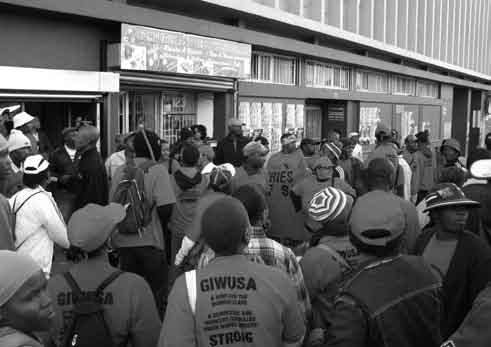
The nationwide strike by 70 000 construction workers between 8 and 15 July 2009 was unprecedented and very significant in several respects. This was the first national strike on 2010 World Cup sites by South African construction workers and was therefore an historic event. A second key feature of the strike was the unity displayed by workers and trade unions within a fractured sector. Engineering and building workers came out on strike, with the Building Construction & Allied Workers Union (BCAWU) and the National Uniom of Mineworkers (NUM) standing together as worker representative organisations. A third feature of the strike was the widespread sympathy for it by the public and the South Africa media, despite its implication for World Cup projects. Fourthly, the pressure placed upon the trade union negotiating teams by the Ministry of Labour and the FIFA Local Organising Committee (LOC) proved lethal, assisting in watering down trade union demands and demobilising the national strike.
Background to the strike
The first strike recorded at a World Cup construction site broke out at Green Point Stadium in August 2007, igniting a wave of individual site strikes and agreements with employers across the country. About 20 of the 26 strikes were wildcat in nature, indicating a spontaneous new militancy among construction workers. This militancy was to some extent captured by the trade unions, ultimately leading to widespread gains such as project bonuses of R6000, no downward variation of working conditions, improved health and safety and increase in pay rates and so on. At this stage of the strike wave, the trade unions could not embark on national (legal) strike action as they had already negotiated a substantive three-year agreement with the South African Federation of Civil Engineering Contractors (SAFCEC) in 2006, thereby tying trade unions’ hands until 2009, when a new round of negotiations could take place. Noting this legal impediment, there had been at least two years’ preparation and build up by the unions through the Building & Wood Workers International’s (BWI) “Campaign for Decent work Towards and Beyond 2010”. The unions were brought together to engage vigorously on issues within the sector, build negotiation capacity, and were provided significant support to research the construction sector and to engage on focused organising drives to recruit new members. Within one and a half years the trade unions combined were able to recruit 16,000 new members. By December 2008 NUM had already sent its memorandum to SAFCEC with a mandated list of some 19 demands to improve wages and working conditions of construction workers. In short, the idea of the national strike, its strategy and the demands were elaborated well in advance of the negotiations with the South African Federation of Civil Engineering Contractors (SAFCEC) in March and the July 2009 strike. BCAWU and NUM, despite possible political differences, forged a coherent alliance in preparations for the national strike.The unity of the trade unions proved pivotal to the national identity of the strike, with a common set of demands to employer organisations. Further, the large scale and nature of the construction projects ensured a huge concentration of unskilled, semi- skilled and skilled construction workers on these projects. This increased the organisational leverage of the trade unions involved, despite the low level of unionisation.
Strike!
On 8 July 2009 some 70 000 construction workers from both the civil engineering sector and the building sector downed tools and embarked on a nationwide strike. This was the first time in South Africa’s trade union history that a national strike by construction workers had taken place. The strike affected major construction projects, including the 2010 World Cup stadia and infrastructure, and marked a turning point in the level of organisation reached by workers in a fractured construction sector. Upon the call for a strike in the engineering sector, thousands of building workers headed the call and came out on illegal strike action with a rate of 100% attendance on the first day of action! This was a decisive show of force for a sector riddled by fragmentation through an artificial division of the workforce into civil engineering and building sectors. Centralised bargaining was taking place in civil engineering on a national level while the 6 building councils engaged in collective bargaining on a regional level in the building sector. Despite this fragmentation of the workforce, the strike action was widespread and took effect in 35 construction sites across South Africa.
The national strike was a commendable achievement by the trade unions in a context where trade union density is only about 10% in a sector which employs just over one million workers, in both the formal and informal sectors.
Negotiations & Demobilisation
The unions were negotiating on a package basis, which not only included a 13% raise in minimum wages (lowered from an initial 20%), but also annual bonuses, paid maternity leave, reduced working hours without the loss of pay and so on. By Friday 10 July the unions and SAFCEC reached a framework agreement, after intense negotiations under the auspices of Labour Minister Membathisi Mdladlana and the Commission for Conciliation, Mediation and Arbitration. The representatives of the FIFA LOC, Danny Jordan and Irvin Khoza, were also present, to ‘place pressure on us’ to stop the strike and settle swiftly, according to union representatives.
In terms of the framework agreement both SAFCEC and the trade unions would consult their respective constituencies about the “acceptability of the framework and endeavour to conclude an agreement by latest Tuesday 14 July 2009.” The framework essentially proposed an 11,5% increase in wages, 1,1% more than initially put forward by SAFCEC. Further, employers agreed to task teams to deal substantively with labour demands. In turn, labour would give up its right to strike until 31st August 2010!
Between Friday 10 and Monday 13 July the trade unions undertook nationwide consultations on the acceptability of the framework agreement. At this point it was clear that it was game over. The trade unions set in motion the demobilisation of the strike so that settlement could be reached on Tuesday 14 July. This despite the unanimous rejection of the new wage offer by workers during the consultations. Workers stuck to the demand for a 13% wage increase. It is unclear whether the no strike clause was discussed or whether workers engaged substantively with the framework agreement during the consultations.
What was won and what was lost?
A 12% wage offer effectively ended the 8 day strike by some 70 000 construction workers on Wednesday 15 July. The hike was well above the 8 percent inflation rate in May, and although the offer was short of the 13 percent the unions wanted, it was not far off. The increase in wages raised the minimum wage in civil engineering from R2618.78 to R2933.04, an increase of R314.26 per month. But given that workers’ inflation is higher than the official rate – lower-paid workers pay proportionately more on transport (14,6%) and food (12,1%) than those who earn larger salaries – the hike may not be as generous as it seems at first glance. The new minimum wage is not in any way close to a living wage when even a “modest low-level standard of living” is currently calculated as R3382. The increase will also affect permanent workers and those working on limited duration contracts (LDCs) differently.
For those workers that have full-time employment the total annual wages of the new wage will amount to R35 196.48 or 12% increase from the old annual wage of R31 425.36. But if we deduct the week’s wages lost during the strike, which amounts to R634.50, then we have a final annual income of R34 561.98 or 9.9% increase. As the agreement is only effective from September 2009 it means that the workers that have LDCs will not benefit from this agreement unless alternative employment is found, as the World Cup and related infrastructure is completed in 2009. Nor can workers ever make up the loss of a week’s pay (about R634.50) as the “no work, no pay” principle was applied during the strike.
Who benefits from the 2010 World Cup?
The agreement presents trade union demands and trade union rights as counterproductive to South Africa hosting a successful World Cup. In terms of this agreement, the unconditional success of the World Cup was therefore dependent upon the condition that unions not use the World Cup as a lever to improve the living conditions of construction workers and forego the right to strike. Unlike the trade unions, employers represented by SAFCEC were not requested to forego the “no work, no pay” principle in order to ensure the unconditional success of the World Cup. The approach adopted in the substantive agreement is the complete opposite of the trade unions’ position that construction workers would not be ‘sacrificial lambs’ in building the World Cup stadia and related infrastructure.
The most serious concern is that both BCAWU and NUM agreed to the peace clause. This means that construction trade unions are foregoing their constitutional right to strike from 15 July 2009 to 31 August 2010 while the task teams deal with the rest of the demands that gave rise to the strike. This means that the trade unions cannot embark on legal strike action no matter what disagreements they may encounter during this time. In effect, the Department of Labour was given the power to write an agreement into the civil engineering sectoral determination, promulgated in September 2009. On projects such as the World Cup, critically time-bound and where billions of rands are being spent, workers have significant leverage when pushing for their demands. Unlike the 2009 municipal workers strike which ended with a 13% increase, the construction workers strike had significant public sympathy, even in the mainstream media, due to the contrast between their low, low wages compared to construction companies’ mega profits and enormous remuneration packages of executive directors . Even the FIFA LOC, despite its own interest in ensuring that the strike end, expressed sympathy for the strike:
“The workers just wanted the benefits of 2010 to be shared with everybody, not only the employers.” Danny Jordan, CEO of FIFA LOC
In a context where construction workers showed such unity and were supported by massive public sympathy, the balance of forces were in favour of the construction workers. It was reasonable to expect that the unions would achieve at lease a15% wage increase, a project bonus as the projects complete, and negotiate effectively on the rest of their demands without foregoing its only weapon to defend workers – the right to strike!
The trade union leadership has agreed to industrial peace for another year without having secured a meaningful substantive agreement to improve the lot of construction workers. It is unfortunate that despite the unique conjunctural power of the national construction strike, the trade union leadership succumbed to the pressure of the Ministry of Labour and FIFA LOC in the “spirit of ensuring unconditionally a successful hosting of the World Cup.” The result was that the trade unions secured only a partial victory for construction workers when so much more was possible.
Leave a Reply
You must be logged in to post a comment.